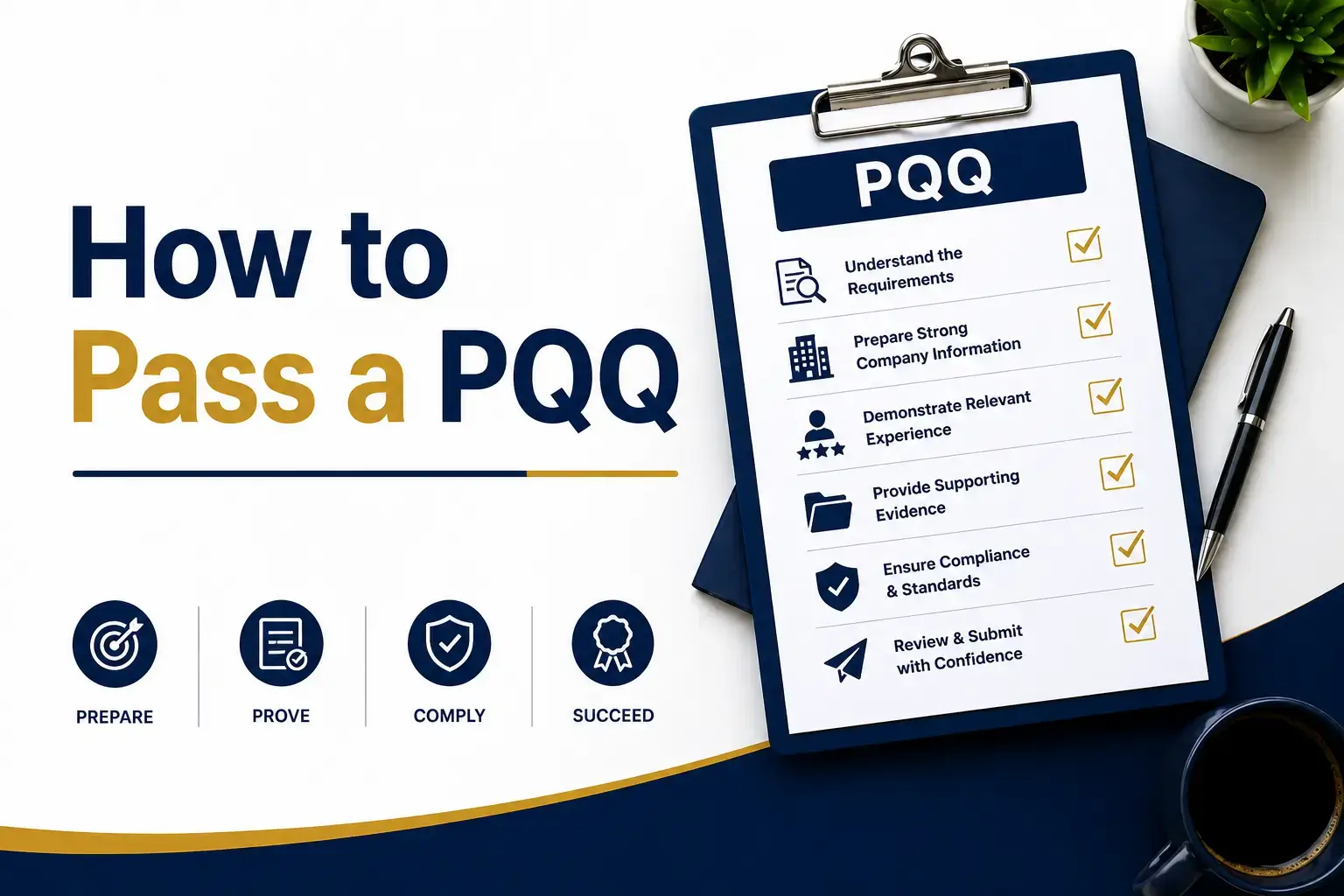
You have found the contract. The opportunity looks perfect for your security company. And then you see it, before you can even submit a tender, you need to pass a PQQ.
For many security companies, the PQQ stage is where opportunities are won or lost before they even begin. Get it right, and you move through to the full tender. Get it wrong, and you are out before you have had a chance to show what your business can really do.
The good news is that passing a PQQ is very achievable if you know what buyers are looking for and how to present your business effectively.
This guide covers everything your security company needs to know. From what a PQQ actually is to the step-by-step process for completing one to the most common reasons security companies fail, we have it all here.
At BizGrow Holdings, we help UK security companies win contracts. Supporting clients through the PQQ and tendering process is one of the things we do best. Let us walk you through it.
What Is a PQQ? (PQQ Meaning in Procurement)
A Pre-Qualification Questionnaire (PQQ) is a structured assessment tool used by supply chains to screen potential suppliers and contractors before inviting them to tender or work on a project. It serves as the first gate in the procurement or tendering process, helping buyers shortlist capable, compliant, and low-risk vendors while saving everyone time, effort, and money.
Think of it as your business’s CV for the contract. It is a pass/fail gateway. Get through it, and you are in the race. Fail, and you are out before you have had a chance to show what you can do.
A PQQ is not the full tender. It is essentially a filter stage that precedes the Invitation to Tender (ITT), a deeper evaluation including pricing, innovation, delivery plans, and project methodology.
In the UK public sector, the PQQ is now sometimes called the Standard Selection Questionnaire (SQ or SSQ), introduced by the Crown Commercial Service in 2016. You may also see it referred to as a Selection Questionnaire. These are all essentially the same thing: a pre-tender filter designed to assess your suitability as a supplier before the buyer invests time in a full evaluation.
For security companies, the PQQ is increasingly common across local authorities, NHS trusts, housing associations, universities, and large commercial clients. Understanding it and completing it well is a core business skill.
What Does PQQ Stand For?
PQQ stands for Pre-Qualification Questionnaire.
Breaking it down:
- Pre: it comes before the main tender or invitation to tender
- Qualification: It assesses whether your business qualifies to proceed
- Questionnaire: It is a formal set of structured questions with required responses and supporting evidence
The PQQ is sometimes also referred to as:
- SQ: Selection Questionnaire (the current term used by Crown Commercial Service for most public sector procurement)
- SSQ: Standard Selection Questionnaire
- PSQ: Procurement Specific Questionnaire (an emerging term under new procurement reforms)
- EOI: Expression of Interest (a lighter-touch version used for some frameworks)
Whatever name it goes by, the purpose is identical. The buyer wants to know: Is this supplier credible, capable, and compliant enough to be considered for this contract?
What Is the Purpose of a PQQ?
The purpose of a PQQ is to filter the field before the full tender process begins.
Councils, NHS trusts, and major commercial buyers often receive over 100 applications for a single security contract. Without a PQQ, they would have to evaluate every one of those applications in full, an enormous administrative burden.
The PQQ process exists to eliminate companies that are not suitable to deliver the contract. Generally, the PQQ is a document covering what your organisation already does, and the tender stage is what you will do.
For buyers, the PQQ answers three core questions:
- Is this supplier legally and financially sound?
- Does this supplier have the relevant experience, qualifications, and accreditations?
- Does this supplier meet our minimum compliance requirements?
For your security company, the PQQ is an opportunity. It is your chance to make a strong first impression, demonstrate your credentials, and show that your business is professional, compliant, and capable of delivering the contract.
Where in a tender the evaluator is looking for reasons to choose you, in a PQQ, they are looking for reasons to eliminate you. That distinction matters. Your job at the PQQ stage is to give them no reason to say no.
What Are the Benefits of PQQ for Security Companies?
PQQs might feel like a burden, but they actually benefit security companies that are well-prepared.
They level the playing field.
A rigorous PQQ process means buyers cannot simply favour the incumbent supplier or the cheapest bidder. Every supplier is assessed against the same criteria. That gives professional, compliant security companies a fair shot at contracts they might otherwise struggle to access.
They filter out weak competition.
If your business is properly accredited, financially stable, and well-documented, a demanding PQQ process works in your favour. It eliminates competitors who have not invested in the right standards, leaving a smaller, stronger field for the full tender.
They build your bid library.
Every PQQ you complete properly gives you a bank of responses, case studies, policies, and evidence that you can use in future submissions. Over time, your PQQ library becomes a significant asset, reducing the time and effort each new submission requires.
They open doors to public sector contracts.
Many of the most valuable security contracts in the UK with councils, NHS trusts, universities, and housing associations are only accessible through a formal procurement process that starts with a PQQ. Without the ability to pass one, you simply cannot access this market.
They drive business improvement.
The process of completing a PQQ often highlights gaps in your documentation, policies, or accreditations. Identifying those gaps and fixing them makes your business stronger and more competitive overall.
The 4 Types of Procurement Methods in the UK
Security contracts are procured in different ways depending on the buyer and the value of the contract. Here are the four main procurement procedures you will encounter:
Open Procedure
The open procedure is the most straightforward. The buyer publishes the contract opportunity, and any interested supplier can submit a full bid. There is no separate PQQ stage; instead, the selection criteria and award criteria are evaluated together in a single submission.
This is increasingly common for lower-value contracts and is used widely across the UK public sector procurement. Your PQQ-style information is submitted as part of the tender itself.
Restricted Procedure
The restricted procedure is a two-stage process. First, interested suppliers complete a PQQ or Selection Questionnaire. The buyer evaluates these and creates a shortlist, typically five to seven suppliers. Only shortlisted suppliers are then invited to submit a full tender.
This is the most common route for medium and high-value security contracts. Passing the PQQ stage is essential; if you do not make the shortlist, you cannot submit a tender at all.
Competitive Dialogue
Competitive dialogue is used for complex contracts where the buyer needs to work with bidders to develop the specification. It involves multiple stages of dialogue between the buyer and a shortlisted group of suppliers before final tenders are submitted.
This route is less common in security procurement but may be used for large, complex multi-site contracts or integrated security solutions.
Negotiated Procedure
The negotiated procedure allows buyers to negotiate directly with one or more suppliers. It is used in limited circumstances, typically where the contract is highly specialised, where previous procurement has been unsuccessful, or in genuine emergencies.
For most security companies, the open and restricted procedures are the most relevant. Understanding which procedure applies to each opportunity helps you plan your bid approach correctly from the start.
The 7 Steps of the Procurement Process
Understanding how procurement works end-to-end helps you position your security company effectively at every stage. Here are the seven steps:
Step 1 | Needs identification.
The buyer identifies their security requirements, whether that is static guarding, mobile patrols, CCTV monitoring, key holding, or a combination of services.
Step 2 | Market engagement.
Some buyers carry out pre-market engagement, publishing a Prior Information Notice (PIN) or hosting a market day, to understand what the market can offer and refine their specification.
Step 3 | Publication of opportunity.
The contract is published on Find a Tender Service (FTS), Contracts Finder, or a sector-specific portal. This is where you find the opportunity.
Step 4 | PQQ / Selection Questionnaire stage.
For restricted procedures, suppliers complete the PQQ. The buyer evaluates responses and shortlists the strongest candidates.
Step 5 | Invitation to Tender (ITT).
Shortlisted suppliers receive the full tender documents and submit detailed bids covering their approach, methodology, team, and commercial proposal.
Step 6 | Evaluation and award.
The buyer evaluates tenders against stated criteria, typically a combination of quality and price. The winning bidder is selected and notified.
Step 7 | Contract mobilisation.
The winning supplier transitions into the contract, mobilising their team, agreeing on operational procedures, and beginning service delivery.
Your PQQ is Step 4. Getting it right is what gives you the chance to compete in Steps 5 and 6.
What Do Buyers Look for in a Security Company PQQ?
A PQQ typically asks a potential supplier for details about company background and structure, financial health and viability, relevant industry experience and capacity, legal, regulatory and compliance credentials, insurance, certifications and quality systems, and health, safety, environmental and sustainability policies.
For security company PQQs specifically, buyers typically focus on:
- Valid SIA licensing for all deployed operatives and evidence of how you manage licence compliance
- SIA ACS approval is increasingly specified as a mandatory requirement
- Relevant accreditations: CHAS, SafeContractor, ISO 9001, ISO 45001
- Financial stability, turnover, profit, and absence of insolvency proceedings
- Relevant experience contracts of similar size, scope, and sector
- Health and safety policy and management systems
- Equality, diversity, and inclusion policies
- Environmental management approach
- GDPR and data protection compliance
- Modern slavery statement and supply chain management
- TUPE obligations and approach to staff transfer
Every section of a security company PQQ is an opportunity to demonstrate that your business is professional, compliant, and capable. Treat every question seriously.
How to Pass a PQQ | Step by Step
Step 1 | Read Every Question Carefully
Before you write a single word, read the entire PQQ document from start to finish. Understand what is being asked in each section. Identify which questions are pass/fail and which are scored. Note any mandatory requirements, accreditations, insurance levels, or financial thresholds that you must meet to proceed.
Make the PQQ evaluation and scoring your main focus when completing the document. Refer back to it at all times and double-check that you meet or exceed all of the criteria and score the most marks available.
If you do not meet a mandatory requirement, do not waste time completing the rest of the PQQ. Note the gap, address it for future bids, and move on to the next opportunity.
Step 2 | Gather Your Accreditations and Certifications
Before you start writing, pull together every relevant accreditation and certificate your business holds. This typically includes:
- SIA Approved Contractor Scheme (ACS) certificate
- CHAS, SafeContractor, SMAS, or other SSIP certifications
- ISO 9001, ISO 45001, and ISO 14001 certificates, if held
- Cyber Essentials or Cyber Essentials Plus certificate
- Employer’s Liability Insurance certificate is valid and current
- The Public Liability Insurance certificate is valid and current
- Any sector-specific accreditations relevant to the contract
Check every expiry date. An expired certificate is a significant weakness in a PQQ submission and may result in automatic disqualification. If a certificate is close to expiry, renew it before submitting.
Step 3 | Write Strong Policy Statements
Many PQQs ask for policies on health and safety, equality and diversity, environmental management, modern slavery, GDPR compliance, and more. These need to be current, relevant, and signed by a senior person in the business.
Generic, downloaded policies do not impress evaluators. Tailor every policy to your business, reflecting the security services you actually provide, the risks your staff actually face, and the commitments you actually make. Make sure every policy has been reviewed recently and bears a current date and signature.
Strong policies are not just a compliance exercise. They demonstrate to the buyer that your business is professionally managed and takes these responsibilities seriously.
Step 4 | Provide Evidence, Not Just Claims
The evidence you provide is critical. Vague claims will not cut it. The buyer needs concrete proof.
For every claim you make in your PQQ, provide evidence. If you say you have an outstanding health and safety record, show the data. If you say you have robust staff training processes, provide examples of your training records and programmes & if you say you have experience managing multi-site contracts, provide the contract details.
Evidence transforms a good PQQ into a great one. Claims without evidence are forgettable. Claims backed by clear, specific evidence are compelling.
Step 5 | Answer the Financial Standing Questions
Financial standing questions are often mandatory and pass/fail. Buyers want to know your business is financially stable and can sustain a contract through its full term.
Be accurate. Provide your most recent filed accounts. If your accounts show a challenging year, address it honestly, explain what happened and what has changed. Buyers are not looking for perfection. They are looking for transparency and stability.
If your business is growing rapidly and your most recent accounts do not reflect your current size, provide additional financial information, such as management accounts, banker’s references, or a parent company guarantee if applicable, to give a fuller picture.
Step 6 | Showcase Your Experience With Case Studies
The experience section is where many security companies either win or lose the PQQ. Buyers want to see that you have handled similar jobs before, and they need concrete proof.
Prepare at least three relevant case studies. Each one should cover:
- The client name (or a description if confidential)
- The scope of the security services provided
- The size of the contract, number of sites, operative hours, and contract value range
- The duration of the contract
- The key challenges involved and how you addressed them
- The outcomes and any measurable results, reduction in incidents, client satisfaction scores, and retention of contract
Case studies should match the scope of the contract you are bidding for as closely as possible. If you are bidding for a multi-site NHS guarding contract, your case studies should ideally include healthcare sector experience. Relevance is everything.
Step 7 | Review Before You Submit
Once you are confident you have completed your responses and brought all the relevant material together, engage in a thorough review of the PQQ before submission. This includes all the policies you intend to submit, as well as the narrative responses prepared in response to specific questions. All policies should have undergone review and be current before they are provided as evidence. Evaluators are experienced professionals and will know if the proposal has been rushed, so plan to leave time for a review of your answers before you submit.
Check every answer against the question asked. Check that every document has been attached, & Check every date is current. Have someone who was not involved in the writing read it through fresh eyes, catch things that writers miss.
Develop your plan well ahead of the deadline and leave plenty of time to get your submission up to the required standard. Rushed PQQs lose marks. Thorough, well-organised submissions win them.
Common Reasons Security Companies Fail PQQs
Understanding why PQQs fail is as important as knowing how to pass them. Here are the most common reasons:
- Expired insurance certificates: public liability or employer’s liability insurance that is out of date at the time of submission is an automatic disqualification in most PQQs
- No SIA ACS approval: many public sector security PQQs list ACS as a mandatory requirement; without it, you do not proceed
- Missing accreditations: CHAS, SafeContractor, or SSIP accreditation is increasingly specified as a minimum requirement
- Generic, undated policies: policies that are clearly downloaded templates, unsigned, or not recently reviewed, undermine your credibility
- Weak or absent case studies: vague references to past contracts without specific detail, sector relevance, or measurable outcomes score poorly
- Financial concerns not addressed: Poor accounts submitted without context or explanation raise red flags
- Answers that do not address the question: a common and damaging mistake; always answer what is actually asked, not what you wish had been asked
- Incomplete submissions: missing documents, unanswered questions, or unsigned declarations result in rejection
- Submitting after the deadline: most buyers will not accept late submissions under any circumstances.
- Cyber security gaps: increasingly, buyers ask about Cyber Essentials certification, GDPR compliance, and data security; gaps here create risk flags
Most of these failures are preventable with the right preparation, the right accreditations, and the right approach to each submission.
Key Accreditations That Strengthen Your PQQ
The accreditations your security company holds are one of the most important factors in PQQ success. Here are the key ones:
- SIA ACS approval: the gold standard for UK security companies and increasingly a mandatory requirement in public sector PQQs
- CHAS or SafeContractor (SSIP): health and safety pre-qualification accreditation recognised across procurement frameworks
- ISO 9001: quality management certification that demonstrates professional, consistent service delivery
- ISO 45001: health and safety management certification is particularly valued in higher-risk security environments
- Cyber Essentials or Cyber Essentials Plus: increasingly required for any security contract involving data, access control, or CCTV systems
- BS 7858 compliance: demonstrates your staff screening meets the recognised British Standard
- BS 10800 compliance: the overarching British Standard for security services, required for SIA ACS
Building a strong accreditation portfolio takes time. But every accreditation you add strengthens your PQQ submissions and opens doors to higher-value contracts. BizGrow Holdings helps security companies plan and achieve the right accreditation mix for their target market.
How BizGrow Holdings Helps You Win PQQs
At BizGrow Holdings, we provide end-to-end support for UK security companies pursuing public and private sector contracts, from building the right accreditation portfolio to completing individual PQQ submissions.
We know what buyers look for. We know what scores well. And we know what gets security companies eliminated before they even reach the tender stage.
Here is how we help:
- Accreditation planning: we help you identify and achieve the accreditations that matter most for your target contracts, SIA ACS, CHAS, ISO 9001, Cyber Essentials, and more
- Policy development: we help you create current, tailored, credible policies that strengthen your PQQ submissions
- PQQ gap analysis: We review your current credentials against specific PQQ requirements and identify what needs to be in place before you submit
- Case study development: we help you articulate your experience effectively, with the specific details and measurable outcomes that evaluators need
- PQQ completion support: we work with you on individual submissions, making sure every question is answered thoroughly and every document is in place
- Bid library development: we help you build a reusable bank of PQQ responses, policies, and case studies that make every future submission faster and stronger
- Pre-submission review: We review your completed PQQ before it is submitted to identify gaps, weaknesses, and opportunities to strengthen your responses
Whether you are completing your first PQQ or looking to improve your success rate, the BizGrow Holdings team is ready to help. Visit bizgrow-holdings.com today.
Conclusion | Start Winning More Contracts
A PQQ is not an obstacle. It is an opportunity.
Every time a rigorous PQQ process filters out under-prepared competitors, it creates more space for security companies that have invested in the right accreditations, built professional systems, and taken the time to present their business effectively.
In 2026, the UK security market is more competitive than ever. But the contracts are there. Local authorities, NHS trusts, housing associations, universities, and commercial clients all need high-quality, compliant security services. And they are looking for suppliers who can prove through a well-completed PQQ that they are the right choice.
Start by auditing your current credentials. Check your accreditations. Review your policies. Build your case study library. And when the next PQQ lands, be ready to pass it.
BizGrow Holdings is here to help every step of the way. Visit bizgrow-holdings.com to speak with our team today.
FAQs About PQQs for Security Companies
1. What does PQQ mean in procurement?
PQQ stands for Pre-Qualification Questionnaire. It is a formal assessment used by buyers to screen potential suppliers before inviting them to submit a full tender. It assesses your company’s compliance, financial stability, experience, and accreditations.
2. Is a PQQ the same as an ITT?
No. A PQQ comes before the Invitation to Tender (ITT). The PQQ filters suppliers to create a shortlist. Only those who pass the PQQ are invited to submit a full tender through the ITT. The PQQ covers what your business already does; the ITT covers what you will do on the specific contract.
3. How long does a PQQ take to complete?
It depends on the complexity of the PQQ and how ready your documentation is. A straightforward PQQ with a strong bid library in place can take one to three days. A complex PQQ for a large contract, particularly if policies or case studies need to be developed, can take two to three weeks. Starting early is always the right approach.
4. Can small security companies pass a PQQ?
Yes. PQQs are not exclusively for large companies. What matters is that you meet the stated requirements, the right accreditations, current insurance, relevant experience, and strong policies. A small, well-prepared security company can outperform a larger, poorly-prepared one at the PQQ stage every time.
5. What accreditations help security companies pass a PQQ?
The most impactful are SIA ACS approval, CHAS or SafeContractor (SSIP), ISO 9001, ISO 45001, and Cyber Essentials. BS 7858 and BS 10800 compliance are also frequently assessed. BizGrow Holdings helps security companies build the right accreditation portfolio for their target contracts. Visit bizgrow-holdings.com for more information.