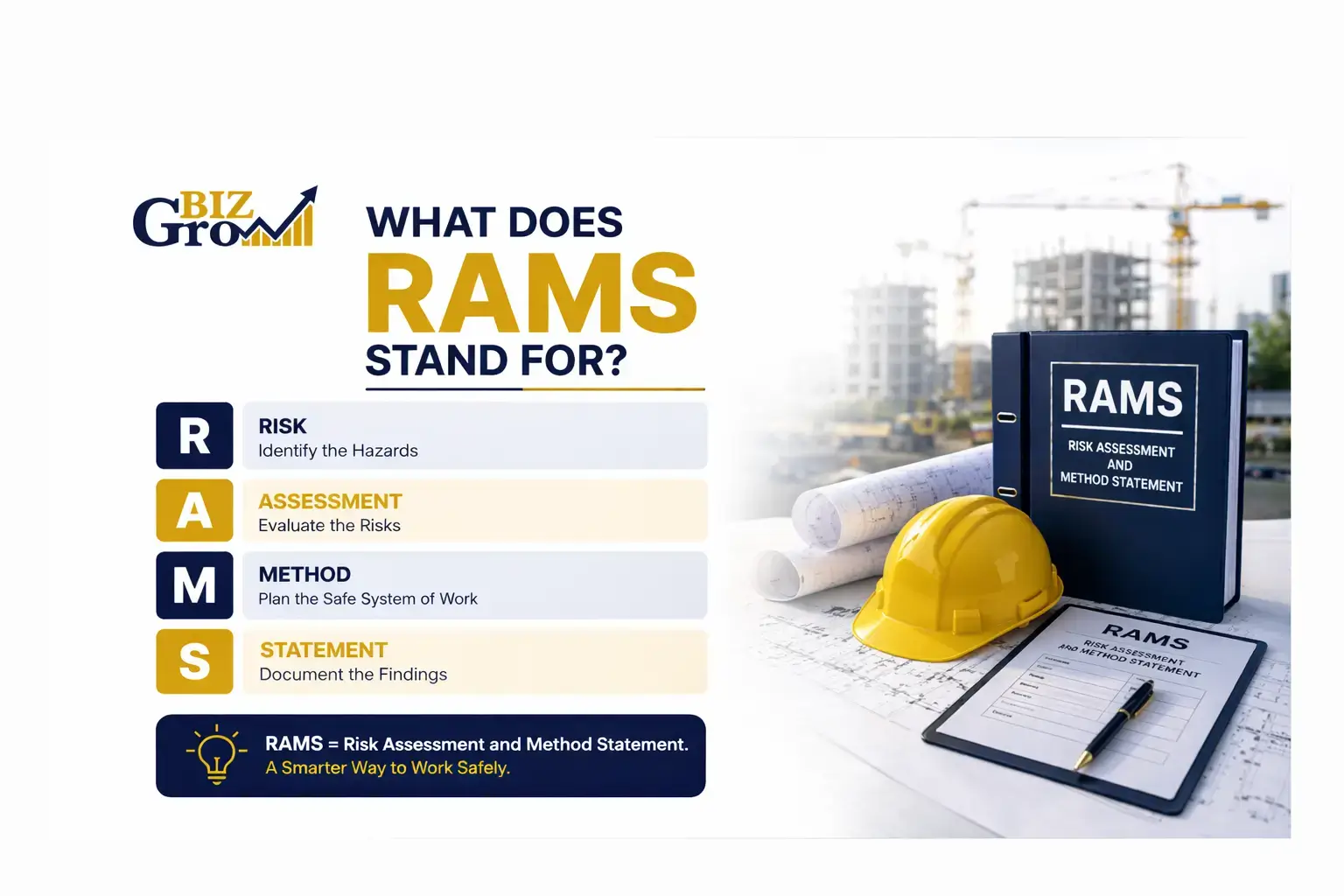
If you work in construction, engineering, manufacturing, or any high-risk industry, you have almost certainly come across the term RAMS. But what does RAMS actually stand for, and why does it matter so much in 2026? This comprehensive guide will answer all your questions from the basic definition of RAMS to the exact steps involved in carrying out a risk assessment, real-world examples, and everything you need to know about site-specific risk assessments.
Whether you are a health and safety manager, a site supervisor, a contractor, or simply someone trying to understand workplace safety documentation, this guide has you covered.
What Does RAMS Stand For?
RAMS stands for Risk Assessment Method Statement. It is a combined health and safety document that brings together two essential components of workplace safety planning: a risk assessment and a method statement.
Let us break down what each part means:
- Risk Assessment (RA): A structured process used to identify potential hazards in a workplace, evaluate how likely they are to cause harm, and put control measures in place to reduce that risk.
- Method Statement (MS): A step-by-step document that outlines exactly how a specific task will be carried out safely, based on the findings of the risk assessment.
Together, RAMS provides both the ‘what could go wrong’ and the ‘here is how we will do it safely’ in a single, unified document. The result is a powerful tool that ensures workers know the risks before they begin a job and know exactly what safe procedures to follow.
What Does RAMS Mean in Practice?
In practical terms, a RAMS document is created before a high-risk task begins. It is read and signed by all workers involved, ensuring that everyone on site understands the hazards, control measures, and the safe method of work.
Important: RAMS is not a legally required document in itself, but the risk assessment component is a legal requirement under the Management of Health and Safety at Work Regulations 1999 (UK). Employers with five or more employees must record their risk assessment findings in writing.
RAMS is most commonly used in the following industries:
• Construction and civil engineering
• Manufacturing and industrial facilities
• Oil, gas, and chemical industries
• Engineering and maintenance
• Events and logistics
RAMS vs Risk Assessment: What Is the Difference?
A common point of confusion is the difference between a standard risk assessment and RAMS. Here is a clear comparison:
| Feature | Risk Assessment | RAMS |
| Purpose | Identifies hazards and evaluates risks | Combines risk assessment + method of work |
| Detail Level | General or task-specific | Highly detailed and job-specific |
| Legal Requirement | Yes (UK HSE) | No (but best practice) |
| Includes Step-by-Step Guide | No | Yes |
| When Used | Ongoing/general workplace safety | Before high-risk or complex tasks |
| Common Industries | All workplaces | Construction, engineering, oil & gas |
As you can see, RAMS is a more comprehensive document. It is not simply a longer risk assessment; it fundamentally combines risk identification with the method of doing the work safely.
What Does RAMS Mean in Health and Safety?
In health and safety terms, RAMS is a framework for safe working. It communicates critical information to workers before a task begins and serves as a live working document that can be reviewed and updated as conditions change on site.
The RAMS document typically includes the following key sections:
- Project and task details: What the job is, where it is, and who is responsible
- Scope of work: A detailed description of the work to be carried out
- Hazard identification: All potential hazards associated with the task
- Risk evaluation: How likely each hazard is to cause harm, and how serious
- Control measures: Steps taken to eliminate or reduce each risk
- Method statement: Step-by-step safe working procedures
- PPE requirements: Personal protective equipment needed
- Emergency procedures: What to do if something goes wrong
- Competency and training: Who is responsible, and what qualifications do they hold
- Sign-off section: Workers sign to confirm they have read and understood the document
Why RAMS Matters in 2026
In 2026, RAMS documents are more important than ever. Regulatory scrutiny has increased, clients and main contractors routinely request RAMS as part of the tender process, and workers are more safety-conscious. A well-written RAMS document demonstrates that your business takes health and safety seriously.
Beyond compliance, RAMS genuinely saves lives. When workers understand both the risks and the correct procedure before they begin, accidents are far less likely to occur. RAMS is not a box-ticking exercise; it is a practical safety tool that keeps people safe and businesses protected.
How Many Steps to a Risk Assessment?
According to the UK Health and Safety Executive (HSE), a risk assessment should follow a clear five-step process. These five steps are universally recognised and apply in all workplaces, regardless of size or industry.
The 5 Steps of a Risk Assessment
Step 1: Identify the Hazards
The first and most critical step is identifying everything in your workplace or task that has the potential to cause harm. A hazard is anything that can cause injury, illness, or damage, whether physical, chemical, biological, or psychological.
How to identify hazards effectively:
- Walk around the workplace and physically observe tasks as they are performed. This is not a desktop exercise
- Speak to workers and supervisors who do the job every day; they often notice hazards that others miss
- Review past accident reports, near-miss records, and incident logs
- Check manufacturers’ instructions, safety data sheets (SDS), and industry guidance
- Consider both routine tasks and non-routine activities such as maintenance, cleaning, and emergency procedures
Step 2: Decide Who Might Be Harmed and How
Once hazards are identified, you must consider who could be harmed by each one and in what way. Do not limit your thinking to full-time employees.
Consider:
- Part-time and temporary workers
- Contractors and sub-contractors working on the site
- Visitors, delivery drivers, and members of the public
- Lone workers and those who work different hours
- Vulnerable groups include new employees, young workers, pregnant workers, and those with disabilities
For each hazard, write down who might be affected and describe how the harm could occur. Being specific at this stage ensures your control measures are targeted and effective.
Step 3: Evaluate the Risks and Decide on Precautions
This step involves evaluating how serious each risk is and deciding what precautions are necessary. The law requires you to do everything ‘reasonably practicable’ to protect people from harm.
A common method is to use a risk matrix, which multiplies the Likelihood of the hazard causing harm by the Severity of the potential harm. The result gives an overall risk score:
| Risk Level | Score Range | Action Required |
| Low | 1–4 | Acceptable risk. Monitor and review. |
| Medium | 5–9 | Implement additional controls. Reassess. |
| High | 10–16 | Work must not proceed. Immediate action is needed. |
| Critical | 17–25 | Stop work. Escalate immediately. |
When deciding on precautions, always follow the Hierarchy of Controls from most effective to least effective: Elimination, Substitution, Engineering Controls, Administrative Controls, and finally Personal Protective Equipment (PPE).
Step 4: Record Your Findings and Implement Them
If your organisation has five or more employees, you are legally required to record the significant findings of your risk assessment in writing. However, it is good practice for all businesses to do this regardless of size.
Your records should clearly show:
- The hazards identified
- Who could be harmed and how
- What control measures are in place
- Who is responsible for implementing each measure
- The date of the assessment
Crucially, recording the findings is not enough; you must actually implement the control measures. A risk assessment document filed away in a cabinet that does not reflect actual working practices is not only ineffective, but it is also potentially dangerous.
Step 5: Review and Update the Risk Assessment Regularly
A risk assessment is a living document. It should be reviewed and updated regularly at a minimum once per year, and also whenever:
- There is a significant change in the workplace (new equipment, new processes, new substances)
- An accident, near-miss, or injury occurs
- New employees who may be at greater risk
- Monitoring or inspection reveals that controls are not working effectively
Pro Tip: Set a reminder to review your risk assessments annually. Build reviews into your safety management calendar so they never get overlooked.
Risk Assessment Example
To make the five steps more concrete, here is a practical risk assessment example from a construction site context, specifically for working at height when installing scaffolding.
Example: Scaffolding Erection on a Construction Site
| Step | Detail |
| Task | Erection and dismantling of scaffolding on a commercial building |
| Hazard 1 | Working at height risk of falls |
| Who is at risk? | Scaffolders, site workers below, members of the public nearby |
| Likelihood (1-5) | 3 — Possible if controls are not in place |
| Severity (1-5) | 5 — Could result in fatality or serious injury |
| Risk Score | 15 — HIGH |
| Control Measures | Use of guardrails, safety nets, harnesses, and toe boards. Exclusion zones below. |
| Hazard 2 | Falling objects, tools, or materials dropped from a height |
| Who is at risk? | Workers and the public below the work area |
| Likelihood (1-5) | 3 — Reasonably likely without controls |
| Severity (1-5) | 4 — Could cause serious injury |
| Risk Score | 12 — HIGH |
| Control Measures | Tool lanyards, debris nets, exclusion zones, site signage and barriers |
| Responsible Person | Site Supervisor / Scaffolding Contractor |
| Review Date | Monthly or after any incident |
What a Good Risk Assessment Example Looks Like
A good risk assessment accurately reflects the real conditions on the ground. It is specific, practical, and not overly complicated. The HSE states that for most businesses, a risk assessment does not need to be a huge exercise; it just needs to note the main points about significant risks and what controls are in place.
Common mistakes to avoid in your risk assessment:
- Being too generic, ‘worker could be injured’ is not helpful; be specific about how
- Failing to consider non-routine activities, which is where many accidents occur
- Completing the assessment as a paperwork exercise without physically inspecting the workplace
- Not involving the workers who actually perform the task
- Failing to update the assessment when things change
Key Benefits of Using RAMS in Your Business
Now that you understand what RAMS stands for and how it works, let us look at why using RAMS is genuinely beneficial for any business working in high-risk environments.
- Legal Compliance: RAMS helps satisfy your legal duty under the Health and Safety at Work Act 1974 and associated regulations.
- Accident Prevention: By identifying and controlling risks before work begins, RAMS dramatically reduces the likelihood of accidents and injuries.
- Clearer Communication: Workers receive clear, written instructions that leave no room for confusion or misinterpretation.
- Client and Tender Requirements: RAMS is routinely required by main contractors and clients as part of the tender process in construction.
- Reputational Protection: Demonstrating robust safety documentation protects your business reputation if an incident ever occurs.
- Safe Decision Making: Workers have a documented process to refer to when making decisions on site, even without a supervisor present.
- Insurance Benefits: Good safety documentation can support insurance claims and may positively affect premiums.
Who Is Responsible for RAMS?
The ultimate responsibility for health and safety, including RAMS documents, lies with the employer. Under UK law, it is the employer’s duty to ensure that suitable and sufficient risk assessments are carried out and that appropriate safe systems of work are in place.
In practice, the creation of RAMS can be delegated to a competent person such as a health and safety manager, a site supervisor, or an external health and safety consultant. However, the employer remains accountable regardless of who prepares the document.
All workers who will carry out the task covered by the RAMS should:
- Read the document before work begins
- Ask questions if anything is unclear
- Sign the document to confirm they have understood it
- Follow the method statement and control measures at all times
- Report any changes in conditions that might affect the assessment
How Often Should RAMS Be Reviewed?
RAMS should be reviewed regularly to ensure they remain accurate and effective. The general guidance is:
- Annually, as a minimum, even if nothing appears to have changed
- Before each new project or job at a new site
- After any accident, near-miss, or incident
- When there are significant changes to the task, equipment, personnel, or site conditions
- When new hazards are identified that were not previously considered
Treating RAMS as a ‘set and forget’ document is one of the most common mistakes businesses make. Conditions change, equipment gets older, new workers join, and all of these factors can affect the accuracy and relevance of a RAMS document.
Conclusion: Why RAMS Remains Essential in 2026
RAMS Risk Assessment Method Statement is one of the most important health and safety tools available to employers and contractors in high-risk industries. It combines the hazard-identification rigour of a risk assessment with the practical, step-by-step clarity of a method statement, producing a document that genuinely protects workers and businesses.
In 2026, the importance of RAMS has only grown. Clients expect it, regulators look for it, and most importantly, it saves lives. Whether you are completing a site-specific risk assessment for a construction project, or reviewing your general workplace risk assessments using the HSE’s five-step framework, the principles remain the same: identify the hazards, protect the people, document your findings, and never stop reviewing.
If you are new to RAMS, start with the five steps of risk assessment and work from there. For high-risk or complex work, invest time in producing a thorough, site-specific RAMS document and ensure every worker on site has read and understood it before work begins.
Remember: Safety is not a document. It is a culture. RAMS is the tool that helps build that culture one job at a time.