Running a business in the UK means managing many responsibilities at once.
You have to keep your staff safe and minimise your environmental impact. You must maintain quality across everything you do. And you have to stay compliant with an ever-growing list of legal and regulatory requirements.
Most businesses manage these things separately. Different teams, systems and policies. That approach is inefficient and often leaves gaps that nobody notices until something goes wrong.
SHEQ changes that. It brings all four of these critical disciplines together into a single, integrated management system. One framework. One approach. Better results across the board.
This guide explains exactly what SHEQ means, what a SHEQ management system involves, and how UK businesses can build and certify one clearly, in plain English.
At BizGrow Holdings, we help UK businesses develop and implement integrated SHEQ management systems. Let us walk you through everything you need to know.
What Is SHEQ?
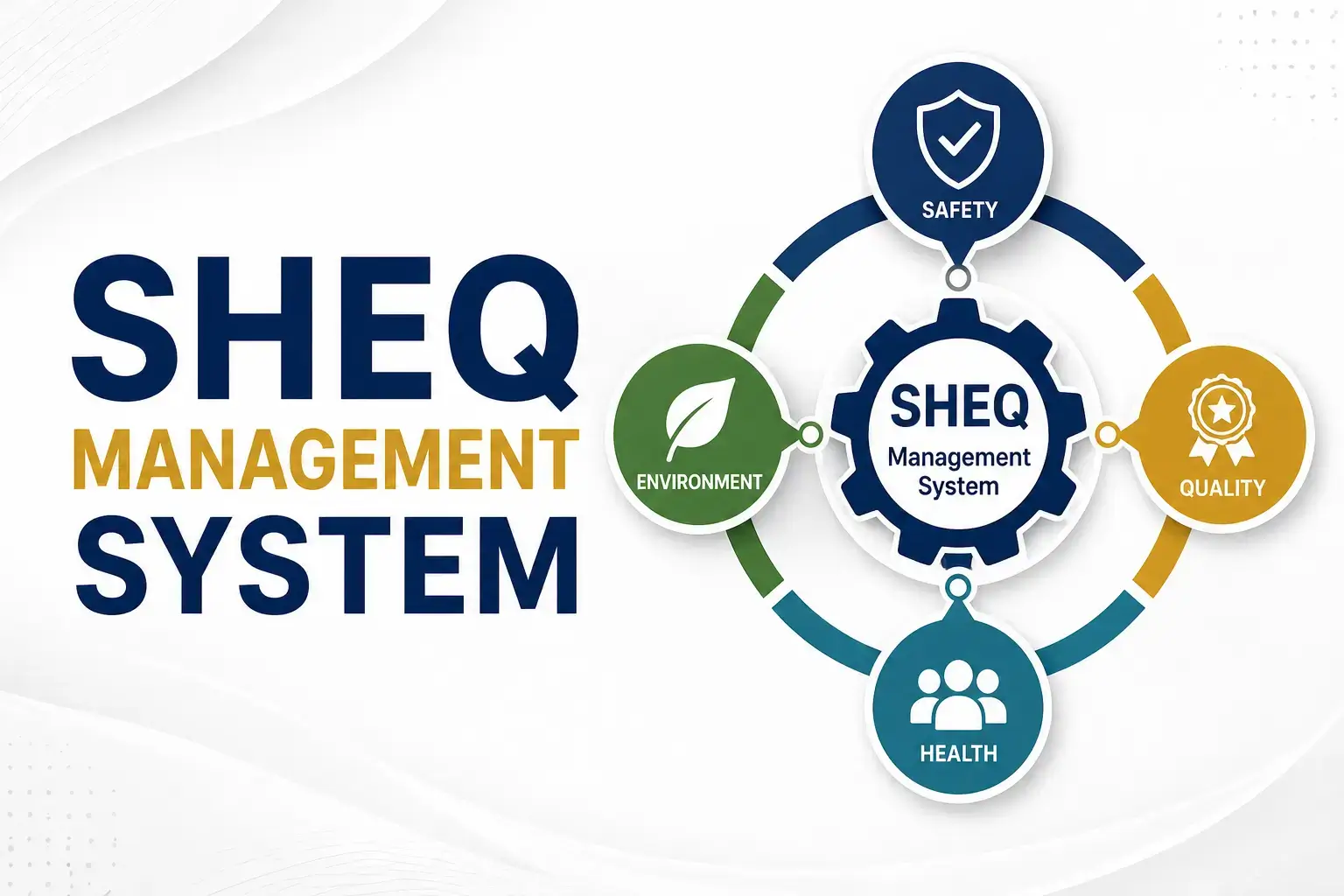
SHEQ is an integrated approach to managing four critical areas of business responsibility simultaneously.
It stands for Safety, Health, Environment, and Quality, the four essential pillars that ensure businesses operate responsibly, efficiently, and in compliance with regulations.
Each pillar protects something important:
- Safety protects your people from workplace accidents, injuries, and hazards
- Health protects the physical and mental well-being of your workforce
- The environment protects the planet from the negative impacts of your operations
- Quality protects your clients, your reputation, and your business performance
These four areas are deeply interconnected. A failure in one almost always affects the others. A safety incident can trigger environmental damage. Poor quality can create health risks. Environmental non-compliance can undermine your quality systems.
SHEQ combines these elements because they are interconnected; a failure in one can affect the others. Businesses adopt an integrated approach to ensure legal compliance and avoid penalties, manage risk and prevent workplace incidents, improve efficiency by streamlining operations, and enhance reputation through sustainability and quality assurance.
In short, SHEQ is about doing things safely, responsibly, and well consistently, across your entire organisation.
What Does SHEQ Stand For?
SHEQ stands for:
- S: Safety
- H: Health
- E: Environment
- Q: Quality
You may also see it written as HSEQ, where Health comes first, particularly in the oil, gas, and energy sectors. Both acronyms refer to the same integrated management concept. In the UK construction, facilities management, and security sectors, SHEQ is the more commonly used term.
Some organisations also use QHSE or QSHE, depending on which discipline they consider most important in their operational context.
Regardless of the order, the meaning is the same. It is an integrated approach to managing safety, health, environment, and quality as one coherent system rather than four separate, disconnected areas.
What Is a SHEQ Management System?
A SHEQ Management System is a structured framework that helps organisations manage their Safety, Health, Environmental, and Quality responsibilities in a consistent and integrated way. It brings together policies, procedures, and processes to ensure that all aspects of SHEQ are effectively controlled, monitored, and improved over time.
Think of it as the operating system of your business. Just as a computer needs an operating system to manage all its functions, your business needs a management system to manage all its SHEQ responsibilities.
A SHEQ management system typically includes:
- A documented SHEQ policy setting out your organisation’s commitments and approach
- Risk assessments and method statements covering all key activities
- Procedures for managing environmental impacts, waste, emissions, and energy use
- Quality control processes, inspection, testing, and non-conformance management
- Training and competence frameworks for all staff
- Internal audit programmes regularly review how the system is working
- Management review processes senior leadership oversight and continuous improvement
- Incident reporting and investigation processes
- Legal compliance registers tracking all applicable regulations and standards
- Performance monitoring and measurement systems
SHEQ refers to the integration of three basic management systems: ISO 14001:2015 Environmental Management System, ISO 45001:2018 Occupational Health and Safety Management System, and ISO 9001:2015 Quality Management System. Businesses typically use management systems individually, but by integrating these three standards, organisations can combine all their systems and processes into one complete framework, resulting in a more effective, more efficient, and easier-to-follow system.
Why Is SHEQ Important for UK Businesses?
SHEQ is important because the consequences of getting any one of its four pillars wrong are serious, and getting all four right simultaneously gives your business a significant competitive advantage.
Here is why SHEQ matters for UK businesses specifically:
Legal compliance.
UK businesses face obligations under the Health and Safety at Work Act 1974, the Environmental Protection Act 1990, the Management of Health and Safety at Work Regulations 1999, and a host of sector-specific regulations. A SHEQ management system helps you meet all of these requirements and demonstrate that compliance to regulators, insurers, and clients.
Winning contracts.
Major clients in construction, facilities management, the public sector, and infrastructure increasingly require suppliers to hold ISO 45001, ISO 14001, and ISO 9001 certifications or an integrated SHEQ management system. Without this, you cannot tender for their work.
Protecting your people.
Workplace accidents cost UK businesses billions each year in lost productivity, insurance claims, investigation time, and reputational damage. A robust SHEQ system dramatically reduces incident rates by identifying hazards before they cause harm.
Protecting your reputation.
One significant environmental incident, quality failure, or safety accident can cause lasting reputational damage. A SHEQ management system demonstrates to the market that you take all of these responsibilities seriously.
Reducing waste and inefficiency.
Quality and environmental management both drive efficiency. Reducing defects, rework, waste, and energy use saves money, often significantly.
Staff wellbeing and retention.
Employees want to work for organisations that take their safety and well-being seriously. A strong SHEQ culture helps you attract and keep good people.
SHEQ Principles | The Foundation of Good Practice
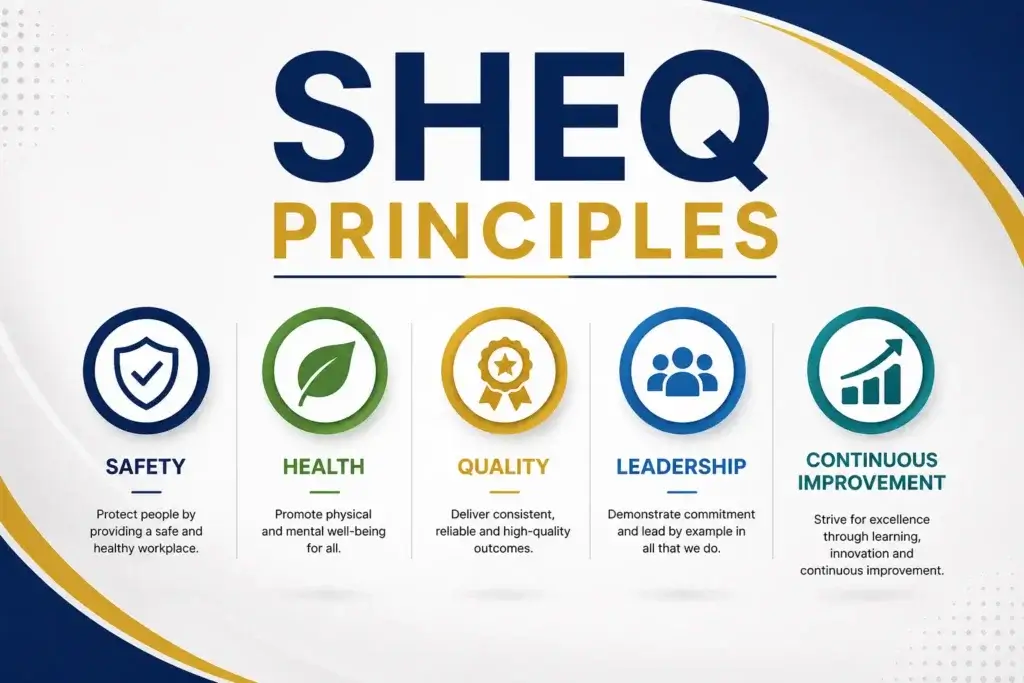
Every effective SHEQ management system is built on a set of core principles. These principles guide how the system is designed, implemented, and maintained:
Leadership commitment.
SHEQ starts at the top. Senior leaders must visibly demonstrate their commitment to safety, health, environmental responsibility, and quality not just in policy documents, but in day-to-day decisions and behaviour.
Worker involvement.
Effective SHEQ systems engage the whole workforce. Workers are often the first to spot hazards, quality issues, or environmental problems. A system that listens to them and involves them in improvement is far more effective than one imposed from the top down.
Risk-based thinking.
Rather than reacting to problems after they occur, SHEQ takes a proactive approach, identifying risks before they materialise and putting controls in place to prevent them.
Legal compliance is a minimum.
SHEQ systems treat legal compliance as the floor, not the ceiling. The goal is always to go beyond mere compliance to genuinely best practice.
Continual improvement.
A SHEQ management system is never finished. It evolves continuously, driven by audits, incident investigations, performance data, and changing business needs.
Process approach.
SHEQ management is based on understanding and managing how your business processes interact with one another rather than treating each area in isolation.
Evidence-based decision making.
Decisions about SHEQ priorities and improvements are driven by data incident statistics, audit findings, environmental measurements, and quality performance metrics.
SHEQ Objectives | What Are You Trying to Achieve?
SHEQ objectives are the specific, measurable targets your business sets for each of the four pillars. They translate your SHEQ policy commitments into practical goals.
Typical SHEQ objectives for UK businesses include:
Safety objectives:
- Reduce the number of Lost Time Incidents (LTIs) by a set percentage year on year
- Achieve zero reportable accidents under RIDDOR
- Complete 100% of required safety training for all staff within defined timescales
- Carry out all scheduled toolbox talks and safety briefings as planned
Health objectives:
- Conduct annual health surveillance for all workers in relevant roles
- Reduce absenteeism related to work-related illness
- Ensure all stress risk assessments are completed and reviewed annually
Environmental objectives:
- Reduce waste sent to landfill by a target percentage
- Cut carbon emissions across operations
- Achieve specified targets for energy consumption reduction
- Ensure 100% compliance with waste management and environmental permit conditions
Quality objectives:
- Reduce the rate of non-conformances or customer complaints by a set percentage
- Achieve specified customer satisfaction scores
- Complete all internal audits on schedule
- Reduce the number of rework incidents across key processes
Objectives should be SMART: Specific, Measurable, Achievable, Relevant, and Time-bound. They should be reviewed at least annually as part of your management review process.
SHEQ Policies | What You Need in Place
A SHEQ policy is a formal, documented statement that sets out your organisation’s commitments across all four pillars.
Many businesses have separate policies for health and safety, environment, and quality. Integrating these into a single SHEQ policy is more efficient and sends a clearer message about your organisation’s holistic approach.
Your SHEQ policy must:
- Be signed and dated by the most senior person in the business, typically the Managing Director or CEO
- Be communicated to all employees and made available to interested parties
- Be reviewed regularly at least annually
- Be relevant to your actual business activities, not a generic, downloaded template
- State your commitment to legal compliance, continual improvement, and worker involvement
- Set the framework within which your SHEQ objectives are established
A signed SHEQ policy on its own is not enough. Assessors, clients, and regulators want to see evidence that the policy is actually implemented, that the commitments made on paper are reflected in how your business operates day to day.
SHEQ Standards in the UK
The SHEQ management system framework in the UK is built around three internationally recognised ISO standards. Here is what each covers and why each matters:
ISO 45001 | Health and Safety
ISO 45001:2018 is the international standard for Occupational Health and Safety Management Systems. It replaced OHSAS 18001 and sets out requirements for identifying, controlling, and eliminating workplace health and safety risks.
ISO 45001 focuses on leadership commitment, worker participation, risk assessment, hazard identification, legal compliance, and continual improvement of health and safety performance. It is relevant to every UK business where people are at risk from workplace activities.
ISO 14001 | Environmental Management
ISO 14001:2015 is the international standard for Environmental Management Systems. It helps organisations identify, manage, monitor, and reduce their environmental impacts, covering waste management, energy use, emissions, water consumption, and compliance with environmental legislation.
For UK businesses, ISO 14001 is increasingly expected by public sector clients and large private sector buyers as evidence of environmental responsibility and compliance.
ISO 9001 | Quality Management
ISO 9001:2015 is the world’s most widely adopted quality management standard. It sets out requirements for a quality management system focused on consistently meeting customer requirements, improving customer satisfaction, and driving continual improvement across all business processes.
ISO 9001 is relevant to any UK business that supplies products or services and wants to demonstrate that those products and services consistently meet the required standard.
How do they work together?
All three standards share a common structure, the High Level Structure (HLS), which means they are designed to be integrated. The core elements of planning, support, operation, performance evaluation, and improvement are aligned across all three, making it far simpler to build and maintain a single integrated SHEQ management system than three separate ones.
When integrating these three standards, organisations can combine all their systems and processes into one complete framework, resulting in a compact management system that is more effective, more efficient, and easier to follow than having several separate systems.
SHEQ Requirements for UK Businesses
To build a compliant SHEQ management system in the UK, your business must address the following core requirements:
- A documented and signed SHEQ policy reviewed at least annually
- A legal register identifying all applicable health, safety, environmental, and quality laws and regulations
- Risk assessments covering all significant workplace hazards
- Environmental aspect and impact assessments, identifying how your operations affect the environment
- Documented procedures for all key SHEQ-related processes
- Training records demonstrating staff competence in SHEQ-relevant areas
- Internal audit programme scheduled, carried out, and findings documented
- Management review meetings, senior leadership reviewing SHEQ performance at least annually
- Incident reporting and investigation system covering accidents, near misses, environmental incidents, and quality non-conformances
- Corrective action process tracking how issues are identified, investigated, and resolved
- Objectives and targets set for each pillar are monitored and reviewed regularly.
- Emergency preparedness and response procedures
These requirements are consistent across ISO 45001, ISO 14001, and ISO 9001. Building a system that addresses all of them once, in an integrated framework, is the most efficient approach.
How to Get a SHEQ Certificate in the UK?
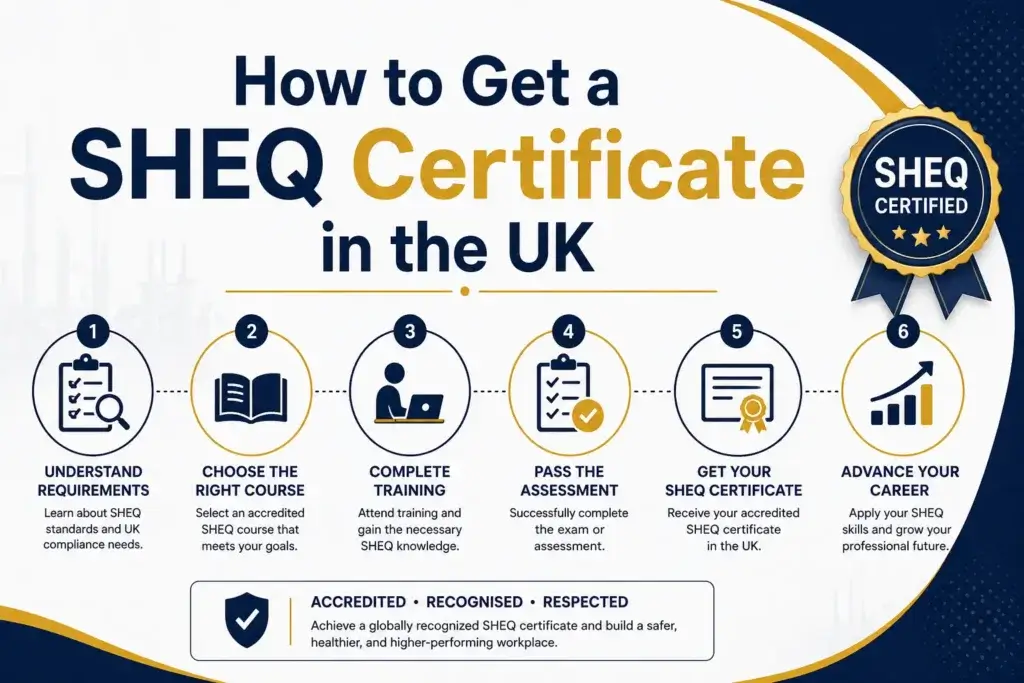
Getting formally certified to ISO 45001, ISO 14001, and ISO 9001 individually or as an integrated SHEQ system involves a structured process. Here is how it works:
Step 1 | Gap Analysis
Before building or certifying anything, carry out a thorough gap analysis. This reviews your current policies, processes, and documentation against the requirements of the relevant ISO standards and identifies exactly what needs to be developed or improved.
A gap analysis gives you a clear, prioritised action plan. It prevents wasted effort by focusing your attention on what actually needs to change rather than what is already in good shape.
Step 2 | Build Your SHEQ Management System
Based on your gap analysis, develop and implement the policies, procedures, processes, and records required to meet the standard. This includes writing your SHEQ policy, developing your risk assessments, creating your legal register, documenting your procedures, and establishing your training and audit programmes.
This is often the most time-intensive stage, but it is also where the real value is created. A well-designed SHEQ management system does not just satisfy auditors. It genuinely makes your business safer, more efficient, and more compliant.
Step 3 | Internal Audit
Once your system is in place, carry out a full internal audit. This checks that everything you have documented is actually being implemented, that your system meets the requirements of the relevant standards, and that there are no significant non-conformances that would cause you to fail an external assessment.
Internal audit findings feed into a management review, a formal meeting where senior leadership reviews SHEQ performance, considers the audit findings, and approves any corrective actions needed before the external assessment.
Step 4 | Certification Body Assessment
Choose a UKAS-accredited certification body such as BSI, LRQA, SGS, or Bureau Veritas. They will conduct a two-stage external assessment:
Stage 1 is a desktop review, where the assessor reviews your documentation to check it meets the standard’s requirements. They identify any areas that need attention before the Stage 2 visit.
Stage 2 is an on-site assessment, where the assessor visits your business, interviews staff, observes operations, and verifies that your management system is genuinely implemented and effective.
If non-conformances are identified, you will be allowed to address them before certification is granted.
Step 5 | Receive Your Certificate
Once the assessor is satisfied, the certification body issues your certificate. For an integrated SHEQ system, you receive certificates for each standard ISO 45001, ISO 14001, and ISO 9001.
Certificates are typically valid for three years, with annual surveillance audits to verify ongoing compliance. A full recertification assessment takes place at the end of the three-year cycle.
SHEQ in Quality Management
Quality management is the fourth pillar of SHEQ, and it is often the one most directly linked to commercial performance.
In quality management, SHEQ means ensuring that your products and services consistently meet the requirements your clients expect every time, not just when someone is watching.
ISO 9001 is the standard that formalises this commitment. It covers how you plan work, how you manage supplier relationships, how you control your processes, how you handle non-conformances, and how you use customer feedback to drive improvement.
For UK businesses in competitive markets, ISO 9001 certification is a powerful differentiator. It tells clients that your quality is not dependent on individual effort or good fortune; it is built into how your business operates as a system.
Within a SHEQ management system, quality management sits alongside safety, health, and environmental management, aligned, integrated, and reinforcing each other. A quality-focused culture and a safety-focused culture are not in tension. They reinforce each other. Both require attention to detail, process discipline, and a commitment to getting things right the first time.
Industries That Need SHEQ in the UK
SHEQ management systems are relevant across virtually every sector. But they are particularly important in:
- Construction high risk of workplace injury, significant environmental impact, quality-critical output, and strong client demand for ISO certification
- Facilities management managing diverse sites and workforces across multiple client environments
- Manufacturing product quality, worker safety, and environmental compliance are all critical
- Oil, gas, and energy have historically been one of the strongest adopters of integrated SHEQ management
- Security increasingly required to demonstrate compliance with quality and health and safety standards, particularly for SIA ACS and public sector contracts.
- Transport and logistics driver safety, environmental impact, and service quality all demand integrated management
- Healthcare and social care duty of care, quality of service, and regulatory compliance are all paramount.
- Utilities and infrastructure high-hazard environments where SHEQ management is often a legal and contractual requirement
- Education, campus safety, environmental management, and service quality all benefit from SHEQ frameworks
How BizGrow Holdings Helps You Build a SHEQ System?
At BizGrow Holdings, we provide end-to-end support for UK businesses building, implementing, and certifying SHEQ management systems.
We work with businesses across construction, facilities management, security, professional services, and the public sector. We understand what certification bodies look for, what clients expect, and what it takes to build a system that genuinely works, not just one that satisfies auditors.
Here is what we do:
- Gap analysis: We assess your current position against ISO 45001, ISO 14001, and ISO 9001 requirements and identify exactly what needs to change
- SHEQ policy development: we help you write a clear, tailored, and credible SHEQ policy
- Procedure and process development: We help you build the documented procedures your system needs
- Risk assessment support: health and safety risk assessments, environmental aspects, and impact assessments
- Legal register development: we identify all the legal and regulatory requirements applicable to your business
- Internal audit support: we carry out or support your internal audit programme
- Management review facilitation: we help you run effective management reviews that drive real improvement
- Certification preparation: We make sure you are genuinely ready before the external assessor arrives
- Integrated system design: we build ISO 45001, ISO 14001, and ISO 9001 as one coherent SHEQ system, not three separate ones
- Ongoing advisory support: we stay with you through surveillance audits and recertification
Our goal is to help you build a SHEQ management system that is genuinely useful to your business, not just a collection of documents that gather dust until the next audit.
If you want to build or improve your SHEQ management system, speak to the BizGrow Holdings team today. Visit bizgrow-holdings.com to get started.
Conclusion | Build a Stronger Business With SHEQ
SHEQ is not red tape. It is a framework for running a better business.
Put all four together in an integrated SHEQ management system, and you have a business that is safer, more efficient, more compliant, and more competitive.
In 2026, the UK businesses that are investing in SHEQ are winning more contracts, satisfying more clients, and building more sustainable operations. Those that are not are increasingly finding themselves locked out of opportunities that require ISO 45001, ISO 14001, or ISO 9001 certification as a minimum.
BizGrow Holdings is here to help you get there. Visit bizgrow-holdings.com today.
Frequently Asked Questions
1. What does SHEQ stand for in safety?
SHEQ stands for Safety, Health, Environment, and Quality. In safety specifically, the S and H pillars focus on preventing workplace accidents, protecting workers from injury, managing occupational health risks, and ensuring compliance with the Health and Safety at Work Act 1974.
2. Is SHEQ certification a legal requirement in the UK?
SHEQ certification is not a legal requirement for most businesses. However, many major clients in construction, facilities management, and the public sector require ISO 45001, ISO 14001, and ISO 9001 certification as a contractual minimum.
3. Can small businesses implement a SHEQ management system?
Yes. SHEQ management systems are scalable. The standards ISO 45001, ISO 14001, and ISO 9001 apply to organisations of any size. A small business implements simpler systems than a large organisation, but the principles are identical.
4. How long does it take to get SHEQ certified?
It depends on how close your current systems are to the required standard. A business starting from scratch typically takes 3 to 6 months to build and implement a SHEQ management system before an external assessment. Businesses with existing systems in place can move faster.
5. What is the difference between SHEQ and HSE?
HSE stands for the Health and Safety Executive, the UK’s statutory regulator for workplace health and safety. SHEQ is a management framework used by businesses to manage their safety, health, environmental, and quality responsibilities. HSE is a regulatory body. SHEQ is a business management approach. Your SHEQ management system helps you comply with the requirements that HSE enforces.