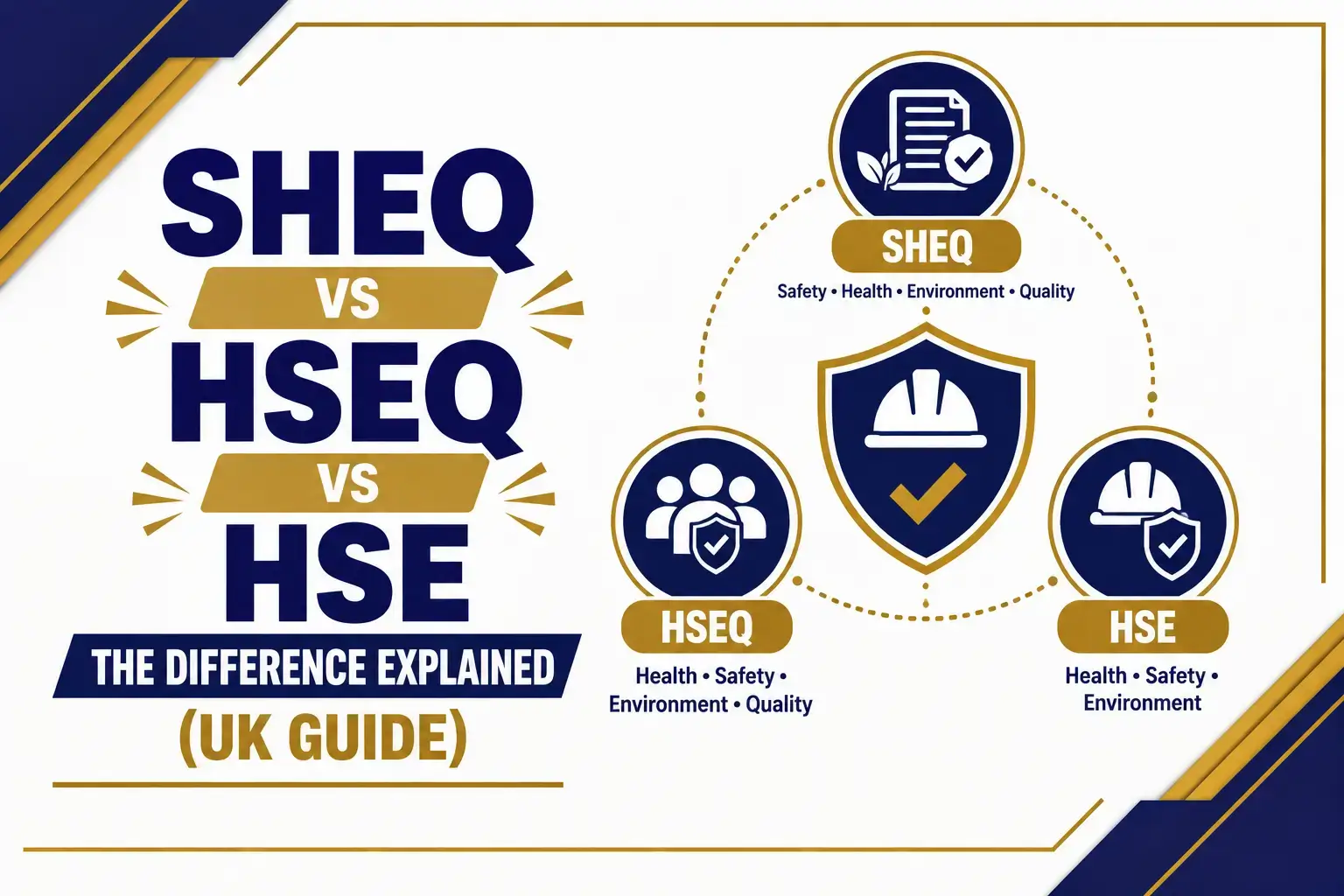
SHEQ vs HSEQ vs HSE. Three short terms. One big question. Are they the same? You may see these terms on tenders, job adverts, and audit forms. So, many UK business owners feel confused. That is normal. Here is the short answer. They are close, but not the same. HSE covers health, safety, and environment. However, SHEQ and HSEQ also cover quality. In this guide on SHEQ vs HSEQ vs HSE, we explain each term in simple words. First, you will learn how they differ. Then, you will see which term UK employers use. Finally, you will find out which one suits your business.
What Do SHEQ, HSEQ and HSE Stand For?
These three terms are short forms. Each letter represents an area of work. To understand SHEQ vs HSEQ vs HSE, let’s take them one by one.
What Is SHEQ?
SHEQ stands for Safety, Health, Environment and Quality.
It is one system that manages four areas:
- Safety: stops accidents and injuries
- Health: protects people from illness, noise, dust, stress and chemicals
- Environment: manages waste, pollution, energy and water
- Quality: makes sure your work meets client and legal standards
A SHEQ system brings all four areas together. So, you do not run four separate systems. You run one. Many UK contractors and supply chains use this term. It is also popular in South Africa.
What Is HSEQ?
HSEQ stands for Health, Safety, Environment and Quality. It covers the same four areas as SHEQ. Only the order of the letters changes. So, the meaning stays the same. Construction, engineering, and large projects often use HSEQ. You may also see QHSE and HSQE. They mean the same thing. Most companies pick one name. Then, they use it in every policy and document.
What Is HSE?
HSE stands for Health, Safety and Environment. It has three areas. It does not include quality. Most UK companies use the term HSE. You will see it in job titles like “HSE Manager” and “HSE Advisor”. North America uses EHS instead. It means the same thing, but the letters come in a different order. An HSE team focuses on protecting people and the environment. In many companies, a separate team looks after quality. That is the key point in SHEQ vs HSEQ vs HSE: quality is the extra part.
SHEQ vs HSEQ vs HSE: Key Differences
The main difference is one word: quality.
Let’s look at what each term covers:
- HSE = health + safety + environment
- HSEQ = health + safety + environment + quality
- SHEQ = safety + health + environment + quality
So, HSE has three parts. However, HSEQ and SHEQ have four parts. Quality is the extra one.
Here is a simple table to compare SHEQ vs HSEQ vs HSE.
| Term | Full form | Includes quality? | Where you often see it |
|---|---|---|---|
| HSE | Health, Safety and Environment | No | UK job roles, oil and gas, general use |
| HSEQ | Health, Safety, Environment and Quality | Yes | Construction, engineering, big projects |
| SHEQ | Safety, Health, Environment and Quality | Yes | Contractors, mining, UK supply chains |
As you can see, HSEQ and SHEQ mean the same thing. Only the order of the letters changes. Therefore, the real choice is between HSE and the two quality-based terms.
What This Means in Real Life
Let’s see SHEQ vs HSEQ vs HSE in a real example. Think about a cleaning company.
- A cleaner slips on a wet floor. That is a safety issue.
- A chemical harms a worker’s skin. That is a health issue.
- Dirty water goes down a drain. That is an environmental issue.
- The client says the office is still dirty. That is a quality issue.
HSE deals with the first three issues. However, SHEQ and HSEQ deal with all four. Why does quality matter? Because poor work can turn into a safety risk. For example, a badly fitted rail, an untrained guard, or a missed cleaning step can hurt people. Also, poor work can make you lose a contract. That is why many buyers prefer an all-in-one approach.
SHEQ vs HSEQ vs HSE in Construction, Security and Cleaning
Each sector uses these systems in its own way. So, let’s see how SHEQ vs HSEQ vs HSE looks in real work.
Construction
Construction is a high-risk sector. Workers face heights, heavy plant, dust, and noise. Also, quality problems like defects can cause safety problems later. For this reason, main contractors often expect an HSEQ or SHEQ approach from their suppliers. They also check your proof, such as risk assessments and method statements. Construction sites follow the Construction (Design and Management) Regulations 2015. Most people call them CDM 2015. In addition, many buyers look for schemes like SafeContractor, SMAS Worksafe, CHAS and Constructionline.
Security Companies
Security officers often work alone. They work nights. They also deal with conflict. As a result, they face real health and safety risks.
A SHEQ system for security covers:
- Lone working rules
- Incident logs
- Training records
- Client complaint handling
- Staff screening and licensing checks
Security firms often follow standards like BS 7858 and BS 7499. Many also aim for SIA ACS approval. NSI Gold accreditation checklist shows what to prepare. Environment matters too. For example, think about vehicle use, paper waste and energy use at control rooms.
Cleaning Companies
Cleaning firms handle chemicals, so the COSHH Regulations 2002 apply. Workers also face slips, manual handling, and work at height. Environment is a big topic here. For example, cleaners deal with chemical waste, water use, and eco-friendly products. Quality is easy to see. Clients notice dirty floors and missed tasks fast. Therefore, a good SHEQ vs HSEQ vs HSE system uses inspection checklists, client feedback, and quick fixes.
SHEQ vs HSEQ vs HSE: Which One Does Your Business Need?
The name matters less than the system. So, ask what your clients need and what risks you face.
Use this quick guide to choose between SHEQ vs HSEQ vs HSE:
- Choose HSE if you mainly need health, safety, and environment controls
- Choose SHEQ or HSEQ if you also want to manage quality and win tenders
- Choose an integrated system if you plan to get ISO 9001, ISO 14001 and ISO 45001
- Start small if you run a small firm. Begin with a policy, risk assessments, and training records
Next, check what your clients ask for. For example, if your key buyers use HSEQ, use that name in your documents. Also, many growing firms move from HSE to SHEQ or HSEQ over time. This is a good sign. It shows that your business is growing and taking quality seriously.
How to Set Up a SHEQ or HSEQ System
You do not need to be an expert. So, follow these six simple steps. They work whether you choose SHEQ, HSEQ, or HSE. Now you know the difference between SHEQ vs HSEQ vs HSE, so let’s put it into practice.
- Write a policy. First, say what your company will do on safety, health, environment, and quality. Then, ask a director to sign it.
- Give clear roles. Next, decide who leads, who checks, and who reports.
- Assess your risks. List the hazards. Score each one. After that, add controls to reduce the risk.
- Write simple procedures. Explain how your staff should do key tasks safely and well.
- Train your people. Train every worker, and keep the training records. Also, add short toolbox talks.
- Check and improve. Run internal audits. Then, fix problems fast. Finally, review your results every year.
Records are the key. Auditors and buyers trust what they can see. Therefore, keep your records neat and up to date. Do you need help? Bizgrow Holding LTD’s internal audit service and QMS software help you keep everything organised.
FAQs
What does SHEQ stand for?
SHEQ stands for Safety, Health, Environment and Quality. It brings all four areas into one system.
Is SHEQ the same as HSEQ?
Yes, in practice. Both cover the same four areas, so only the order of the letters changes.
Is HSE the same as SHEQ?
No. HSE covers health, safety and environment only. However, SHEQ also covers quality.
Is a SHEQ system a legal requirement in the UK?
No, the law does not ask for a SHEQ system by name. But UK law does require you to manage health, safety and environmental risks.
Do small businesses need a SHEQ management system?
Small firms need basic health and safety controls by law. Also, a simple SHEQ system helps you pass audits and win tenders.