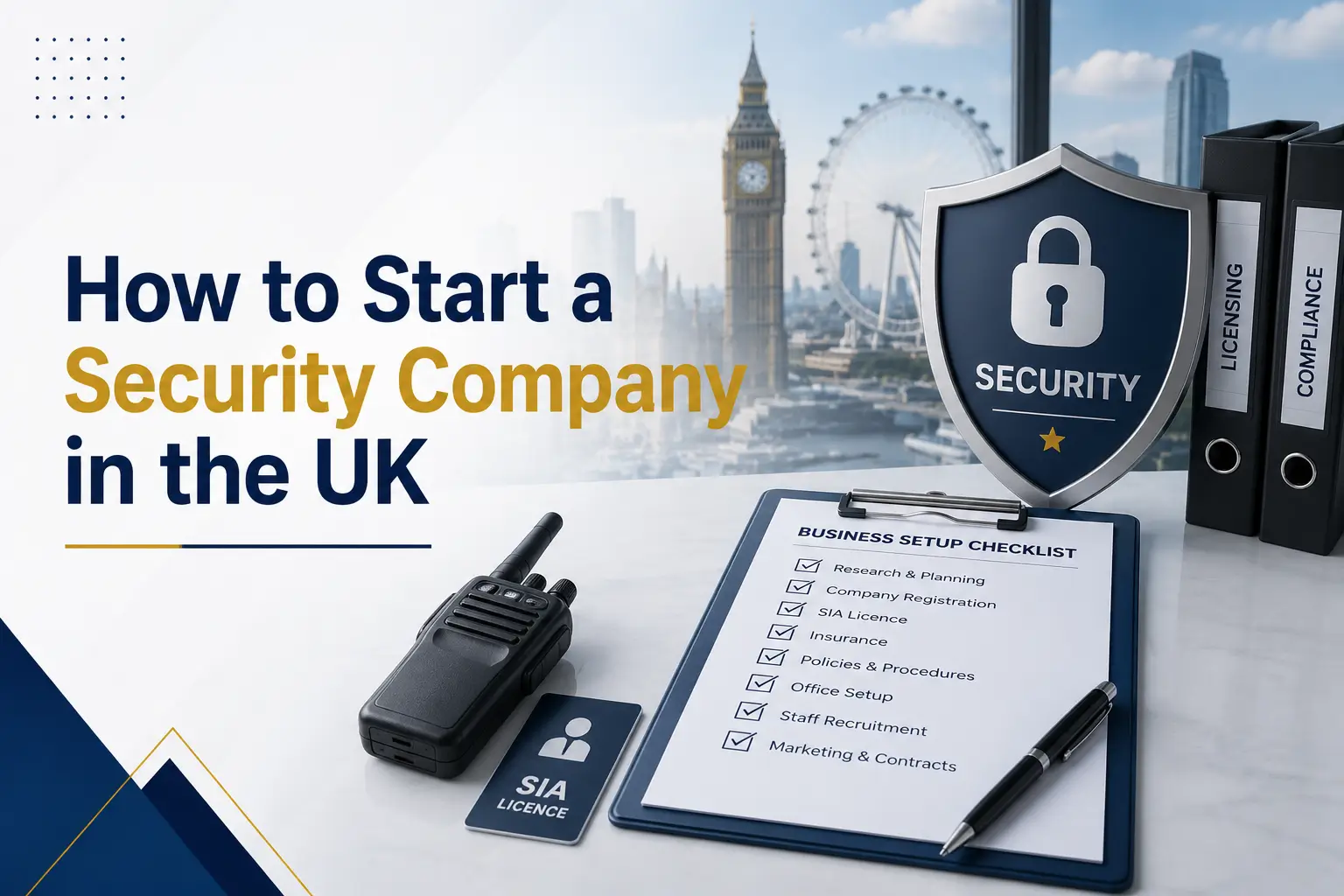
Starting a security company in the UK can be profitable, but only if you build it on compliance, structure, and credibility. The UK security industry is heavily regulated, and contracts are awarded based on trust, documentation, and proven systems, not just manpower.
Here’s a detailed step-by-step breakdown.
Step 1: Understand SIA Regulations and Legal Requirements
The Security Industry Authority (SIA) regulates the UK private security sector. If you provide services such as manned guarding, CCTV monitoring, door supervision, or close protection, your staff must hold valid SIA licences.
But it’s not just about individual licences.
As a business owner, you must:
- Ensure licence validity is monitored
- Maintain proper training records
- Verify identity and right-to-work documentation
- Keep up with SIA compliance updates
Failing to meet SIA requirements can lead to contract termination, fines, or even criminal charges.
Step 2: Register Your Security Company Properly (UK Setup)
In the UK security industry, buyers don’t just look at your manpower; they look at how professionally your business is structured. Proper registration builds credibility and makes your company eligible for procurement opportunities.
What you need to do:
- Choose the right business structure: Most security companies operate as a Limited Company, as it provides more credibility and scalability.
- Register with Companies House: This includes your company name, director details, registered address, and business classification.
- Select the correct SIC code: A common code is 80100 – Private security activities, but you should choose the one that matches your service.
- Open a business bank account: This keeps company finances clean and helps you manage payroll, VAT, and expenses properly.
- Set up accounting and tax processes: Register for Corporation Tax, arrange bookkeeping systems, and ensure payroll compliance if hiring staff.
Why it matters:
Many tenders and corporate clients immediately reject businesses that look informal or unstructured. A properly registered company creates trust and improves your chances of being taken seriously.
Step 3: Secure the Right Insurance Cover (Contract Qualification)
Insurance is not optional in the UK security sector. It is one of the first things procurement teams check, and many tenders fail at this stage.
Key insurance policies you typically need:
- Employers’ Liability Insurance (Legal requirement): Mandatory if you employ staff.
- Professional Indemnity Insurance (Recommended): Useful if you provide management services, consultancy, or advisory work.
- Vehicle or equipment cover (If applicable): Especially important for mobile patrol and key-holding operations.
What buyers check:
They review your insurance schedule, cover limits, expiry dates, and whether your policies meet contract requirements.
Insurance is not just protection; it is a major contract qualification factor.
Step 4: Recruit, Vet, Train, and Control Your Workforce (BS7858 + Evidence)
Security is a people-driven industry, but tenders and audits don’t just evaluate your staff; they evaluate your evidence.
Recruitment and screening requirements include:
- SIA licence verification: Ensuring licences are valid and monitored for expiry.
- Right-to-work checks: Documented evidence of eligibility to work in the UK.
- BS7858 screening (Highly recommended): A recognised standard for security staff screening.
- Employment history verification: Including explanation of any gaps.
- Criminal record checks (When required): Particularly for high-risk contracts.
Training and competence management should include:
- Induction training records
- Site-specific training and briefing logs
- Refresher training schedules
- Supervisor spot-check reports and performance monitoring
Why it matters:
ACS, ISO standards, and major buyers often request proof of competence. If your training and vetting evidence is incomplete, your business becomes high-risk in the eyes of procurement teams.
Step 5: Build Core Policies and Documentation (Not Generic Templates)
This is where most new security companies fail.
Having policies is not enough; they must reflect how your business actually operates.
Essential documents include:
- Health & Safety policy
- Risk assessments and method statements
- Incident reporting procedures and logs
- Assignment instructions (site-specific)
- Training matrix and training records
- Screening and vetting records
- Complaints handling procedure
- Equality and diversity policy
- GDPR / data handling procedures (where relevant)
Important:
Procurement evaluators can easily identify copy-and-paste documentation. They want policies that clearly show:
- Your company structure
- Your operational responsibilities
- How incidents are handled
- How supervision works
- How training and monitoring are controlled
Why it matters:
Tenders are not based on assumptions. They are based on evidence.
Step 6: Implement ISO Systems (9001 / 45001 / 14001) for Growth
ISO certification is one of the strongest credibility tools for security companies in the UK. It improves trust and increases your tender scoring.
ISO 9001 (Quality Management System)
Focus: Consistency, service delivery, and customer satisfaction.
In security, this applies to patrol performance, reporting standards, customer feedback, and corrective actions.
ISO 45001 (Health & Safety Management System)
Focus: Risk management and safety compliance.
For security companies, this includes lone working risks, conflict management, incident response, and emergency procedures.
ISO 14001 (Environmental Management System)
Focus: Environmental responsibility and sustainability.
Relevant areas include waste handling, vehicle usage, and compliance with client environmental expectations.
Why ISO matters:
ISO certification helps you achieve:
- Higher tender scores
- Stronger operational control
- Better internal systems
- Improved business reputation
- Increased contract opportunities
For growing security companies, ISO is often a turning point.
Step 7: Prepare for SIA ACS (Approved Contractor Scheme)
The SIA Approved Contractor Scheme (ACS) is one of the most respected accreditations in the UK security sector. Many buyers prefer ACS-approved contractors, and some contracts require it.
ACS evaluates key areas such as:
- Leadership and management involvement
- Workforce screening and competence
- Operational control and supervision
- Customer service and contract performance
- Compliance systems and continuous improvement
- Internal audits and evidence management
Common ACS failure reasons include:
- Missing evidence
- Policies not matching real operations
- Weak training and supervision records
- No internal audits or performance reviews
- Poor documentation structure
ACS is not passed by paperwork alone. It is passed through systems, evidence, and consistent business control.
Step 8: Become Tender-Ready (PQQ, SQ and Evidence Packs)
Security companies often lose bids not because they are incapable, but because they fail the documentation and compliance stage.
To become tender-ready, prepare:
- A professional company profile
- Insurance certificates and schedules
- Staff licence and screening evidence
- Risk assessments and method statements
- Compliance policies pack
- Organisational chart and management structure
- Accreditation certificates (ISO, ACS, CHAS, SMAS, etc.)
Tender reality:
Procurement teams do not interpret your intentions; they score your written evidence.
If your documents are unclear, inconsistent, or incomplete, your bid is treated as high-risk.
Step 9: Build Compliance Readiness as a System (Not a Last-Minute Fix)
Successful security companies do not panic before audits. They stay ready all year through structured systems.
Compliance readiness includes:
- Document control systems (version control, updates, approvals)
- Scheduled internal audits
- Corrective action logs (problems and solutions)
- Training refresh calendars
- Licence and screening trackers
- Incident review and improvement processes
- Management review meetings
Why it matters:
Audits and tenders are ongoing cycles. If compliance is only handled when deadlines arrive, the business remains unstable and vulnerable.
Real growth comes from building compliance into everyday operations.
Common Mistakes to Avoid
Many startups fail because they:
- Focus on hiring before building systems
- Delay ISO certification
- Ignore workforce screening standards
- Submit tenders with incomplete documentation
- Underestimate procurement scrutiny
Almost compliant is not compliant.
How BizGrow Holdings Supports Security Businesses?
At BizGrow Holdings, we help security entrepreneurs:
- Structure compliance from day one
- Achieve ISO 9001, 14001 & 45001 certification
- Prepare for SIA ACS approval
- Align documentation with UK procurement standards
- Improve contract win rates
We don’t just help you start a security company; we help you build a contract-ready operation.
Final Takeaway
Starting a security company in the UK requires:
- Licensing
- Insurance
- Workforce verification
- Structured documentation
- ISO systems
- Tender readiness
Capability wins clients. Compliance wins contracts.