If you are a contractor or business owner in the UK, health and safety accreditation is no longer something you can ignore.
More and more clients in construction, facilities management, education, social care, and the public sector now require proof of health and safety compliance before they will even let you tender for work. And one of the most widely respected ways to provide that proof is SMAS certification.
SMAS Worksafe is one of the UK’s leading health and safety accreditation schemes. It is recognised by thousands of clients across the country, and it is growing in popularity every year.
But what exactly is SMAS? What does it involve? How do you get it? And is it the right accreditation for your business?
At BizGrow Holdings, we help UK businesses navigate the accreditation process with confidence. Let us walk you through it.
What Is SMAS Accreditation?
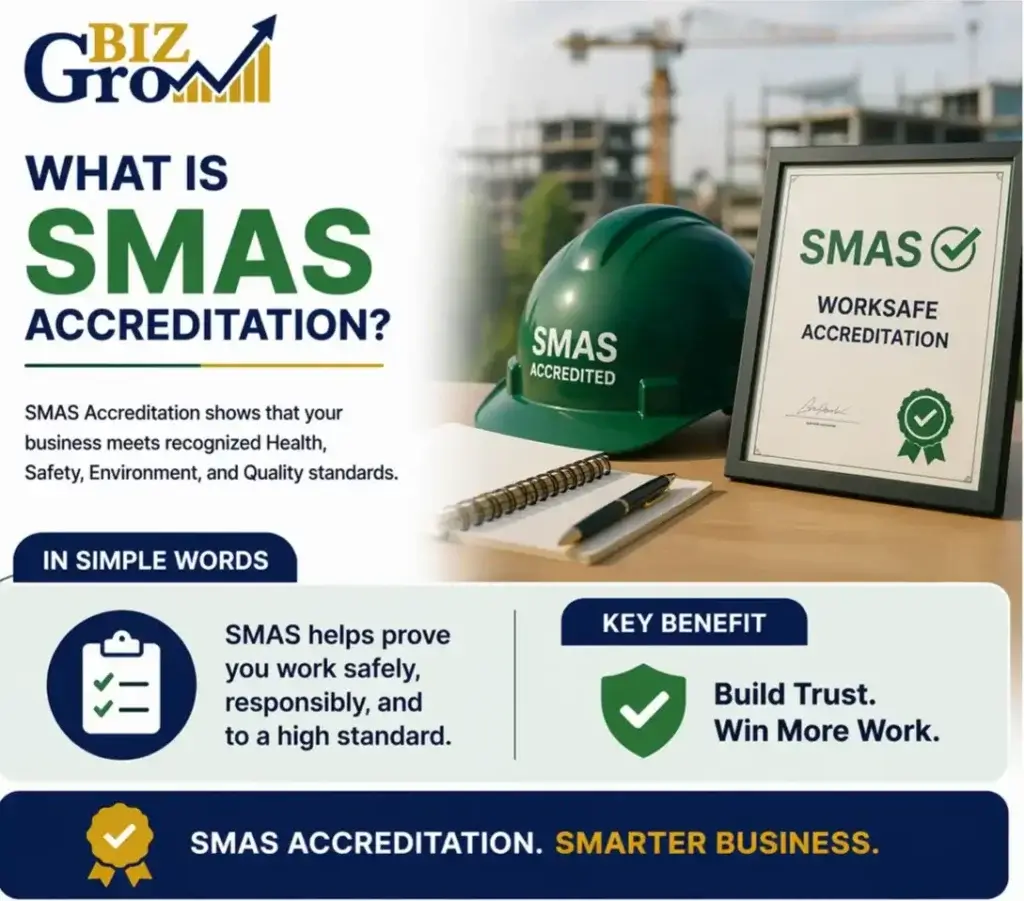
SMAS accreditation, or more precisely, SMAS Worksafe certification, is a nationally recognised health and safety accreditation scheme for UK contractors and businesses.
It demonstrates to clients, principal contractors, and procurement teams that your business has been independently assessed and meets the required standards for health and safety management.
SMAS was created to give buyers in the construction, facilities management, education, and social care sectors a reliable, consistent way to check that the contractors they work with operate safely and legally.
It is not a vague quality mark. The assessment is based on clear, defined criteria, the SSIP Core Criteria, which are aligned with the Health and Safety at Work Act 1974 and its associated regulations. Meeting these criteria means your business has documented policies, risk management processes, training records, and procedures that comply with UK health and safety law.
SMAS is accredited by UKAS, the United Kingdom Accreditation Service, to ISO 17020. That is the international standard for inspection bodies. It gives SMAS one of the highest levels of assurance available in the UK accreditation market.
Over 25,000 contractors are currently registered on the SMAS Worksafe database. The scheme is particularly popular with housebuilders over 45 of the UK’s largest housebuilding companies using the SMAS Contractor Portal to find and manage their supply chain.
What Does SMAS Stand For?
SMAS stands for Safety Management Advisory Services.
The certification product is called SMAS Worksafe, and this is the name you will most commonly see on certificates, portal listings, and procurement requirements.
You may also see it referred to as:
- SMAS accreditation the general term for holding any level of SMAS certification
- SMAS Worksafe, the specific accreditation product and certificate name
- SMAS SSIP referencing the SSIP framework that SMAS is part of
- SMAS Worksafe Plus is the intermediate level that adds environmental and quality management
- SMAS Worksafe Pro the highest level, covering the Common Assessment Standard
All of these refer to products delivered by SMAS Ltd, the organisation behind the scheme. When a client or tender requirement asks for SMAS accreditation, they are almost always referring to SMAS Worksafe or one of its higher tiers.
What Does a SMAS Certificate Mean?
A SMAS certificate means your business has been independently assessed by a qualified SMAS assessor and confirmed to meet the required health and safety standards.
It is a formal, dated document that:
- Confirms your business has a valid, signed, and relevant Health and Safety Policy
- Confirms you have appropriate Risk Assessments and Method Statements (RAMS) in place
- Confirms your staff are trained and competent for the work they carry out
- Confirms you have appropriate insurance cover in place
- Confirms your business has systems for recording and managing accidents and incidents
- Confirms you meet the SSIP Core Criteria as endorsed by the Health and Safety Executive (HSE)
The certificate is valid for 12 months. When you hold a valid SMAS certificate, you are listed on the SMAS Contractor Portal, visible to clients and principal contractors across the UK who use the portal to find and verify compliant subcontractors.
Holding an SMAS certificate also entitles you to mutual recognition across other SSIP member schemes. That means if a client requires CHAS, SafeContractor, or another SSIP accreditation, you can use your SMAS certificate to satisfy that requirement through a simplified Deem to Satisfy (DTS) process, saving time and avoiding duplicate applications.
Is SMAS an SSIP Accreditation?
Yes. SMAS Worksafe is a member scheme of SSIP Safety Schemes in Procurement.
SSIP is an umbrella framework endorsed by the Health and Safety Executive. It was created to standardise health and safety pre-qualification across UK industries, reducing the burden of repeated assessments for contractors and the administrative overhead for buyers.
All SSIP member schemes assess contractors against the same 15 SSIP Core Criteria.
These cover:
- Health and safety policy and management
- Risk assessments and method statements
- Staff training and competence
- Employer’s liability and public liability insurance
- Accident and incident reporting and investigation
- Health surveillance and welfare provision
- Subcontractor management
- Monitoring, review, and audit of health and safety systems
Because all SSIP schemes assess against the same core criteria, your SMAS Worksafe certificate is recognised by other SSIP members through the mutual recognition system. You do not need to resit a full assessment for each scheme. You simply show your SMAS certificate and apply via DTS at a reduced effort and investment.
Other SSIP member schemes include CHAS, SafeContractor, Constructionline, and SMAS, all operating under the same umbrella framework.
Who Needs SMAS Certification in the UK?
SMAS certification is suitable for any UK contractor or business that needs to demonstrate health and safety competence to clients or principal contractors.
It is particularly valued in:
- Construction from groundworks and bricklaying to electrical, mechanical, and specialist trades
- Facilities management and maintenance
- Education schools, colleges, and universities increasingly require SSIP certification from suppliers.
- Social care providers and housing associations often require it from contractors working on their premises.
- Housing and housebuilding SMAS is especially popular with residential developers and their supply chains
- Utilities and infrastructure
- Cleaning, landscaping, and other site-based service businesses
The question to ask yourself is simple: do your current or target clients ask for proof of health and safety accreditation before allowing you to tender or work on their sites? If the answer is yes or if you want to be able to say yes confidently, SMAS certification is for you.
SMAS is open to businesses of all sizes. You do not need to be a large company to apply. Sole traders, small contractors, and growing businesses can all benefit from SMAS accreditation.
What You Need to Get SMAS Certified
Before you apply, you need to have certain documents and systems in place. The SMAS assessment covers 15 questions based on the SSIP Core Criteria. Here is what you need to prepare:
Health and Safety Policy
You must have a written Health and Safety Policy that is signed and dated by a senior person in your business, typically the director or owner. It must be relevant to your actual operations and reviewed regularly.
A generic, downloaded policy that does not reflect your work activities will not pass. The policy needs to be tailored to what your business actually does, the hazards you face, the controls you have in place, and the responsibilities of your staff.
Risk Assessments and Method Statements
You need Risk Assessments and Method Statements (RAMS) relevant to your work activities. These must identify the hazards involved in your type of work, assess the risk they present, and describe the controls you have in place to manage those risks.
Your RAMS must be specific to your actual activities, not generic documents. If you carry out multiple types of work, you will need RAMS for each significant activity.
Insurance Documents
You must hold Employer’s Liability Insurance and Public Liability Insurance, and both certificates must be current at the time of application. Expired insurance certificates are an automatic failure.
Make sure your insurance documents clearly show your company name, the level of cover, and the expiry date. Your assessor will check that these are valid.
Training and Competence Records
You need to demonstrate that your staff are appropriately trained and competent for the work they carry out. This includes:
- Records of induction training for all staff
- Trade qualifications and professional certifications, such as CSCS cards, in construction
- Any licence-specific training relevant to your activities
- Records of toolbox talks and ongoing safety training
- Records of any specialist training required for specific tasks
The key is evidence. It is not enough to say your staff are trained, you need records that prove it.
Accident and Incident History
You need a system for recording accidents, near misses, and incidents and records of any that have occurred. SMAS assessors expect to see three years of accident and incident history.
If you have had no accidents in three years, that is fine, but you still need to be able to demonstrate that the recording system exists and is actively maintained.
You should also be able to show how you investigate incidents and implement corrective actions when something goes wrong.
How to Apply for SMAS | Step by Step
Step 1: Prepare Your Documents
Gather all the documents listed above before you start the application. Make sure your Health and Safety Policy is current and relevant. Confirm your insurance certificates are valid. Check your RAMS are up to date and specific to your work activities. Having everything ready before you start saves significant time during the application.
Step 2: Register on the SMAS Worksafe Portal
Go to the official SMAS Worksafe website and create a company account. You will enter basic details about your business name, address, company registration number, number of employees, and the type of work you carry out.
The SMAS portal is designed to show you only the questions relevant to your type of business. You will not be asked about activities that do not apply to you. This keeps the process focused and avoids unnecessary complexity.
Step 3: Complete the Online Assessment
Work through the 15 assessment questions based on the SSIP Core Criteria. Each question relates to a specific area of health and safety management. Answer each question honestly and accurately based on your actual systems and documents.
If you are unsure about any question, SMAS assessors are available by phone and email during working hours to help you understand what is required. This direct access to assessors is one of the genuine advantages of SMAS over some other schemes.
Step 4: Upload Your Evidence
After completing the questionnaire, upload your supporting documents directly to the SMAS portal. This includes your Health and Safety Policy, RAMS, insurance certificates, training records, and accident history.
Make sure everything is clearly labelled and easy to review. Clear, well-organised documentation makes the assessor’s job easier and tends to speed up the process.
Step 5: Assessor Review
A qualified SMAS assessor reviews your submission. They will check that your questionnaire answers are consistent with your uploaded documents and that everything meets the SSIP Core Criteria.
SMAS’s first-time pass rate is an impressive 93%. Businesses that are well-prepared with complete, accurate documentation almost always pass the first time. If the assessor identifies any issues, they will contact you to clarify or request additional information before making a decision.
Step 6: Receive Your Certificate
Once approved, you receive your SMAS Worksafe certificate valid for 12 months. You are added to the SMAS Contractor Portal, where clients can find and verify your certification. You can use the SMAS logo on your website, marketing materials, tenders, and company vehicles.
How Long Does SMAS Take?
The timeline depends on how ready your documents are when you apply.
- Well-prepared businesses with all documents ready: 1 to 3 working days
- Typical timeline for most applicants: 1 to 7 working days
- First contact from an assessor: within 7 working days of submission
- A 24-hour fast-track service is also available if you need certification urgently
Preparation is the biggest factor. Businesses that start the application with everything in order get their certificate in days. Those who start without complete documents spend longer going back and forth with their assessor.
At BizGrow Holdings, we review your documents before you apply, so when you submit, you submit with confidence.
SMAS vs CHAS vs SafeContractor | Which Do You Need?
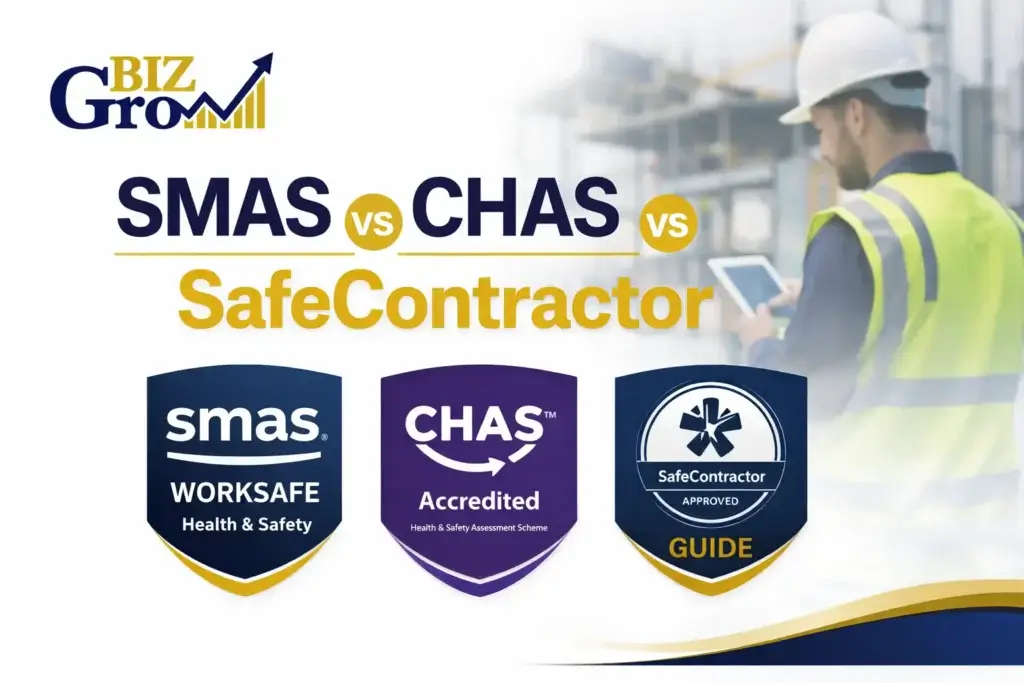
All three are SSIP member schemes. All three assess against the same SSIP Core Criteria. So what is the difference, and which one is right for you?
SMAS Worksafe
SMAS is particularly well-established in construction, housebuilding, education, and social care. It is known for fast turnaround, direct access to assessors, fair and transparent pricing regardless of company size, and a strong portal presence with major housebuilders. Over 25,000 contractors are registered.
SMAS is widely described as straightforward and well-balanced, a strong, all-round SSIP accreditation that works for businesses of all sizes.
CHAS
CHAS is the UK’s largest and most widely recognised SSIP scheme, with over 70,000 registered contractors. It is particularly strong in the public sector, the NHS, and local authority work. CHAS also offers higher tiers, including the Common Assessment Standard, making it a viable route for businesses targeting public sector frameworks.
If your target clients are primarily in the public sector or if you want the broadest possible recognition, CHAS is the strongest choice. However, for construction and housebuilding specifically, SMAS often has the stronger portal presence with the right buyers.
SafeContractor
SafeContractor is popular with private sector clients and local authorities. It also covers broader areas beyond health and safety, including diversity and equality, environmental management, data protection, and anti-bribery. This makes it attractive to clients who want a more comprehensive pre-qualification check beyond pure H&S.
Over 33,000 contractors are registered, and it is used by over 400 major clients. It tends to be preferred by facilities management clients and property managers.
Which One Should You Choose?
The honest answer is: it depends on who your clients are. Check what your existing and target clients specifically ask for. If they use the SMAS portal, get SMAS. If they require CHAS, get CHAS. Because of SSIP mutual recognition, once you hold one accreditation, getting others is significantly simpler and more affordable through the Deem to Satisfy process.
Many businesses hold two or more SSIP accreditations. This is common and smart; it opens doors with different client types without the burden of repeated full assessments.
Benefits of SMAS Accreditation
Here are the practical, real-world benefits of holding SMAS Worksafe certification:
- Win more tenders, clients who require SSIP accreditation will consider you; without it, they often will not
- Portal visibility: you appear in the SMAS Contractor Portal, used by over 45 major housebuilders and thousands of other buyers
- Save time on pre-qualification; your SMAS certificate answers many standard H&S questions in tender documents automatically.
- Mutual recognition: Use your SMAS certificate to satisfy CHAS, SafeContractor, and other SSIP requirements via DTS.
- Improve your internal H&S. The certification process itself drives improvements in your documentation and systems.
- Demonstrate professionalism, clients trust SMAS-accredited businesses more than uncertified competitors.
- Staff confidence that your team knows you take their safety seriously, which supports recruitment and retention
- Insurance and liability proper H&S systems reduce incident risk and support your insurance position.
How to Renew Your SMAS Certificate
SMAS certification is valid for 12 months. You must renew annually to maintain your approved status on the portal and your recognition by clients.
The renewal process follows the same steps as the initial application, but it is faster. SMAS’s smart portal retains up to 60% of your previous application information, which significantly reduces the time spent on renewal.
Key renewal tips:
- Start your renewal process at least 4 to 6 weeks before your certificate expires
- Update your Health and Safety Policy annually; do not wait until renewal to review it
- Keep your training records and accident logs maintained throughout the year
- Ensure your insurance certificates are renewed before your SMAS renewal date
- If your business or work activities have changed, update your RAMS before renewing
If your certificate lapses, you lose your listed status on the SMAS portal and your ability to present a valid certificate to clients. Avoid this by treating renewal as a calendar commitment, not an afterthought.
How BizGrow Holdings Helps You Get SMAS Certified
Applying for SMAS Worksafe certification is straightforward, but getting it right the first time requires proper preparation. Many businesses submit applications with incomplete or outdated documents and face delays or rejections that could easily have been avoided.
BizGrow Holdings provides end-to-end support for UK businesses pursuing SMAS and other SSIP accreditations. We know exactly what assessors look for, and we make sure your application is complete, accurate, and submission-ready before you submit it.
Here is what we do:
- Document review, we check your Health and Safety Policy, RAMS, insurance, and training records against SMAS requirements
- In a gap analysis, we identify what is missing or needs updating before you apply
- Policy and RAMS development, we help you create or update documents that meet the assessment standard
- Application support, we guide you through the SMAS portal and help you complete the questionnaire accurately
- Evidence organisation, we help you prepare and present your supporting documents clearly
- Multi-scheme planning, we advise on whether SMAS, CHAS, SafeContractor, or a combination is right for your business and clients
- Renewal management, we help you stay on top of annual renewal so your certification never lapses.
We have helped businesses across construction, facilities management, cleaning, maintenance, and other sectors achieve SMAS Worksafe certification, many of them for the first time, within days.
If you want to get SMAS certified without the uncertainty of doing it alone, the BizGrow Holdings team is here to help. Visit bizgrow-holdings.com to get started today.
Conclusion | Start Your SMAS Journey Today
SMAS Worksafe certification is one of the most practical investments a UK contractor can make. It opens the door to tenders you cannot currently access. It gives clients the assurance they need to choose you. And it drives real improvements in your health and safety systems.
In 2026, the number of clients requiring SSIP accreditation as a minimum condition for working with them continues to grow. Businesses without certification are being left behind, not because they are unsafe, but because they cannot prove they are safe.
SMAS makes that proof simple, credible, and recognised across the UK.
Start your application today. And if you want expert support to get it right the first time, BizGrow Holdings is ready to help. Visit bizgrow-holdings.com now.
FAQs About SMAS Certification in the UK
1. Is SMAS free to apply for?
No. SMAS Worksafe requires an annual certification investment, which varies by company size and the level of accreditation you choose. Get in touch with BizGrow Holdings at bizgrow-holdings.com for guidance on what is right for your business.
2. Can sole traders apply for SMAS?
Yes. SMAS is open to businesses of all sizes, including sole traders and self-employed contractors. The assessment is scaled to your business; you will only be assessed on what is relevant to your size and type of work.
3. How long is the SMAS certification valid?
SMAS Worksafe certification is valid for 12 months. You must renew annually to maintain your listed status on the SMAS portal and keep your certificate current for client and tender requirements.
4. Is SMAS recognised by main contractors?
Yes. SMAS is widely recognised by main contractors, developers, and principal contractors across construction, housebuilding, facilities management, education, and social care. Over 45 of the UK’s largest housebuilders use the SMAS Contractor Portal directly.
5. Do I need SMAS if I already have CHAS?
Not necessarily. Because both CHAS and SMAS are SSIP members, you can use your CHAS certificate to satisfy SMAS requirements through the Deem to Satisfy (DTS) process, and vice versa. However, if your clients specifically use the SMAS portal, holding SMAS directly gives you better visibility with them.