If you run a business in the UK, you have probably heard the words “internal audit” and “external audit” many times. But do you really know what they mean? And more importantly, do you know which one your business needs in 2026?
Many business owners get confused between these two types of audits. They sound similar, but they are very different in terms of purpose, process, and results. Understanding the difference between internal audit and external audit can help you make better decisions for your business, stay compliant with regulations, and avoid costly mistakes.
In this article, BizGrow Holdings breaks it all down in simple words so you can fully understand both types of audits and how they can benefit your business this year.
What Is an Internal Audit?
An internal audit is a check that happens inside your own organisation. It is done by someone from within your company or by a consultant hired to act as an internal auditor on your behalf.
The main goal of an internal audit is to look at how well your business is running. It checks if your processes, systems, and controls are working properly. It also helps identify risks before they become big problems.
Think of it like a health check for your business. You are not doing it because someone forced you; you are doing it to improve yourself.
Key Features of an Internal Audit:
- Done by internal staff or a hired consultant
- Focuses on improving operations and managing risks
- Not required by law in most cases (but often required for ISO certification)
- Results are shared with management, not the public
- Can be done at any time throughout the year
- Follows your organisation’s own goals and priorities
Internal audits are very common in businesses that hold certifications like ISO 9001, ISO 14001, and ISO 45001. These standards actually require regular internal audits to make sure the management system is working as intended.
At BizGrow Holdings, we help businesses carry out professional internal audits as part of our compliance consultancy services, making sure you are always prepared and always improving.
What Is an External Audit?
An external audit is a check carried out by someone from outside your organisation, usually an independent auditing company or a certification body. This auditor has no connection to your business, which makes their review completely independent and unbiased.
The most well-known type of external audit is the statutory financial audit, which many limited companies in the UK are legally required to have. But external audits also happen in the world of certifications..
Key Features of an External Audit:
- Done by a qualified, independent third party
- Legally required in many cases (especially for large companies)
- Focuses on financial accuracy, legal compliance, and certification standards
- Results may be shared with shareholders, investors, regulators, or certification bodies
- Usually happens once or twice a year
- Must follow strict national or international standards
External audits give confidence to the outside world, your clients, your investors, and your regulators that your business is doing things the right way.
Internal Audit vs External Audit: Key Differences in 2026
Now that you understand both types, let’s look at the main differences side by side. This is where most business owners get confused, so we’ll keep it as simple as possible.
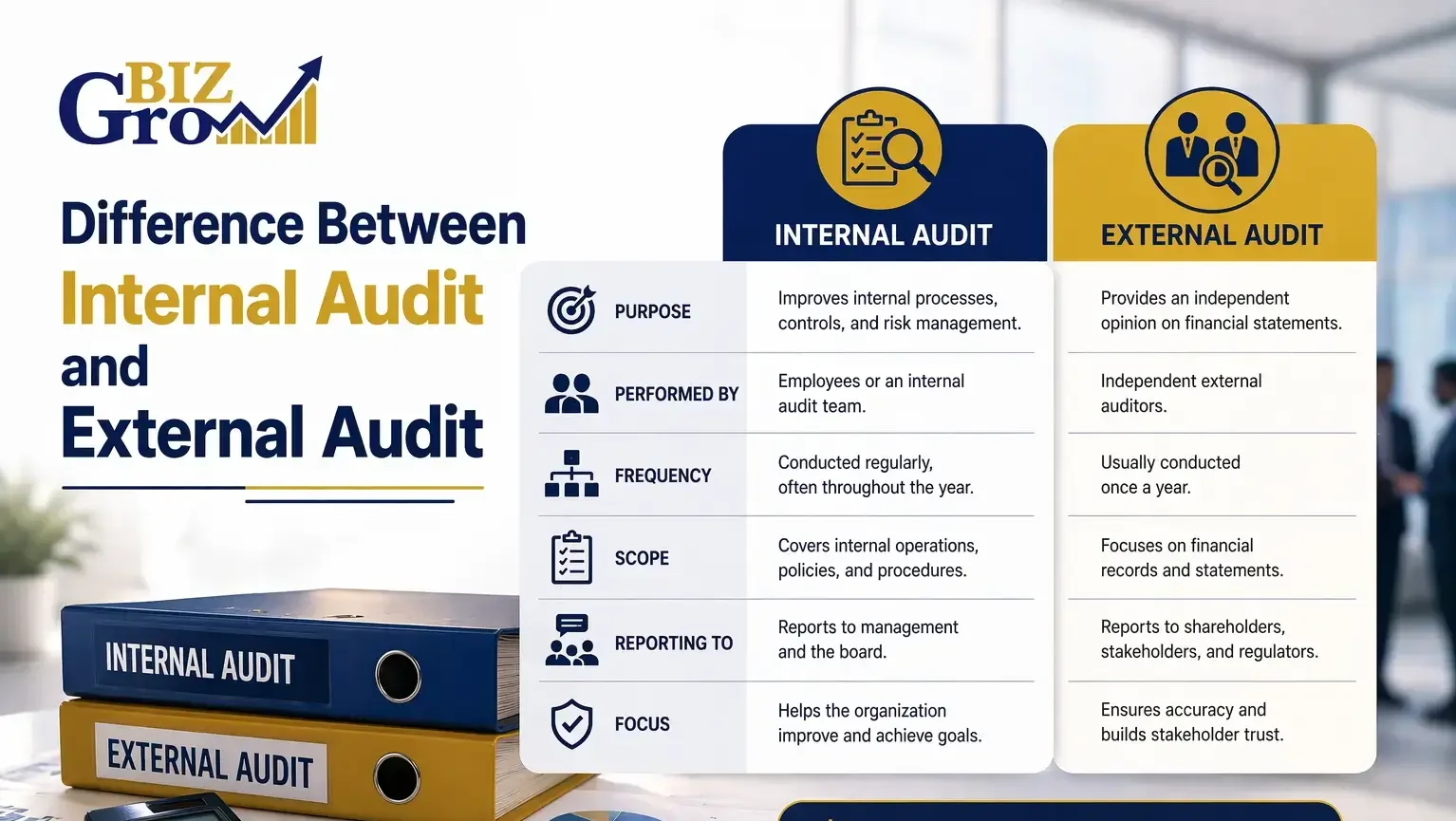
1. Who Carries Out the Audit?
Internal Audit: Done by your own staff or an external consultant acting on your behalf (like BizGrow Holdings).
External Audit: Done by a completely independent third-party auditor or certification body.
2. What Is the Main Purpose?
Internal Audit: To find problems, improve processes, reduce risks, and prepare your business for external audits.
External Audit: To give an independent opinion on whether your business meets legal, financial, or certification standards.
3. Is It a Legal Requirement?
Internal Audit: Not always legally required, but it is required for ISO standards and many other accreditations like SIA ACS, CHAS, and SafeContractor.
External Audit: Often legally required, especially financial audits for larger UK companies under the Companies Act 2006. Also required to gain or maintain ISO certification.
4. Who Sees the Results?
Internal Audit: Results stay within the organisation. They go to management and are used to make improvements.
External Audit: Results may be shared with shareholders, regulators, certification bodies, or even the public in some cases.
5. How Often Does It Happen?
Internal Audit: Can be done at any time. Many businesses do them quarterly or before a big external audit.
External Audit: Usually once or twice a year, depending on legal requirements or certification cycles.
6. What Does It Focus On?
Internal Audit: Operations, risk management, process efficiency, staff compliance, and system performance.
External Audit: Financial statements, regulatory compliance, or conformance to a specific standard (like ISO 9001).
7. What Is the Outcome?
Internal Audit: A report with findings and recommendations for improvement used internally to fix issues.
External Audit: A formal certificate, audit opinion, or compliance report used to prove your credibility to the outside world.
Why Are Both Audits Important for UK Businesses in 2026?
In 2026, compliance is no longer optional for UK businesses, especially in the private security sector, construction, and facilities management industries. Clients, regulators, and contracting bodies are now demanding higher levels of transparency and accountability.
Here is why having both internal and external audits matters:
Internal audits keep you ready. If you regularly audit your own systems, you will catch problems before an external auditor finds them. This reduces the risk of failing a certification audit, which can be costly and damaging to your reputation.
External audits build trust. When you hold a recognised certificate such as ISO 9001, ISO 45001, or SIA ACS, it tells your clients and partners that an independent expert has verified your business. This gives you a massive competitive advantage when bidding for contracts.
Together, they create a cycle of continuous improvement. Internal audits help you improve, and external audits confirm that you have improved. This cycle is exactly what standards like ISO 9001 are built on.
Common Mistakes Businesses Make with Audits
Many businesses make the mistake of only thinking about audits when they have to, usually just before a certification renewal or a client visit. This is the wrong approach.
Here are some common mistakes to avoid:
Skipping internal audits between external audits. If you only audit when required, problems build up over time and become harder to fix.
Not training staff on what auditors look for. Your team needs to understand the standards your business is measured against.
Treating audits as a box-ticking exercise. Audits should drive real improvement, not just paperwork. If you treat them seriously, they will make your business genuinely stronger.
Hiring unqualified internal auditors. A poor internal audit gives you a false sense of security. It is always better to work with experienced consultants who know the standards inside out.
How BizGrow Holdings Can Help Your Business in 2026
At BizGrow Holdings, we specialise in helping UK businesses, especially in the private security sector, to achieve and maintain their compliance certifications. Our internal audit service is designed to prepare you for external audits, identify gaps in your management system, and keep your business performing at its best.
Whether you need an internal audit for ISO 9001, ISO 14001, ISO 45001, SIA ACS, CHAS, SafeContractor, or BS 10800, our experienced consultants will carry out a thorough, professional review and give you a clear action plan to move forward.
We do not just find the problems; we help you fix them.
Our team has years of experience working with businesses across the UK, and we understand the pressures that come with maintaining multiple accreditations while running a growing business. That is why we make the audit process as simple and stress-free as possible for you.
Final Thoughts
Understanding the difference between internal audit and external audit is essential for any business that takes compliance seriously in 2026. Both types of audits serve different purposes, but they work best when used together as part of a strong quality management system.
Internal audits help you continuously improve from the inside. External audits prove to the world that you meet the highest standards. Together, they protect your business, build your reputation, and help you win more contracts.
If you are not sure where to start or you need expert support with your internal audit process, BizGrow Holdings is here to help. Get in touch with our team today and let us help you stay compliant, competitive, and confident in 2026.