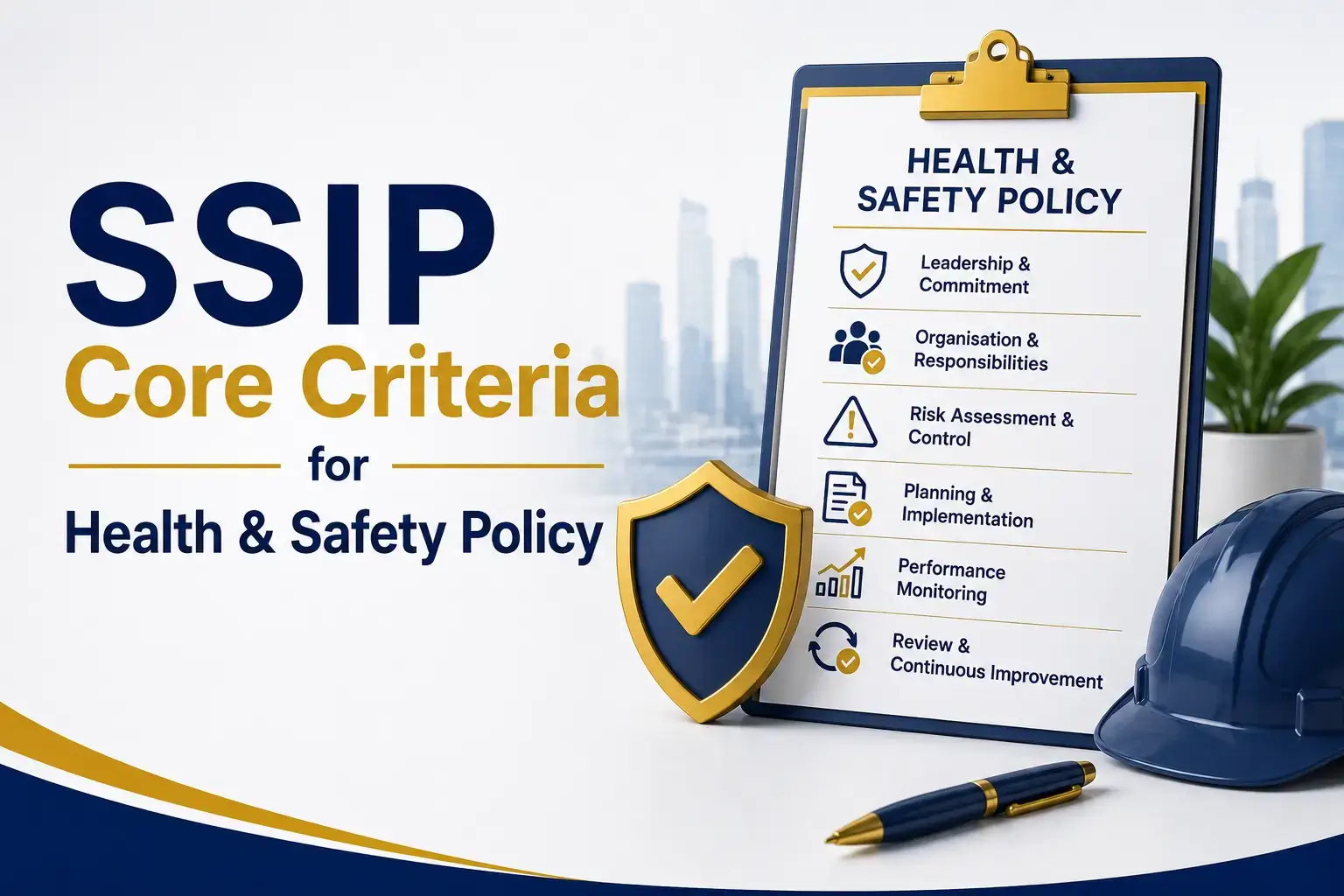
For many UK contractors and service providers, health and safety is not just a legal duty. It is also a key part of winning work.
Many clients, main contractors, councils, and larger organisations want to see that your business can work safely before they allow you on site. This is where the SSIP Core Criteria become important.
SSIP stands for Safety Schemes in Procurement. It helps create a common health and safety standard across different assessment schemes. The HSE explains that SSIP supports mutual recognition between health and safety assessment schemes, especially in construction and related industries.
In simple words, SSIP helps reduce repeated checks. Instead of proving your health and safety standards again and again, you can show that your business has already been assessed against recognised criteria.
For UK businesses, this can make the tender process smoother. It can also help build trust with clients.
In this blog, we will explain the SSIP Core Criteria in easy words. We will focus mainly on the health and safety policy part. You will also learn what evidence may be required, common mistakes to avoid, and how BizGrow Holdings can support your compliance journey.
What Are the SSIP Core Criteria?
The SSIP Core Criteria are the basic health and safety standards used by SSIP member schemes. These criteria help assess whether a business has suitable systems in place to manage health and safety.
They are used by many recognised schemes in the UK. These may include schemes linked with SSIP certification, SSIP accreditation, contractor approval, and health and safety pre-qualification.
The official SSIP website states that the Core Criteria apply to SSIP-approved organisations and CDM duty holders under relevant construction regulations.
In simple terms, the criteria check whether your business can show that:
- You understand your health and safety duties.
- You have a clear health and safety policy.
- You manage workplace risks properly.
- Your workers are trained and competent.
- You keep records and evidence.
- You review your safety arrangements.
The aim is not only to have documents. The aim is to prove that your business actually follows safe working practices.
This is very important for UK contractors. Many clients want suppliers who can show proper health and safety management before work begins.
Why SSIP Core Criteria Matter for UK Businesses
The SSIP Core Criteria matter because they help show that your business takes health and safety seriously.
In the UK, businesses have legal duties under health and safety law. Employers must protect employees, subcontractors, visitors, and others affected by their work. SSIP assessment helps check that your business has the right arrangements in place.
UKAS also explains that SSIP supports health and safety competence in the UK construction sector through a robust assessment approach.
For many businesses, SSIP is also linked to growth. This is because many buyers prefer working with contractors who have already passed recognised health and safety checks.
SSIP may help your business when applying for:
- Construction projects
- Facilities management contracts
- Council tenders
- Private sector contracts
- Larger supply chain opportunities
- Maintenance and installation work
- Security and site-based services
It also helps clients feel more confident. They can see that your business has been checked against recognised health and safety standards.
This does not mean SSIP replaces good safety management. It means your safety systems are reviewed and presented in a structured way.
For small businesses, this can feel difficult at first. But once your documents are organised, the process becomes much easier.
Health & Safety Policy Requirements Under SSIP Core Criteria
Your health and safety policy is one of the most important documents in an SSIP application.
It tells assessors how your business manages health and safety. It also shows your commitment to protecting people.
A good health and safety policy should not be copied from a random template. It should match your real business activities.
For example, a cleaning company, a private security company, a building contractor, and an electrical contractor will all have different risks. Their policies should reflect those risks.
Most health and safety policies include three main parts:
- Statement of intent
- Roles and responsibilities
- Arrangements for managing health and safety
Let’s look at each part in more detail.
Clear Statement of Intent
The statement of intent is the opening part of your health and safety policy.
It explains your company’s commitment to health and safety. It should clearly show that your business wants to provide a safe workplace and reduce risks.
This section should be simple and direct.
It should usually include commitments such as:
- Protecting employees and others
- Following UK health and safety law
- Providing training and supervision
- Managing workplace risks
- Reviewing health and safety performance
- Keeping safe systems of work in place
The statement should be signed by a senior person in the business. This may be the director, owner, managing director, or another responsible person.
It should also be dated.
This matters because SSIP assessors want to see that the policy is current. An old, unsigned, or undated policy may create problems.
A common mistake is using a generic statement that does not mention the company’s real work. This can make the policy look weak.
For example, if your company works on client sites, your policy should mention site safety, risk control, and cooperation with clients where relevant.
The statement of intent should be short. But it should be meaningful.
It should show leadership commitment, not just tick a box.
Defined Roles and Responsibilities
The second part of the policy should explain who is responsible for health and safety in your business.
This is very important under the SSIP Core Criteria because assessors need to see clear accountability.
If responsibilities are not clear, safety tasks may be missed.
Your policy should explain the duties of key people, such as:
- Business owner or director
- Health and safety manager
- Supervisors
- Site managers
- Employees
- Subcontractors
For small businesses, one person may have several roles. That is fine. But the policy should still explain who does what.
For example, the director may be responsible for reviewing the policy, providing resources, and making sure legal duties are met.
Supervisors may be responsible for checking work areas, reporting hazards, and making sure workers follow safe procedures.
Employees may be responsible for following training, using equipment safely, and reporting unsafe conditions.
This section should be practical. It should not be too complicated.
The main purpose is to show that health and safety are managed properly at every level.
For SSIP approval, vague wording can weaken your application. For example, saying “everyone is responsible for safety” is not enough on its own. You should explain specific duties.
Clear responsibilities help assessors understand how your business controls risk in daily work.
Arrangements for Managing Health and Safety
The arrangements section is usually the most detailed part of the policy.
This section explains how your business actually manages health and safety.
It should connect your policy to real actions.
Under the SSIP Core Criteria, assessors often want to see that your arrangements are suitable for your business activities. SafeContractor notes that SSIP requirements can cover areas such as health and safety policy, risk assessments, competent advice, insurance, training, qualifications, and health and safety history.
Your arrangements may include:
- Risk assessments
- Method statements
- Training
- Accident reporting
- Emergency procedures
- PPE
- Equipment checks
- COSHH management
- Manual handling
- Fire safety
- First aid
- Monitoring and review
- Subcontractor control
You do not need to make this section overly complex. But it should be clear.
For example, if your workers visit client sites, your arrangements should explain how they receive site instructions, follow client rules, and report hazards.
If your business uses subcontractors, you should explain how you check their competence and safety standards.
If your team uses tools, machinery, vehicles, chemicals, or access equipment, your arrangements should explain how risks are controlled.
The best health and safety policies are not full of difficult words. They are easy to understand and easy to follow.
That is what assessors want to see.
What Evidence Do You Need for SSIP Approval?
A health and safety policy is important. But it is only one part of the evidence.
SSIP assessors usually want to see supporting documents. These documents prove that your policy is actually used in the business.
The evidence you need can depend on your business type, size, work activities, and the SSIP scheme you apply through.
However, common evidence may include:
- Signed health and safety policy
- Risk assessments
- Method statements
- Training records
- Insurance documents
- Accident reporting records
- Competent advice details
- Employee certificates
- Equipment inspection records
- Fire safety arrangements
- PPE records
- Subcontractor checks
- Health and safety review records
Constructionline’s SSIP guidance says assessors require evidence to meet the SSIP Core Criteria.
This is why documentation matters.
Many businesses fail or face delays because their documents are incomplete. Sometimes the business may be working safely, but the evidence does not show it clearly.
For example, you may train your staff, but if you do not keep training records, it becomes hard to prove.
You may complete risk assessments, but if they are generic and not related to your actual work, they may not be accepted.
Your documents should be:
- Current
- Clear
- Signed where needed
- Relevant to your work
- Easy to understand
- Consistent with each other
This is important. Your health and safety policy, risk assessments, method statements, and training records should all match.
If your policy says you review risk assessments every year, your records should show that reviews happen.
If your policy says workers receive PPE, your evidence should show how PPE is issued and checked.
Small details can make a big difference in SSIP applications.
Common Mistakes in Health & Safety Policies
Many UK businesses struggle with SSIP because their health and safety policy is not strong enough.
The problem is not always the work itself. Often, the issue is poor documentation.
Here are some common mistakes.
Using a Generic Template
Templates can be helpful. But a copied policy can create problems.
If the policy does not match your real business, assessors may question it.
For example, a security company should not use a policy written for a building contractor. A cleaning company should not use a policy written for an electrical firm.
Your policy should reflect your actual services, risks, and work environment.
No Signature or Date
A health and safety policy should be signed and dated by a responsible person.
This shows management commitment. It also shows that the policy is current.
An unsigned policy can look unfinished.
Outdated Information
If your company details, staff roles, or work activities have changed, your policy should be updated.
Old policies can create confusion.
You should review your policy regularly, especially if your business changes.
No Clear Responsibilities
Some policies do not explain who is responsible for what.
This is a major issue.
SSIP assessors want to see clear roles. They want to know who manages safety, who supervises work, and who reports issues.
Weak Arrangements Section
Some policies include a strong statement of intent but very little detail about arrangements.
This makes the policy incomplete.
You need to show how health and safety are managed in practice.
Documents Do Not Match
Your policy should match your other evidence.
If your policy says one thing but your risk assessments say something different, this may cause delays.
Consistency is important.
Not Linked to Real Work
A strong policy should connect to your actual activities.
If your workers operate on client sites, use tools, drive vehicles, handle chemicals, or manage public-facing duties, your policy should reflect this.
SSIP is not about writing fancy words. It is about providing safe management.
How BizGrow Holdings Can Support Your SSIP Compliance
Preparing for SSIP can feel confusing, especially if you are applying for the first time.
You may not know what documents are needed. You may also be unsure whether your health and safety policy is suitable.
This is where BizGrow Holdings can help.
At BizGrow Holdings, we support UK businesses with compliance, documentation, and business improvement services. We aim to make complex compliance requirements easier to understand and easier to manage.
For SSIP-related support, BizGrow Holdings can help you review and improve key documents such as:
- Health and safety policy
- Risk assessments
- Method statements
- Compliance documents
- Internal procedures
- Supporting evidence
- Training and responsibility records
We help businesses understand what assessors may look for. We also help make documents clearer, more organised, and more relevant to the company’s real work.
This can be helpful for businesses in sectors such as:
- Private security
- Construction support services
- Facilities management
- Cleaning services
- Maintenance services
- Startups and growing companies
- Service-based contractors
BizGrow Holdings focuses on practical support. That means easy wording, structured documents, and a clear process.
We do not believe compliance should feel overwhelming. It should help your business work better, stay safer, and build client confidence.
When your documents are properly prepared, your business looks more professional. It also becomes easier to respond to client requests, tender requirements, and health and safety checks.
If you are planning to apply for the SSIP certification in the UK, or you want to improve your health and safety policy before submission, BizGrow Holdings can guide you through the process.
The cost of poor preparation can be delays, stress, and missed opportunities. That is why having the right support matters.
Final Thoughts on SSIP Core Criteria
The SSIP Core Criteria are an important part of health and safety assessment for many UK businesses.
They help clients see that your company has suitable safety systems in place. They also help your business organise its documents and responsibilities.
Your health and safety policy is one of the key parts of this process.
A strong policy should include:
- A clear statement of intent
- Defined responsibilities
- Practical safety arrangements
- Relevant supporting evidence
- Regular review and updates
It should not be long for the sake of being long. It should be clear, useful, and connected to your real work.
For UK contractors and service providers, SSIP can help build trust. It can also support tender applications and client approval processes.
If your business wants to improve its health and safety documents, BizGrow Holdings can help you prepare with confidence.
With the right guidance, SSIP compliance becomes easier to understand. It also becomes easier to manage.
Frequently Asked Questions
1. What are the SSIP Core Criteria?
SSIP Core Criteria are common health and safety standards used by SSIP member schemes.
They help check if a business manages safety properly.
2. Why is a health and safety policy needed for SSIP?
It shows your company’s commitment to safety, roles, and arrangements.
Assessors use it to understand how you manage risks.
3. Who needs SSIP accreditation in the UK?
Many contractors, suppliers, and service providers need it for client approval.
It is common in construction and site-based work.
4. Can a small business apply for SSIP?
Yes, small businesses can apply if they have suitable safety documents.
The evidence should match their size and work activities.
5. Can BizGrow Holdings help with SSIP documents?
Yes, BizGrow Holdings can support UK businesses with SSIP documentation.
We help make policies and evidence clear, organised, and relevant.