How BizGrow Holdings Supports Businesses with SIA Inspection Preparation
Getting through an SIA inspection is one of the most important milestones a UK security company can achieve. But for many businesses, it is also one of the most stressful.
The self-assessment workbook runs to 92 pages. The seven criteria cover 78 individual performance indicators. And the consequences of being unprepared a failed inspection, a delayed approval, or a missed contract and are real and costly.
That is exactly what BizGrow Holdings (bizgrow-holdings.com) is here to prevent.
We provide specialist SIA ACS consulting support for UK security businesses. We help you understand exactly what inspectors look for, prepare your documentation thoroughly, and present your business in the strongest possible way so you pass your SIA inspection first time.
Our support covers:
- Full gap analysis against the ACS standard and seven criteria
- Self-Assessment Workbook (SAW) completion support is accurate, evidenced, and well-presented
- BS 10800 and sector-specific British Standards implementation
- Policy and procedure development tailored to your operations
- Management system alignment with ISO 9001
- Inspection preparation and mock assessment support
- Post-approval maintenance and annual continuation support
If you are preparing for an SIA inspection for the first time or as part of your three-year reassessment, BizGrow Holdings makes the process straightforward. Visit bizgrow-holdings.com to get started.
What Is an SIA Inspection?
An SIA inspection is the independent assessment process that security companies must pass to achieve and maintain SIA Approved Contractor Scheme (ACS) status.
The Approved Contractor Scheme (ACS) aims to achieve its objectives by putting in place a system of inspection for providers of security services. Certification bodies, such as the SSAIB, NSI, and British Assessment Bureau, will undertake the inspection activities on behalf of the SIA to ensure that companies that achieve the required standard can be registered as approved.
During an SIA inspection, a qualified assessor from an approved assessing body visits your business. They review your documentation, speak with your management team, and verify that your operations genuinely meet the ACS standard, not just on paper, but in practice.
The SIA makes the final approval decision. The assessing body submits its report, and the SIA grants or withholds ACS status based on the findings.
Secondary keywords: SIA ACS inspection, SIA approved contractor inspection, ACS assessment UK, security company inspection UK, SIA verification visit.
Understanding the SIA Approved Contractor Scheme (ACS)
The Approved Contractor Scheme is a voluntary scheme managed by the SIA as part of its remit to raise performance standards and assist the private security industry in developing new opportunities.
The SIA is the statutory regulator for the UK private security industry, established under the Private Security Industry Act 2001. It has two primary duties: the compulsory licensing of individuals working in designated security roles, and the management of the voluntary Approved Contractor Scheme.
ACS approval is available to security companies operating across the following sectors:
- BS 7499 — Static site guarding and mobile patrol
- BS 7960 — Door supervision
- BS 7958 — CCTV and public space surveillance
- BS 7858 — Security screening of staff
- BS 7872 — Cash and valuables in transit
- BS 7984 — Key holding and response services
- BS 8517 — Security dog handling
- Close protection services
When a security company achieves ACS approval, it is listed on the SIA’s public Register of Approved Contractors. Clients can verify approval status directly through the SIA’s online register. Approved contractors can also display the ACS accreditation mark on their websites, vehicles, and marketing materials.
Purpose of the Approved Contractor Scheme
The purpose of the Approved Contractor Scheme is clear and twofold: to protect the public and to maintain and improve standards in the private security industry.
The ACS was launched in 2006. Many security businesses have obtained approval under the scheme since its launch, and many buyers and users of security services require that their suppliers are approved.
More specifically, the ACS exists to:
- Raise performance standards, giving the industry a consistent benchmark of quality, professionalism, and service delivery
- Protect the public by ensuring security operatives are properly licensed, trained, and managed
- Give clients confidence that approved contractors are demonstrably committed to customer service and the compulsory licensing of their staff. This means their customers can rest assured that every private security operative deployed on their premises will be working within the law.
- Drive continuous improvement. The ACS framework encourages businesses to review, learn, and improve, not just meet a minimum standard.
- To support business growth, many security companies are unsuccessful in being awarded contracts with councils, local government, large corporate and construction companies due to not holding ACS approval. Approval removes that barrier.
The ACS is built around seven criteria that cover all aspects of how a security business operates. These are strategy and leadership, policy and processes, people management, customer and supplier relationships, service delivery, business results, and continuous improvement.
Why SIA Inspections Are Important for Security Companies
Passing an SIA inspection matters for every UK security company that wants to grow and compete seriously.
Here is why the inspection is so important:
- Commercial access: customers can easily distinguish between properly run companies by selecting an approved contractor. Many buyers use ACS approval as a filter before awarding contracts.
- Independent verification: approved contractors have demonstrated their confidence in the technical and operational competence of their business by opening the organisation’s technical capability and management to third-party inspection
- Regulatory credibility: the SIA promotes ACS benefits to buyers in local authority, government, and commercial sectors. Being approved tells all of these clients that you meet the required standard.
- Competitive differentiation: in a crowded market, ACS approval separates professionally managed businesses from those that are merely compliant on paper
- Continuous improvement: the ACS inspection process itself identifies areas for business improvement. Most companies that go through it come out better managed and more professionally run.
Key SIA Inspection Requirements
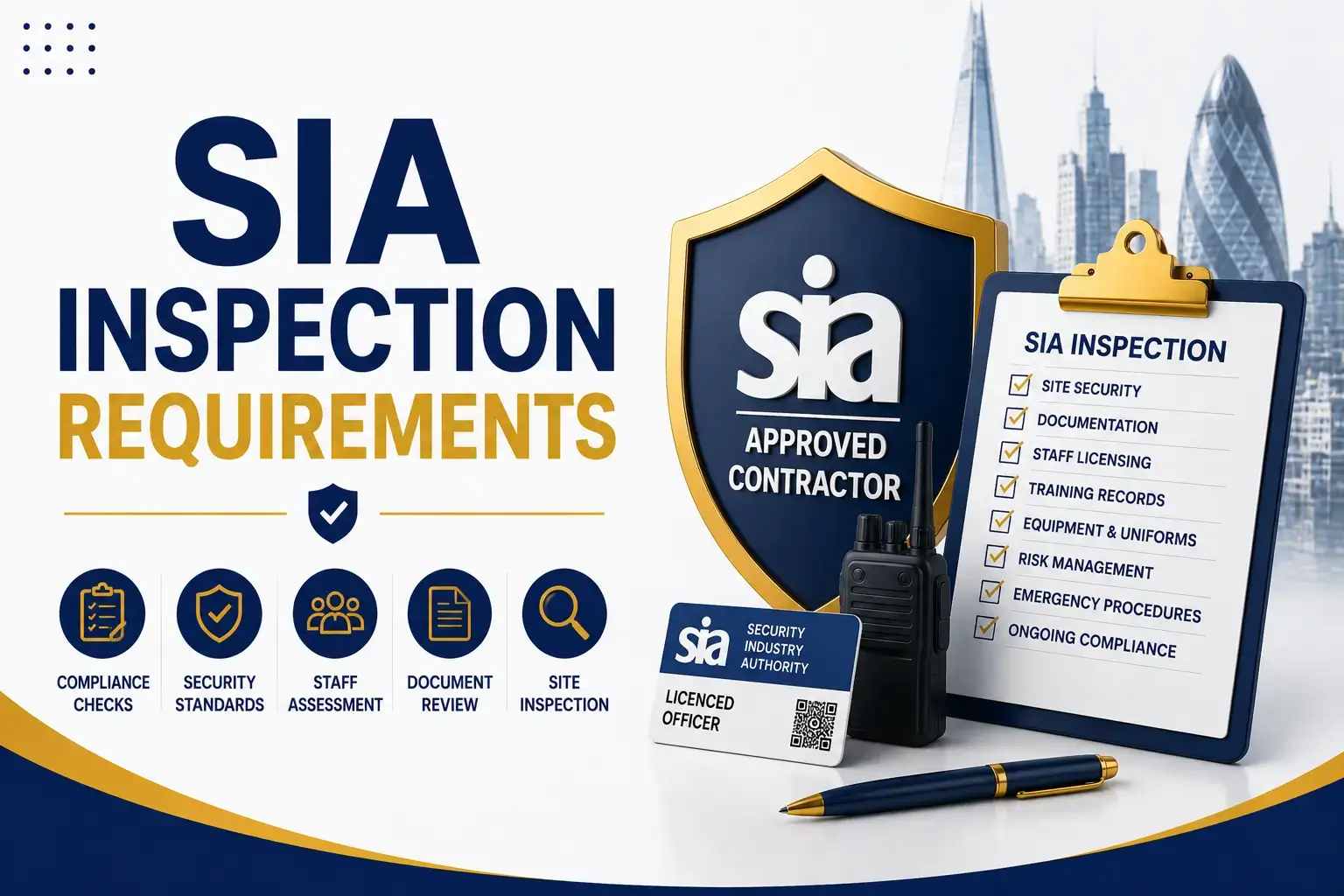
The ACS standard consists of seven criteria, underneath each of which sits several indicators of good practice. Here is what inspectors focus on across the key areas:
Management and Leadership
Inspectors assess whether your business has clear strategic direction and strong leadership commitment to quality and improvement. This includes documented business objectives, management review processes, and evidence that senior leadership actively drives performance, not just signs off on a policy once a year.
An SIA-approved contractor has a clear strategic direction enabling it to deliver value to all stakeholders. Inspectors want to see that this direction is genuine and embedded, not just stated.
Staff Screening and Vetting
All security operatives must be screened in accordance with BS 7858, the British Standard for the screening of individuals employed in a security environment. Inspectors check that your vetting processes cover:
- Identity verification
- Five-year employment history checks with no unexplained gaps
- DBS (criminal record) checks
- Financial probity assessments
- Right to work in the UK verification
All directors must also hold valid SIA licences; this is an eligibility requirement, not just good practice.
Training and Development
Your business must demonstrate a structured approach to staff training and development. Inspectors look for:
- Training records for all deployed operatives
- Evidence of role-specific training relevant to the sector (BS 7499, BS 7960, etc.)
- CPD and ongoing development processes
- Induction training records for new starters
- Evidence that training needs are regularly reviewed
Customer Service Standards
The ACS has a strong emphasis on customer relationships. Inspectors review how your business manages client contracts, monitors service delivery, handles complaints, and measures customer satisfaction.
An SIA-approved contractor has robust processes in place that ensure service delivery to its customers and stakeholders. Evidence of regular client communication, formal review meetings, and documented feedback processes all support this criterion.
Health and Safety Compliance
Your business must demonstrate a clear commitment to health and safety across all operations. This includes:
- A current, signed Health and Safety Policy
- Risk assessments for all significant activities
- Accident and incident recording systems
- Health surveillance was required
- Safe systems of work and emergency procedures
- Evidence of staff health and safety awareness training
Common Reasons Security Companies Fail SIA Inspections
Many security companies face delays or rejections because of avoidable mistakes. Here are the most common:
- Directors without valid SIA licences are automatically deemed ineligible before the inspection even begins
- Inadequate BS 7858 screening vetting records that are incomplete, outdated, or do not cover all required checks
- Self-assessment workbook inaccuracies, over-scoring or under-scoring, with evidence that does not match claimed performance
- Poor management review evidence: no formal management review meetings, or no records showing they took place
- Weak customer satisfaction processes, no formal client feedback system, and no documented complaint handling procedure
- No British Standards compliance, particularly BS 10800, which is mandatory for all ACS applicants regardless of sector
- Policies that are not implemented in practice, documents that exist on paper but are not followed operationally
- Insufficient training records, claims of competence not supported by documented evidence
Every one of these is avoidable with proper preparation. BizGrow Holdings identifies and resolves all of these issues before your inspection takes place.
How to Prepare for an SIA Inspection
Preparation is everything. Here is the practical approach:
Start with a gap analysis. Review your current position against all seven ACS criteria honestly. Identify every area where your business does not yet meet the required standard. Do this well before you apply, not after.
Work through the Self-Assessment Workbook accurately. The SAW is a 92-page document. Complete it honestly and accurately. Every score must be supported by real, accessible evidence. An experienced consultant helps ensure your scores are credible and your evidence is clearly organised.
Implement BS 10800 and relevant sector standards. Compliance with BS 10800 and all applicable sector-specific British Standards is mandatory. Build these requirements into your management systems before you apply.
Align with ISO 9001. Meeting ISO 9001 requirements satisfies approximately two-thirds of the ACS self-assessment workbook indicators. Businesses with ISO 9001 in place move through the ACS process significantly faster.
Prepare your management team. Your management team will speak with the assessor during the inspection visit. Make sure every senior person understands your quality management systems, your procedures, and how your business operates. An unprepared management team is one of the most common causes of inspection delays.
Keep your evidence accessible. The assessor needs to see everything quickly. Organise your documentation clearly. Every claim in your self-assessment workbook should be matched by a named, accessible document.
Benefits of Passing an SIA Inspection
Passing your SIA inspection and achieving ACS approval delivers real, commercial benefits:
- Access to major contracts: councils, NHS trusts, housing associations, and large corporates increasingly require ACS approval before awarding security contracts
- Public Register listing: your business appears on the SIA Register of Approved Contractors, visible to buyers across the UK
- Use of the ACS mark: displaying the ACS accreditation mark on your website, vehicles, and proposals signals quality to every potential client
- Stronger management systems: the inspection process itself makes your business better managed, more consistent, and more professionally run
- Competitive differentiation: ACS approval separates you from the majority of UK security companies that are not approved
- Reduced client risk: clients know that every operative you deploy is SIA licensed, properly vetted, and working within the law
Final Thoughts on SIA Inspection Requirements
The SIA inspection is thorough. It is designed to be. The purpose is to protect the public and ensure that only genuinely professional, properly managed security companies carry the ACS mark.
But it is absolutely achievable with the right preparation and the right support.
Security companies that approach their SIA inspection with thorough documentation, genuinely implemented systems, and a well-prepared management team pass. Those who rush in without preparation do not.
The decision is simple. Start your preparation early. Work through every requirement carefully. And if you want expert support to get it right the first time, BizGrow Holdings is ready to help.
Visit bizgrow-holdings.com today or contact our team at info@bizgrow-holdings.com.
FAQs About SIA Inspections in the UK
1. What is an SIA inspection?
An SIA inspection is the independent assessment visit carried out by an approved assessing body on behalf of the SIA. It verifies that a security company genuinely meets the ACS standard across all seven criteria before approval is granted.
2. How often are SIA ACS inspections carried out?
ACS requires annual re-registration with the SIA and an annual continuation assessment. A full, comprehensive reassessment takes place every three years. Companies must maintain compliance continuously throughout the approval period.
3. What documents are required for an SIA inspection?
Inspectors expect to see your completed Self-Assessment Workbook with supporting evidence, BS 10800 and sector-specific standards compliance documents, BS 7858 screening records, training records, health and safety documentation, client contracts and satisfaction records, and management review minutes.
4. Can a security company operate without ACS accreditation?
Yes! ACS is voluntary. But without it, most councils, NHS trusts, housing associations, and large corporate clients will not consider you. In practice, for any serious UK security business targeting growth in 2026, ACS is effectively essential.
5. How can businesses prepare for an SIA inspection?
Start with a thorough gap analysis, complete the SAW accurately with full evidence support, implement BS 10800 and relevant British Standards, align with ISO 9001, and ensure your management team is fully prepared for the assessor visit.