What Is a Risk Assessment?
If you run a security company or any business in the UK, you cannot afford to ignore safety. One small mistake can lead to accidents, failed audits, or even contract loss.
That is why risk assessment steps are so important.
A risk assessment is a simple but powerful process where you identify what could cause harm, decide who will be affected, and take action to control those risks.
It is not just paperwork. It is how you protect:
- Your staff
- Your clients
- Your business reputation
When you follow clear steps, you move from guessing to structured decision-making. That is exactly what auditors and clients expect in 2026.
Who Needs Risk Assessments in the UK?
In the UK, every business with employees must follow these steps.
This applies to:
- Security and guarding companies
- Construction businesses
- Cleaning and facilities services
- Offices, retail, and logistics
For security companies, this becomes even more critical. Your staff often work alone, at night, or in high-risk environments.
Without proper risk assessment steps, you cannot guarantee their safety or meet compliance standards.
Legal Rules for Risk Assessments in the UK
UK law requires you to protect your workforce and anyone affected by your operations.
You must follow proper risk assessment steps under the Health and Safety at Work Act 1974.
You are legally expected to:
- Identify workplace risks
- Apply control measures
- Record your findings (if you have 5+ employees)
- Review regularly
Failing to follow these steps can lead to penalties, audit failures, and reputational damage.
The 5 Main Risk Assessment Steps
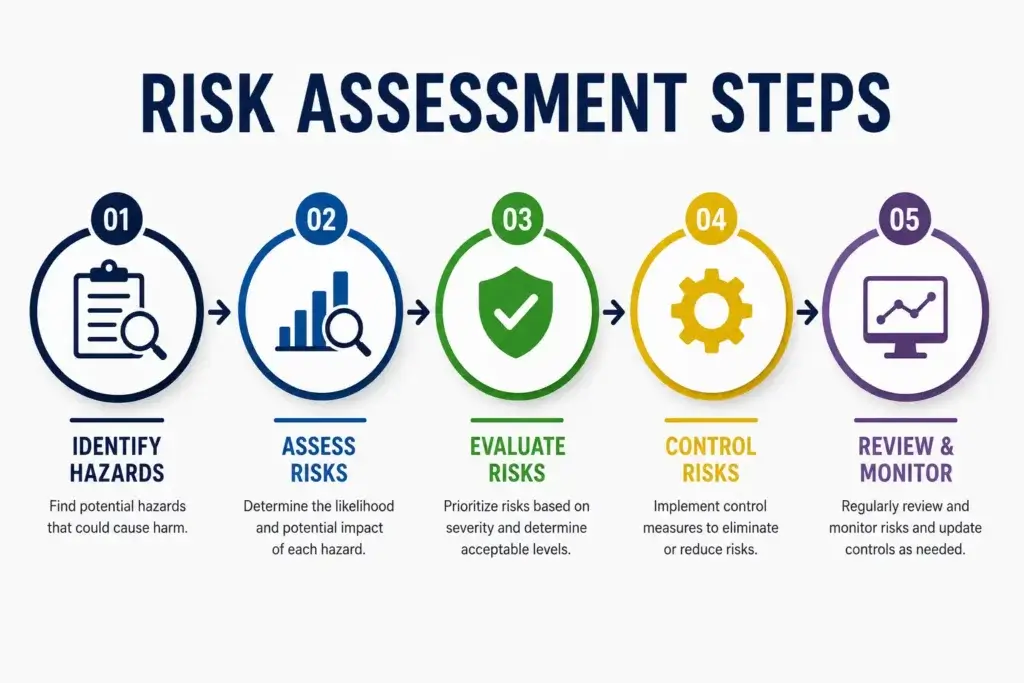
Every UK business follows the same structured assessment steps. These steps are simple, but they only work when you apply them properly.
- What each step means in simple words
You look for hazards, understand who will be affected, decide how to control the risk, record your actions, and review everything regularly.
- How these steps protect your staff and clients
When you follow these steps, you create a safer working environment. Your staff feel more confident, your clients trust your systems, and your business operates with fewer disruptions.
Step 1: Identify Hazards
The first of the assessment steps is to identify hazards.
A hazard is anything that can cause harm. In a security environment, hazards are often linked to people, locations, or working conditions.
You should walk through the site and observe. Look at how your staff work, where they stand, and what they deal with daily. Speak directly to your team because they often see risks that managers miss.
In real security roles, hazards may include aggressive behaviour, poor lighting, unsafe entry points, or working alone at night. Strong assessment steps always start with real observation, not assumptions.
Step 2: Decide Who Could Be Harmed
The next step of the risk assessment focuses on people.
You must clearly understand who could be affected by each hazard. This includes your employees, but also anyone who interacts with your business.
Think about your security guards, visitors, contractors, and even members of the public. Each group faces different risks depending on the situation.
When you follow proper assessment steps, you avoid general thinking. Instead, you identify specific people and how the risk affects them in real conditions.
Step 3: Evaluate Risks and Plan Controls
This step is where your assessment steps become practical.
You now assess how serious each risk is and how likely it is to happen. Then you decide what actions will reduce or control that risk.
Controls should always match the situation. In a security setting, this involves improving visibility, adding supervision, or adjusting working procedures.
You should not rely on basic solutions. Strong assessment steps involve realistic and effective controls that your staff can actually follow on-site.
Step 4: Record Your Risk Assessment and Take Action
Once you have identified risks and controls, you must document everything clearly.
Recording your assessment steps is not just a legal requirement. It also proves to clients and auditors that your business operates in a structured and professional way.
Your documents should be easy to understand and directly linked to the site. Avoid generic templates. Instead, show how your controls apply in real situations.
At the same time, you must implement the actions you have planned. If you do not apply the controls, your assessment steps lose their value completely.
Step 5: Review and Update Regularly
The final stage of the assessment steps is ongoing review.
Your business changes over time. New risks appear, contracts change, and working conditions shift. If you do not review your assessments, they quickly become outdated.
You should update your risk assessments when incidents occur, when you take on new sites, or when working methods change.
Strong risk assessment is always active. They evolve with your business instead of staying fixed on paper.
Common Mistakes in Risk Assessment Steps
Many businesses follow risk assessment steps, but they still fail audits because they do not apply them correctly.
One common mistake is using generic documents that do not match the actual site. Another is completing risk assessments once and never reviewing them again.
Some businesses also fail to involve their staff. When employees do not understand the risks or controls, the system breaks down.
Good steps are always specific, practical, and regularly updated. That is what auditors look for.
How Risk Assessment Steps Help You Pass ISO, SIA ACS, CHAS, SafeContractor, COP-119
Strong steps play a direct role in passing compliance audits.
1. How do risk assessment steps support ISO 45001
ISO 45001 focuses on health and safety management systems. It requires you to identify risks, control them, and show continuous improvement. Clear assessment steps provide the evidence needed to meet these requirements.
2. How do they help you meet SIA ACS and COP-119 rules
SIA ACS and COP-119 require structured operations and safe working practices. Your assessment steps show how you manage risks on each site and protect your staff during operations.
3. How risk assessment helps you pass CHAS and SafeContractor
CHAS and SafeContractor focus heavily on documentation and compliance. They expect to see clear, site-specific risk assessment steps that demonstrate real control over workplace risks.
Risk Assessment Examples for Security and Guarding Companies
In real situations, risk assessment steps must reflect the environment in which your staff work.
For example, a retail security guard may face confrontation risks. A construction site guard deals with unauthorised access. A night patrol officer faces lone working challenges.
In each case, your assessment steps must identify the hazard, assess the risk, and apply clear controls that your staff can follow.
This is how you turn theory into real safety.
Conclusion: How Strong Risk Assessment Steps Improve Your Business
When you apply proper risk assessment steps, you do more than meet legal requirements.
You create a safer workplace, reduce incidents, and build trust with your clients. Your business becomes more reliable, more professional, and more competitive in the UK market.
Strong assessment steps also improve your chances of passing audits and winning contracts. Clients want to work with businesses that manage risk properly.
Work With BizGrow Holdings
If you want to strengthen your risk assessment steps and improve your compliance systems, expert support can make the process faster and more effective.
BizGrow Holdings helps UK security and guarding companies build structured, audit-ready systems for ISO 9001, ISO 14001, ISO 45001, SIA ACS, COP-119, CHAS, SafeContractor, and BS 10800.
We create tailored risk assessments that match your real operations and help you pass audits with confidence.
Get in touch with BizGrow Holdings today and take your compliance to the next level.
Frequently Asked Questions
1. What are the 5 risk assessment steps in the UK?
The 5 steps include identifying hazards, deciding who could be harmed, evaluating risks, recording findings, and reviewing regularly. These steps help UK businesses stay compliant and reduce workplace risks.
2. Are risk assessment steps a legal requirement in the UK?
Yes, risk assessment steps are required under UK health and safety law. Businesses must identify risks, apply controls, and maintain records, especially if they have five or more employees.
3. How often should risk assessments be reviewed?
Risk assessments should be reviewed regularly and updated whenever there are changes in the workplace, new risks, incidents, or new business activities.
4. Why are risk assessment steps important for security companies?
Risk assessment steps help security companies manage real-world risks such as lone working, public interaction, and site hazards. They are essential for passing audits like SIA ACS, ISO 45001, CHAS, and SafeContractor.