When it comes to security dog handlers in the UK, not all handlers are created equal.
You see two companies offering canine security services. Both have dogs. Both have handlers in uniform. On the surface, they look similar. But underneath, the difference can be enormous, and it matters more than many clients realise.
One handler may be NASDU-certified, working to nationally recognised standards, trained to British Standard BS 8517, SIA-licensed, and annually assessed. The other may have no formal certification at all, just a dog and a uniform.
That gap is not just about paperwork. It is about safety, accountability, legal compliance, and the real-world effectiveness of the security you are paying for.
This guide explains what NASDU certification actually means, what non-certified handlers lack, and why the difference matters so much for UK businesses and event organisers in 2026.
At BizGrow Holdings (bizgrow-holdings.com), we believe in transparent, compliant security services. So let us be honest about what separates the professionals from the rest.
What Is NASDU?
NASDU stands for the National Association of Security Dog Users. It was established in 1996 and is the UK’s leading membership organisation for security dog handlers, trainers, and dog teams in the private security sector.
NASDU’s core purpose is to promote, develop, and maintain professional standards for everyone involved in security dog work, from the handlers themselves to the trainers, the training companies, and the dogs they work with.
NASDU is formally recognised by some of the most important bodies in UK security:
- The Security Industry Authority (SIA) is the statutory regulator for private security in the UK
- The British Standards Institution (BSI), which produces BS 8517, the code of practice for security dogs
- Skills for Security, the sector skills body for the UK security industry
- The British Security Industry Association (BSIA)
- The Home Office and National Police Chiefs’ Council (NPCC)
- Animal welfare groups and Local Authority Dog Wardens
NASDU is also an approved centre with HABC, the Highfield Awarding Body for Compliance, which Ofqual and the SIA regulate. This means the qualifications NASDU oversees are nationally recognised, formally assessed, and subject to external quality assurance.
In short, NASDU is not an informal club. It is the recognised professional body for security dog work in the UK, and its certification is the benchmark on which the industry is built.
What Is a NASDU Certified Handler?
A NASDU certified handler is a security dog handler who has completed a formally assessed, nationally recognised training programme delivered by a NASDU Approved Instructor.
The certification is structured into levels, each designed to reflect the handler’s experience, skill level, and operational role:
Level 2 Award | General Purpose Security Dog Handler
This is the entry-level certification for professional security dog handlers. It requires a minimum of 60 guided learning hours (GLH) of formal training theory in the classroom and practical sessions in realistic operational environments.
To be eligible, the learner must already be trained and competent in a general security officer role, and should hold a valid SIA licence. They cover roles, responsibilities, legal powers, dog control, patrol techniques, search procedures, animal welfare, and emergency response.
The handler certificate is a lifetime achievement. The team certificate awarded to the handler and dog together expires after 12 months and must be renewed annually. This ensures the dog-and-handler team is regularly assessed and remains operationally competent.
Level 3 Certificate | Advanced General Purpose Handler
This builds on the Level 2 qualification. It is designed for experienced handlers who want to advance their skills and meet the higher standards recommended in BS 8517-1. It covers advanced techniques, higher levels of dog control, and more complex operational scenarios.
Level 3 Certificate | Detection Dog Handler
This specialised qualification covers drug detection dogs, both passive and proactive. It meets the requirements of BS 8517-2, the code of practice for detection dogs. These handlers work in airports, events, construction sites, and other environments where drug or explosive detection is required.
All courses involve ongoing practical assessment, written examinations, and an end-point assessment conducted by an independent sector-competent person, someone with no prior involvement in the learner’s training. Internal quality assurance is carried out by NASDU, with external oversight by HABC.
What Does NASDU Training Cover?
NASDU training is comprehensive. It goes far beyond teaching someone to walk a dog on a patrol. Here is what it actually covers:
Legal Knowledge
Handlers learn the legal framework they operate within, including the Guard Dogs Act 1975, the Animal Welfare Act 2006, the Dangerous Dogs Act 1991, and their obligations under UK health and safety law. A certified handler knows exactly what they are legally permitted to do, and what they are not.
Dog Control and Handling
This covers practical handling techniques, commands, control under pressure, working in different environments, and managing the dog’s behaviour around crowds, traffic, and unexpected situations. It also covers bite and release, handler protection, and patrol scenarios.
Search Techniques
Handlers are trained in systematic search procedures for premises, vehicles, and people. These techniques must be consistent and legally defensible.
Animal Welfare
A significant part of NASDU training covers the welfare of the dog itself. This includes nutrition, health monitoring, kennel hygiene, recognising signs of stress or injury, canine first aid, and veterinary care obligations. A certified handler understands that the dog is not just a tool; it is a working animal with legal protections.
Incident Reporting and Record Keeping
Handlers learn how to accurately record patrols, incidents, and dog behaviour. This documentation is critical for insurance purposes, legal proceedings, and client reporting.
Continuation Training
NASDU-certified handlers are not certified once and forgotten. BS 8517 recommends ongoing continuation training. Many NASDU-accredited companies carry out monthly training sessions, with quarterly assessments and annual team recertification. This keeps both handler and dog sharp and operationally ready.
Who Are Non-Certified Handlers?
Non-certified handlers are individuals who work or attempt to work as security dog handlers without holding NASDU qualifications or equivalent nationally recognised certification.
This is more common than many people realise. Because NASDU certification is not yet a statutory or legal requirement in the same way that an SIA licence is for most security roles, some individuals and companies operate in this space without formal qualifications.
A non-certified handler may:
- Owns a dog with good basic obedience, but no specialist security dog training
- Have informal experience with dogs, perhaps as a pet owner or hobby trainer
- Have attended a short, unaccredited course with no external quality assurance
- Hold an SIA licence (which covers the guarding role) but no specialist dog-handling qualification
- Be working for a company that has not invested in proper certification for its canine teams
None of this is the same as NASDU certification. And the gap between the two has real consequences.
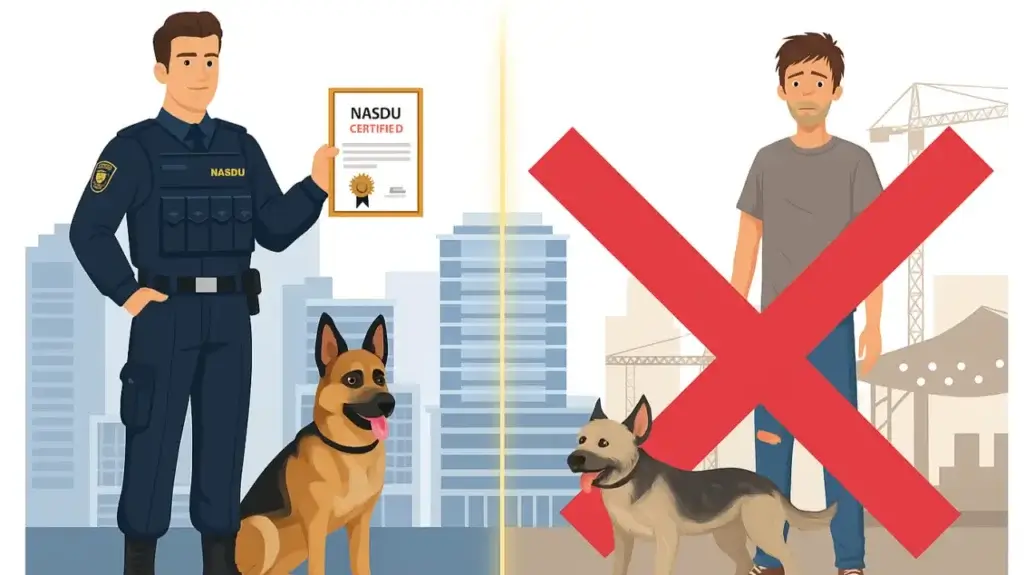
NASDU vs Non-Certified Handlers | The Key Differences
1. Training Standards
A NASDU-certified handler has completed a minimum of 60 to 120 guided learning hours of formal, assessed training against nationally recognised standards. A non-certified handler may have had no formal training at all or may have completed a short course with no external oversight or quality assurance.
Training quality is the foundation of everything else. Without it, all other claims about professionalism and safety are undermined.
2. Legal and Regulatory Compliance
NASDU training includes detailed coverage of the legal framework for security dog work in the UK. Certified handlers know the Guard Dogs Act, the Animal Welfare Act, and their obligations under health and safety legislation. They know what they can and cannot do legally.
A non-certified handler may have no formal understanding of these laws. That creates legal risk not just for the handler, but for the business that deployed them and the client who hired them.
3. Dog Welfare Standards
NASDU-certified handlers are trained in animal welfare as a core part of their qualification. They know how to identify stress, injury, or illness in their dog. Understand nutrition, kennel hygiene, and veterinary obligations. They meet the standards expected under the Animal Welfare Act 2006.
Non-certified handlers may have no formal understanding of animal welfare requirements. This creates risks for the dog and legal exposure for everyone involved.
4. Insurance and Liability
When something goes wrong, a dog bites someone, an incident occurs, or a dog causes damage, the question of certification becomes immediately critical.
Insurance companies take certification seriously. A NASDU-certified handler, working under a properly insured security company with documented training records, is in a very different position from an uncertified handler with no formal qualifications. Claims involving uncertified handlers can be significantly more complex, and liability can fall directly on the client who hired them.
This is a risk many businesses do not fully appreciate until they need to make a claim.
5. Annual Assessment and Recertification
NASDU team certificates expire after 12 months. The handler and dog must be reassessed annually to maintain their certification. This means the standard is not just met once it is maintained continuously.
A non-certified handler has no such requirement. There is no annual check. No reassessment. No verification that the dog is still operationally fit and the handler is still competent.
6. Accountability and Records
NASDU-certified teams maintain documented training records, monthly training logs, quarterly assessment records, annual certifications, and veterinary records for the dog. These records are available to clients and can be requested by insurers, courts, or regulators.
Non-certified handlers have no such records. If a question arises about how the handler was trained or how the dog was managed, there is nothing to show.
7. Professional Credibility
For businesses hiring security dog services, NASDU certification is the benchmark. Procurement teams, councils, NHS trusts, event organisers, and large corporations increasingly specify NASDU certification along with SIA licensing and BS 8517 compliance as a minimum requirement for canine security contracts.
A non-certified handler cannot satisfy these requirements. They close doors that NASDU certification would keep open.
Why This Matters for UK Businesses
If you are a business or event organiser hiring security dog services in the UK, the difference between NASDU-certified and non-certified handlers is not an abstract concern. It has direct consequences for your organisation.
Your Duty of Care
Under UK health and safety law, you have a duty of care to everyone on your premises: staff, visitors, and members of the public. If you hire a security provider whose dog handler is not properly trained and certified, and something goes wrong, you could share liability for that incident. Saying ‘we didn’t know they weren’t certified’ is not an adequate defence.
Your Insurance
Your public liability insurance and your security provider’s insurance both depend on services being delivered by appropriately trained and qualified personnel. An incident involving an uncertified handler could complicate or invalidate an insurance claim significantly.
Your Contract Obligations
If you are a public sector organisation or a business operating under a framework contract, you may have contractual obligations to use appropriately certified security personnel. Hiring non-certified handlers could put you in breach of those obligations.
Your Reputation
An incident involving an untrained or uncertified security dog handler can cause serious reputational damage to your event, your venue, or your organisation. The headline ‘security dog bites visitor at [your event]’ is not one any business wants. Certification does guarantee nothing will ever go wrong, but it does demonstrate that you took every reasonable precaution.
What to Ask When Hiring Security Dog Services
Before hiring any security dog service, ask these questions:
- Are all handlers NASDU certified to the relevant level for this role?
- Do handlers hold valid SIA licences?
- Are the handler and team certificates current and renewed within the last 12 months?
- Does the company work to BS 8517-1 (general purpose) or BS 8517-2 (detection)?
- Are monthly training records and quarterly assessment records maintained and available?
- Are current veterinary records held for each working dog?
- Is the company a NASDU member or associate member?
- Can they provide documented evidence of their training and certification on request?
Any reputable, professional security dog provider should be able to answer every one of these questions clearly and confidently. If a company struggles to answer them or becomes evasive, that is a significant warning sign.
How BizGrow Holdings Supports Compliant Security Services
At BizGrow Holdings, we work with UK businesses to help them understand the standards that matter and to make sure the security services they procure actually meet those standards.
When it comes to canine security, compliance is not optional. It is the foundation of a safe, legally defensible, professionally delivered service.
We help our clients:
- Understand the difference between compliant and non-compliant security dog providers
- Develop procurement specifications that require NASDU certification, SIA licensing, and BS 8517 compliance
- Review their current security contracts and identify any compliance gaps
- Source and verify security providers across all disciplines, including canine security
- Build security frameworks that satisfy insurance requirements, duty of care obligations, and contract terms
- Develop security policies and procedures that reflect current UK industry standards
We do not cut corners. And we help our clients make sure their security providers do not either.
If you want independent, expert guidance on your security procurement, including canine security, speak to the team at BizGrow Holdings. Visit bizgrow-holdings.com today.
Conclusion | Certification Is Not Just a Badge
NASDU certification is not just a piece of paper. It represents hundreds of hours of formal training. It represents annual reassessment. It represents legal knowledge, animal welfare standards, documented records, and professional accountability.
A non-certified handler, whatever their personal experience with dogs, cannot offer any of that. And in 2026, with duty of care expectations higher than ever and insurance requirements tightening across the sector, the gap between certified and non-certified handlers matters more than ever.
For UK businesses, the message is clear. When it comes to security dog services, always ask for proof of NASDU certification. Always ask to see team certificates. Always verify SIA licensing. And always work with providers who can demonstrate their standards, not just claim them.
At BizGrow Holdings, we are here to help. Visit bizgrow-holdings.com for expert guidance on security compliance and procurement across the UK.
FAQs About NASDU Certified Handlers in the UK
1. Is NASDU certification a legal requirement in the UK?
NASDU certification is not a statutory legal requirement in the same way as an SIA licence. However, it is the industry benchmark recognised by the SIA, BSI, and major procurement bodies. Many clients now require it as a contractual minimum.
2. Do NASDU-certified handlers also need an SIA licence?
Yes. To work in contracted security roles in the UK, handlers must hold a valid SIA licence. NASDU certification complements the SIA licence by validating specialist dog-handling skills. Both are required for full professional compliance.
3. How often must NASDU team certificates be renewed?
The NASDU team certificate awarded to the handler and dog together expires every 12 months. It must be renewed through reassessment. The handler’s individual certificate is a lifetime achievement, but the team must be assessed annually.
4. What is BS 8517 and why does it matter?
BS 8517 is the British Standard Code of Practice for security dogs. BS 8517-1 covers general purpose dogs and BS 8517-2 covers detection dogs. NASDU qualifications are developed to meet these standards. Compliance with BS 8517 is expected by professional buyers of canine security services.
5. Can non-certified handlers legally work in UK security?
An individual can legally own and operate a dog in many contexts, but to work as a contracted security dog handler in regulated security roles, an SIA licence is required. Without NASDU certification, handlers lack the nationally recognised training that professional clients and insurers expect.