Security dog teams are increasingly used across the UK private security sector, from site patrols to detection and specialist search tasks. With this rise, the need for formal, recognised qualifications has become essential. One such pathway is NASDU certification, a widely acknowledged standard for security dog handlers and dog teams.
In this guide, we’ll explain what NASDU stands for, the key requirements for its security certification, and clarify common questions such as whether an SIA badge is required to be a dog handler in the UK. All information is designed for UK security professionals seeking factual, actionable guidance aligned with industry expectations.
What Does NASDU Stand For?
NASDU stands for the National Association of Security Dog Users, a UK organisation dedicated to promoting, developing, and maintaining professional standards for security dog handlers, trainers, and canine partners. NASDU supports training, education, and operational best practice within the private security dog sector and collaborates with recognised bodies in the security industry.
While NASDU itself is not a statutory regulator, the qualifications it oversees are developed to reflect recognised industry standards and are usually delivered in partnership with an awarding body regulated by Ofqual, such as Highfield Awarding Body for Compliance (HABC).
Why NASDU Matters in UK Security
Dog handlers are a specialist group within the private security workforce. Beyond general security roles, dog teams must demonstrate competence in animal handling, risk assessment, operational control, and safety management. NASDU training and certification ensure that both handler and dog meet key performance and welfare standards that many clients, including construction, retail, transport, and crowd management organisations, expect before awarding contracts.
Qualifications awarded through NASDU are widely recognised across the UK and are often accepted as proof of industry-appropriate training for handlers and their canine partners.
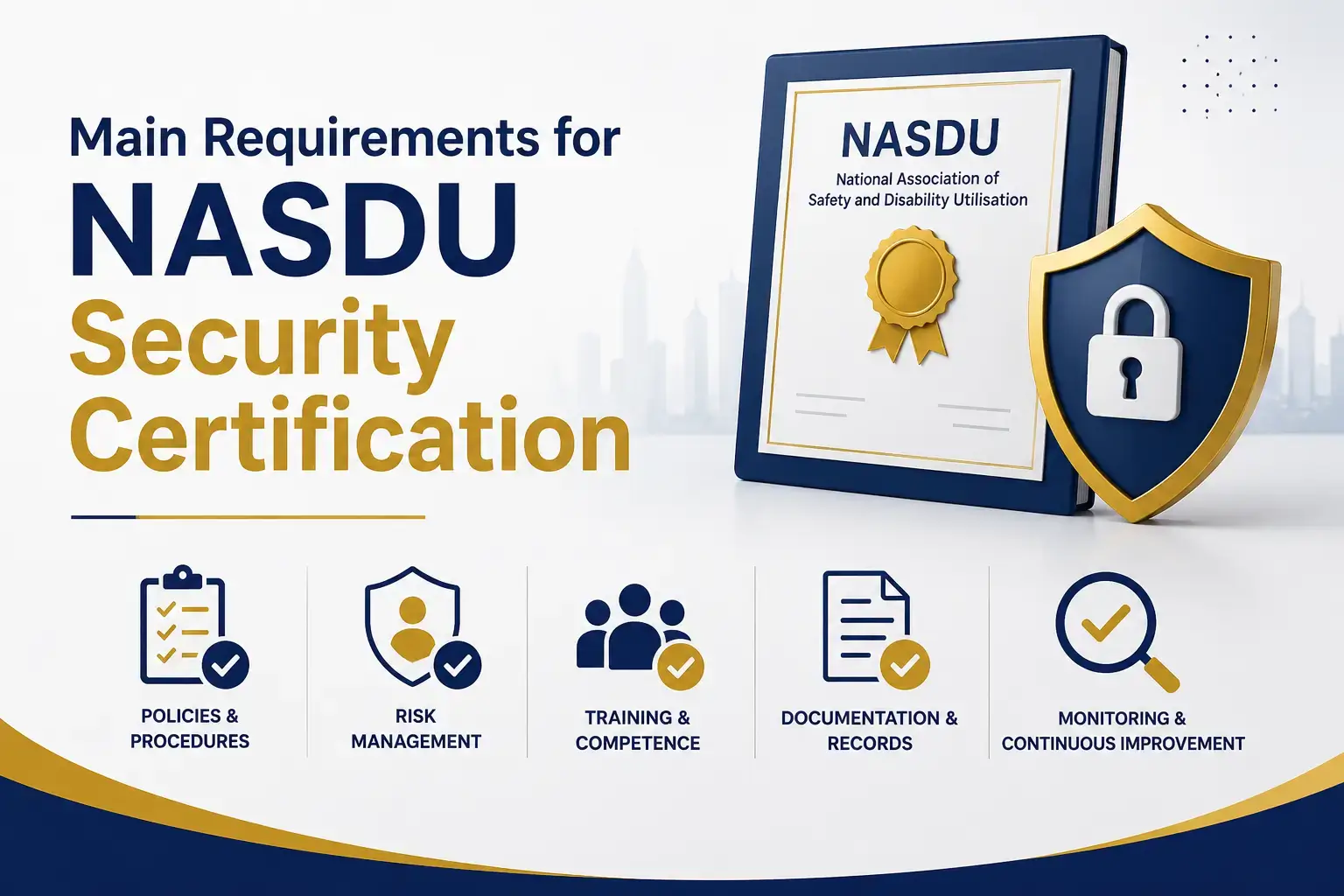
Core NASDU Security Certification Requirements
1. Appropriate Background in Security
Before undertaking a NASDU security dog qualification, candidates typically must have prior experience and training as a security officer. This helps ensure they already understand the fundamentals of private security work, including risk management, legal boundaries, and industry responsibilities.
In many cases, possession of a valid SIA licence (Security Industry Authority licence) covering roles such as Security Guarding or Dog Handling is expected or required, as it demonstrates existing competency in security duties.
Tip: Even if NASDU training is technical and dog-focused, most employers still expect handlers to hold an SIA licence when operating in regulated UK security roles.
2. Training Hours and Guided Learning
NASDU qualifications have structured minimum guided learning hours (GLH). For example:
- Level 2 Award for a General Purpose Security Dog Handler requires a minimum of 60 GLH’s, ensuring learners spend sufficient time building competence through both theory and practical sessions.
- Higher-level and specialist pathways such as detection or advanced operational roles require progressively more GLH’s, reflecting wider knowledge and more complex skill sets.
These hours include supervised training, assessments, and practical demonstrations as part of the certification process.
3. Practical Handling and Control Skills
A significant part of the NASDU certification focuses on dog control and handling. Handlers must demonstrate:
- Basic obedience and command responses
- Patrol techniques with the dog
- Controlled reactions during operational scenarios
- Safe restraint, release, and contact techniques
This ensures both handler and dog can operate safely in dynamic environments.
4. Operational Scenarios and Assessment
NASDU certifications require ongoing practical assessments throughout the course. This includes:
- Written knowledge checks
- Scenario-based demonstrations
- Observed operational tasks with the dog
For example, handlers must conduct patrols, searches, and safety checks using real-world scenarios under the supervision of an approved instructor.
Successful candidates demonstrate competence in controlling the dog, maintaining safety protocols, and applying training within recognisable UK security contexts.
5. Dog Welfare, Health, and Safety
Security dog qualifications under NASDU also examine a handler’s ability to ensure animal welfare. This includes:
- Health inspections
- Grooming and hygiene
- Transportation best practices
- Canine first aid basics
Dog safety is critical, as it protects the animal, the handler, and the public during operations.
6. Documentation and Competency Evidence
Handlers must provide verifiable evidence of training completion and competence. This may include:
- Training logs
- Performance checklists
- Video or assessor records
- Written examinations
This documentation supports the final certification decision and is essential if the handler seeks to join security dog teams professionally.
Do You Need an SIA Badge to Be a Dog Handler?
This is a common question in the UK security sector.
The Security Industry Authority (SIA) regulates security licencing in the UK. An SIA licence is mandatory for most frontline security roles, such as Security Guarding or Door Supervision.
However, for dog handling work, the requirement depends on context:
- If the role involves regulated security activities (e.g., guarding with a dog on a contracted site), an appropriate SIA licence is generally required.
- NASDU certification itself does not replace an SIA licence rather, it complements it by validating specialist dog handling skills.
In simple terms:
Yes, you usually need a valid SIA licence to work legally as a security dog handler in the UK, in addition to NASDU training.
NASDU Levels and Progressions
NASDU offers structured levels tailored to handler experience and role complexity:
Level 2 — Security Dog Handler
Designed for those entering professional roles, this qualification covers core skills and operational basics for general-purpose or tracking dog teams.
Level 3 — Advanced Handler
Level 3 expands on foundational skills, adding advanced techniques and competencies for experienced handlers.
Level 4 — Specialist Detection
This qualification focuses on specialist roles such as explosive detection or vehicle search handlers, reflecting higher standards of training and operational demands.
All levels involve formal assessments and endorsement by an awarding body such as HABC, recognised in the UK security and compliance landscape.
Benefits of NASDU Certification for UK Security Companies
Achieving NASDU certification provides several key advantages:
✦ Recognised competence in specialist dog handler skills
✦ Better credibility with clients and principal contractors
✦ Evidence of structured training aligned with BS standards and NOS frameworks
✦ Supports regulatory compliance when combined with SIA licencing
✦ Enhanced opportunities in specialist security contracts
These benefits make NASDU certification a valuable asset in a competitive UK security sector.
Common Misconceptions About NASDU and SIA
1. “NASDU replaces the SIA licence.”
False. NASDU training focuses on specialist dog handling competence, while the SIA licence covers statutory security regulation. Both are important when operating in regulated roles.
2. “Any dog can be used in security after NASDU training.”
Certain breeds and appropriate behaviour standards are recommended by NASDU and BS standards to ensure operational suitability.
Preparing for Your NASDU Course
To maximise success:
- Hold the correct SIA licence (if required for your role)
- Choose an Approved NASDU Trainer/Instructor
- Ensure your dog meets breed and age criteria.
- Log training hours and practical assessments carefully.
Preparation sets the foundation for certification completion and professional deployment.
Frequently Asked Questions
What is the Nasdu certificate for the company?
A Nasdu certificate for the company proves compliance with UK standards for security dog services.
It ensures your business meets recognised UK training and operational requirements.
It is often required for UK contracts involving dog handler security services.
What is Dog handler security?
Dog handler security in the UK involves trained professionals working with licensed security dogs.
These services are used for site security, patrols, and risk prevention.
It is widely required across UK construction sites, events, and high-risk environments.
What qualifications do you need to be a dog handler?
In the UK, you need recognised qualifications such as NASDU certification and an SIA licence.
Training must cover dog handling, control, and safety procedures.
Practical experience with trained security dogs is also essential.
How to get the NASDU certificate?
To get the NASDU certificate in the UK, you must complete approved training with a recognised provider.
Both the handler and the dog must pass assessments.
Ongoing compliance and regular renewal are also required.
What are Nasdy level 2 requirements?
Nasdy level 2 requirements include formal training in dog handling and operational control.
You must demonstrate practical skills, safety awareness, and handling techniques.
Assessment is required to achieve certification at this level in the UK.
Final Thoughts
NASDU security certification plays a crucial role in setting professional standards for security dog handling in the UK. While it does not replace mandatory SIA licences, it provides an essential specialist qualification that enhances operational credibility and career progression.
As the UK security sector evolves, having both statutory licences and recognised specialist certifications will increasingly distinguish compliant, professional companies from the rest.
If your organisation wants clarity, structured training pathways, and effective certification outcomes, partnering with expert security compliance consultants such as BizGrow Holdings ensures your teams are trained, prepared, and audit-ready.