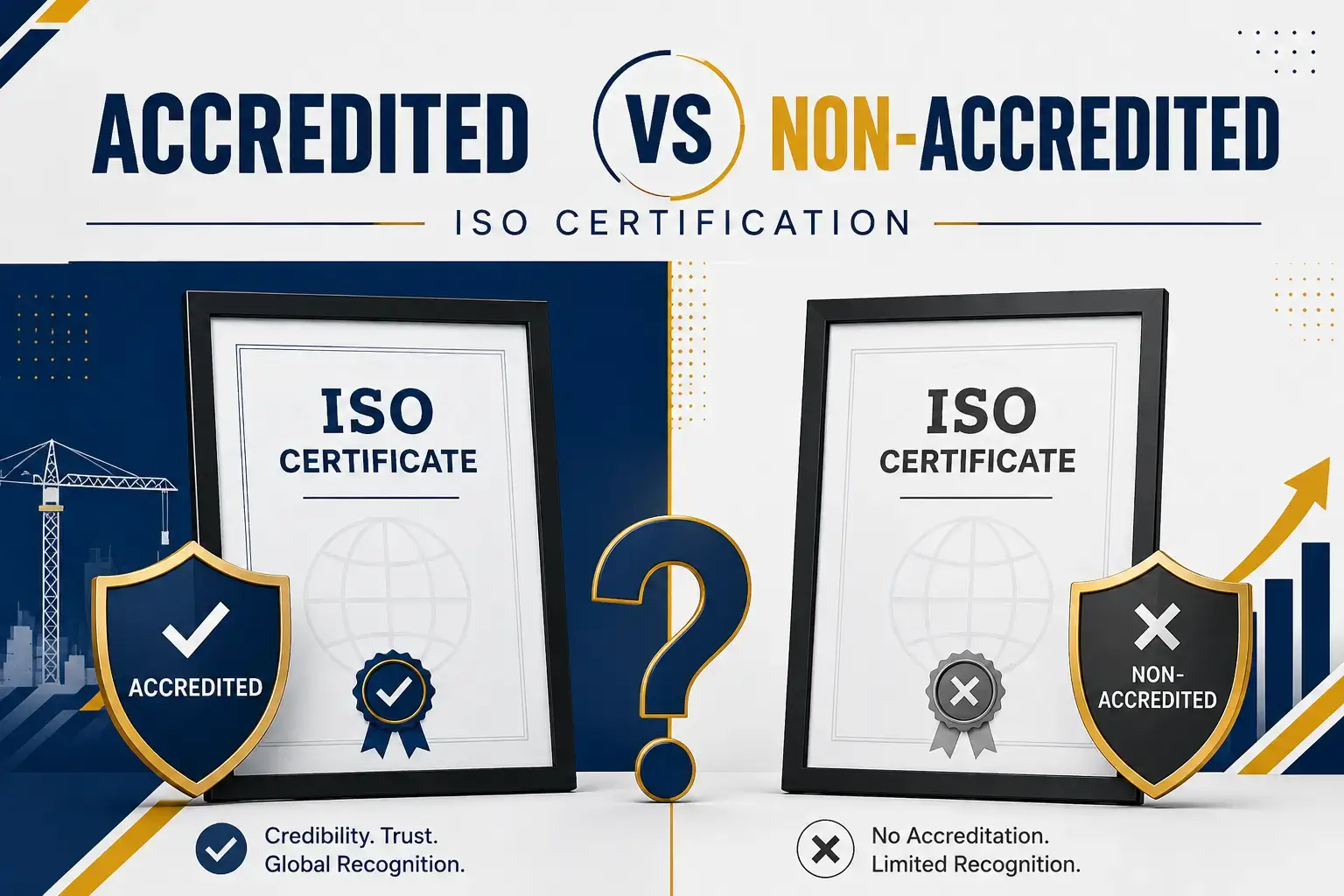
ISO Accredited” means the certification body that gave you your ISO certificate has itself been checked and approved by a national accreditation body. In the UK, this body is UKAS (United Kingdom Accreditation Service). UKAS checks certification bodies to make sure they follow the correct rules before they are allowed to issue ISO certificates.
UKAS calls this process “checking the checkers.” In simple words, UKAS does not check your business directly. UKAS checks the company that checks your business. This creates a chain of trust that runs from UKAS to the certification body, to your business, and finally to your clients.
UKAS is the only accreditation body officially appointed by the UK Government. It works under the Department for Business and Trade. UKAS is also part of the International Accreditation Forum (IAF), which means an accredited certificate from the UK is accepted in many other countries too.
To stay accredited, certification bodies go through tough yearly checks by UKAS. Their auditors, their paperwork, and their decision-making are all reviewed closely. This is what makes accredited certification so trusted.
In short:
- UKAS checks the certification body
- The certification body then checks your business
- Your ISO certificate becomes trusted, valid, and recognised
What Is Non-Accredited ISO Certification?
Non-accredited ISO certification means the certifying body has not been checked or approved by UKAS or any other official accreditation body. This is one of the most misunderstood parts of ISO certification in the UK.
Here is the surprising part: there is no law stopping anyone from setting up a company and calling it a “certification body.” Anyone can do this. There is no rule saying they must be accredited first. This means two businesses can both say “we are ISO certified,” yet only one of those certificates may actually mean something when it gets checked.
This does not always mean the certificate is fake or worthless. But it does mean there is no outside body confirming that the certifying company is doing its job properly. The certifying company makes its own audit rules. There is nobody checking if those rules match real ISO requirements.
Non-accredited certification is often:
- Cheaper
- Faster
- Easier to get
- Sometimes more flexible with paperwork
But it usually carries far less weight with serious clients, public sector buyers, and large companies. Many tenders will not accept it at all, no matter how good the underlying business actually is.
Some non-accredited bodies also use confusing wording. They may say things like “internationally recognised” or “fully certified body,” without ever saying they hold UKAS or IAF accreditation. This can mislead a business owner who is not familiar with the difference.
ISO Accredited vs Non-Accredited Certification: Key Differences
Recognition and Credibility
An accredited certificate is recognised across the UK and around the world. People trust it because they know UKAS has checked the certifying body using strict international rules. A non-accredited certificate may not carry the same trust, since no outside body is confirming it is genuine. Some clients may simply reject it at first sight.
Audit Quality and Standards
Accredited certification bodies must follow strict audit rules under a standard called ISO 17021. Their auditors are trained, tested, and checked regularly by UKAS. The audit process stays consistent no matter which client they visit.
Non-accredited bodies can create their own audit process from scratch. This means the audit could be detailed and fair, or it could be a quick checklist with very little real checking involved. There is no outside body making sure the process is fair or thorough.
Trust with Clients and Buyers
Big companies, government departments, and serious buyers often check whether your ISO certificate is accredited before they trust it. An accredited certificate builds instant confidence. A non-accredited one may raise questions, slow down a deal, or get rejected completely during due diligence.
Tender and Contract Requirements
Many UK tenders, especially public sector ones, clearly state that only accredited ISO certification will be accepted. Purchasing departments often use specifications that name UKAS accreditation directly as a requirement. If your certificate is not accredited, you could lose the chance to bid at all, even if your business runs perfectly well day to day.
Ongoing Compliance Monitoring
Accredited certification bodies must keep checking your business through regular surveillance audits, usually every year. This keeps your management system active, alive, and improving over time. Non-accredited bodies may not follow up properly, which means your certificate could quietly become outdated without you even knowing it.
Benefits of Choosing an ISO Accredited Certification
Greater Business Credibility
An accredited ISO certificate tells everyone that your business has been checked by a trusted, government-recognised body. It builds your reputation as a serious, dependable company that takes standards seriously rather than just collecting paperwork.
Improved Tender Success
Many tenders ask for accredited certification as a non-negotiable requirement. Having one opens doors to contracts, frameworks, and partnerships that would otherwise stay closed, especially in construction, security, healthcare, and public sector work.
Increased Customer Confidence
Customers feel safer working with a business that holds a properly recognised certificate. It shows you take quality, safety, environmental responsibility, or information security seriously, not just on paper but in daily practice.
Better Compliance Management
Regular audits from an accredited body help keep your systems sharp. This means fewer mistakes, smoother operations, and steady improvement year after year, rather than a certificate that simply sits framed on a wall and is forgotten.
Stronger Long-Term Business Performance
Recent UK research looked at thousands of certified firms over many years and found that businesses holding accredited certification generally report higher revenue and productivity than similar non-certified businesses, and certified firms also showed stronger resilience during major shocks like Brexit, COVID-19, and energy price swings. This shows accredited certification is not just a badge. It can genuinely support stronger, steadier business performance over time.
When Can Non-Accredited Certification Be a Risk?
Non-accredited certification can become a real risk in several common situations:
- If you plan to bid for government, NHS, or large corporate contracts
- If your clients specifically ask for UKAS-accredited certification
- If you want your certificate to be recognised outside the UK
- If you operate in construction, security, healthcare, or other regulated sectors
- If you want long-term assurance that your management system actually works
In these cases, a non-accredited certificate may be rejected straight away, even if your business is doing everything right internally. This can waste the time, money, and effort that went into getting certified in the first place, leaving you back at square one.
There is another hidden risk, too. Some non-accredited certification bodies offer consultancy and certification together as one combined package. This sounds convenient, but it raises a fairness problem, since the same company would be helping you build your system and then marking its own work. Properly accredited bodies are not allowed to do this, which keeps the process honest and impartial.
How UK Businesses Can Verify an ISO Accredited Certification
It is simple to check if a certification body is genuinely accredited. You can:
- Search the certification body’s name on the official UKAS website
- Use the UKAS CertCheck tool to confirm if a certificate is currently valid
- Check the IAF database for international recognition
- Ask the certification body directly for their UKAS accreditation number and scope
- Look for the official UKAS “crown and tick” symbol on certificates and marketing material
It is also worth checking exactly what the certification body is accredited for. Accreditation can be specific to certain ISO standards and certain activities, so a body may be properly accredited for one standard but not another. Always ask: “Are you accredited for this exact ISO standard?” rather than just “Are you accredited?”
A few minutes of checking before signing any contract can save your business from ending up with a certificate that holds little real value later.
Why More UK Organisations Prefer ISO Accredited Certification
More UK businesses are now choosing accredited certification because buyers, regulators, and partners are becoming stricter about proof. A framed certificate on the wall is no longer enough by itself. People increasingly want to know it was issued properly and means something real.
This shift is also being driven from the top. The UK government has been increasingly promoting the value of UKAS-accredited certification, treating it as something that benefits both UK businesses and wider society. As more sectors, from construction to healthcare to digital services, lean on UKAS-accredited proof as their standard requirement, the gap between accredited and non-accredited certification is only going to matter more, not less.
Accredited certification also helps businesses stay ahead during tenders, audits, and partnership deals. It removes doubt, builds long-term trust, and shows real commitment to quality, safety, or security standards, which matters more every year in a competitive UK market.
How BizGrow Holdings Supports Businesses with ISO Certification
BizGrow Holdings helps UK businesses move through the entire ISO certification journey with clarity and confidence. From understanding which ISO standard fits your business to preparing your management system to getting ready for the final audit, the BizGrow Holdings team guides you every step of the way.
BizGrow Holdings supports businesses with ISO 9001, ISO 14001, and ISO 45001 certification, along with SIA ACS approval and other compliance needs across the UK. Their structured approach includes gap analysis, staff training, internal audits, and full support right up to certification, so nothing important gets missed along the way.
With a strong track record of successful audits and a high pass rate, BizGrow Holdings is trusted by UK businesses that want to get certification right the first time, without confusion, guesswork, or wasted effort. Their team works closely with each client’s management to build a tailored roadmap, rather than offering a one-size-fits-all process.
Conclusion
Understanding the difference between ISO accredited and non-accredited certification is important for any UK business. Accredited certification brings trust, recognition, and real long-term value, especially when tenders, clients, or regulators ask for solid proof. Non-accredited certification might look like a quick and cheap option at first, but it can create real problems later, especially for businesses with bigger goals or ambitions to grow into new markets.
Choosing the right path from the start saves time, protects your reputation, and avoids the disappointment of a rejected tender. With expert guidance from a team like BizGrow Holdings, UK businesses can move through the certification process smoothly and confidently, building a foundation that supports real, lasting growth for years to come.
Frequently Asked Questions
Is ISO accredited certification mandatory in the UK?
No, it is not legally mandatory. But many tenders and large clients still ask for it before signing any contract. Without it, you may lose chances that a fully accredited business would easily get.
What is the difference between accredited and non-accredited ISO certification?
Accredited certification is checked and approved by UKAS, the UK’s official accreditation body. Non-accredited certification has no outside body checking its quality or process. This is why accredited certificates carry much stronger trust and value.
Do UK tenders prefer ISO accredited certification?
Yes, most public sector and large company tenders ask specifically for accredited certification as proof. Many tender documents will not accept a non-accredited certificate at all. This makes accreditation important for businesses that want to grow through contracts.
How can I check if a certification body is accredited?
You can check the official UKAS website to confirm if a certification body is listed. The UKAS CertCheck tool also lets you verify a certificate’s current status. Always do this check before signing any agreement.
Is a non-accredited ISO certification recognised by clients?
Sometimes, smaller clients may accept it without asking further questions. But many serious clients and corporate buyers prefer accredited certification for stronger trust. This makes accredited certification a safer long-term choice for most businesses.