
Security dog handling is one of the most specialist and respected roles in the UK private security industry.
Trained dog teams provide a level of deterrence, detection, and physical presence that no other security measure can match. But to work legally and professionally as a security dog handler in the UK, you need the right certification, and that means the NASDU certificate.
Whether you are an experienced security officer looking to specialise, a veteran transitioning into private security, or a business owner building a compliant security dog team, this guide covers everything you need to know.
What is the NASDU certificate? How do you get it? What does Level 2 training involve? And how does it all relate to your SIA licence?
At BizGrow Holdings (bizgrow-holdings.com), we help UK security businesses build compliant, professional operations. We know the standards that matter, and NASDU certification is one of them. Let us walk you through it.
What Is NASDU?
NASDU is the National Association of Security Dog Users. It promotes welfare, standards, training and education within the Security Dog Sector and offers support and guidance to its membership.
NASDU was established in 1996 and is the UK’s recognised professional body for the security dog sector. It sets the standards for how security dogs and their handlers are trained, assessed, and certified in the United Kingdom.
NASDU is recognised by some of the most important bodies in UK security:
- The Security Industry Authority (SIA): the statutory regulator for private security
- The British Standards Institution (BSI), which publishes BS 8517, the code of practice for security dogs
- Skills for Security: the sector skills body for the UK security industry
- The Highfield Awarding Body for Compliance (HABC): a regulated awarding organisation with OFQUAL, SQA, and the SIA
The NASDU qualifications have been developed to meet the National Occupational Standards (NOS) for Security Dog Handling and the training requirements contained within BS 8517-1:2016.
In short, NASDU is not an informal club. It is the official standard-setter for security dog work in the UK, and its certificates are the industry benchmark.
What Is the NASDU Certificate?
The NASDU certificate is the formal proof that a security dog handler and their dog have been trained and assessed to the nationally recognised standard for security dog work in the UK.
It comes in two parts:
The Handler Certificate (HABC Endorsed | Lifetime Achievement).
This is awarded to the individual handler. The endorsed certificate from HABC is a lifetime achievement for the handler. Once earned, this certificate does not expire. It confirms the individual has completed the required training and passed the assessment.
The Team Certificate (NASDU | 12 Month Expiry)
The NASDU certificate is issued as a Team handler and dog, with a 12 Month expiry. This annual team certification is essential. It ensures the dog-and-handler combination is regularly reassessed and remains operationally fit and competent. When a team certificate lapses, the handler cannot legally deploy that dog in a professional security role until it is renewed.
This dual structure, a lifetime individual certificate plus an annual team certificate, is one of the key features of the NASDU certification model. It ensures continuous quality and ongoing compliance, not just a one-time pass.
NASDU vs SIA Dog Handling Licence | What Is the Difference?
This is one of the most common questions, and it is an important one to understand clearly.
The SIA Licence
The SIA (Security Industry Authority) issues licences for various security roles in the UK, including security guarding, door supervision, close protection, and more. A relevant SIA licence will be required to work in the contract security industry.
Currently, there is no separate SIA licence specifically for security dog handlers. If a handler is working in a contracted security role, for example, as a security officer who also handles a dog, they need an SIA licence for their primary security function (typically a Security Guard licence).
The NASDU Certificate.
The NASDU certification is the specialist qualification for the dog-handling aspect of the role. It is distinct from the SIA licence and covers the specific skills, knowledge, and competence required to work with and control a security dog professionally and legally.
In practice, a professional UK security dog handler needs both:
- A valid SIA Security Guard licence (or other relevant SIA licence)
- A current NASDU team certificate for their specific dog
All learners should hold an appropriate SIA licence (unless exempt) and should be trained and competent in a general Security Officer role.
The SIA licence proves you are qualified as a security professional. The NASDU certificate proves you are qualified to handle a security dog. Both are required for fully compliant, professional security dog work in the UK.
NASDU Level 2 | What Does It Cover?
The nationally recognised Level 2 Award for a General Purpose Security Dog Handler aims to provide the learner with the basic skills, knowledge and understanding required to ensure the provision of a professional level of service as a General Purpose Security Dog Handler.
Who Is NASDU Level 2 For?
This programme meets the requirements of those learners who have experience as a Security Officer and wish to become General Purpose Security Dog Handlers. It would also be suitable for members of HM Armed Forces, Police or Prison Service who wish to take on a General Purpose Security Dog Handler role.
The minimum age for vocational training as a Security Dog Handler is 18 years old.
You also need a minimum Level 1 literacy standard. Your instructor will confirm this before training begins.
What Does the Training Include?
The programme is flexible with a mixture of theory and practical tuition and is made up of 4 Units 3 Core Units plus 1 Pathway Unit, all of which are compulsory.
The four units cover:
- Unit 01 | Roles and Responsibilities of a Security Dog Handler: the legal framework, professional standards, and operational responsibilities
- Unit 02 | Dog Care and Welfare: animal welfare obligations, kennelling, nutrition, health monitoring, and veterinary requirements
- Unit 03 | Dog Handling Techniques: practical control skills, commands, patrol techniques, and operational scenarios
- Unit 04 (Pathway) | Search Techniques: systematic search procedures for people, vehicles, and premises
Training covers everything from canine first aid and kennel hygiene to understanding relevant laws, attack commands, and search techniques.
How Is the Level 2 Assessed?
Course assessment is carried out by an Approved NASDU Instructor or Trainer. The mode of assessment is practical, ongoing assessment, question-and-answer sessions, and a written examination.
The end-point assessment is particularly important. The End Point Assessment (EPA) regarding the efficient safety and control of a GP dog during an operational patrol scenario, including pick up and indication, handler protection, bite and release, is observed by an independent sector competent person who does not have an interest in the learner achieving or who has not been involved with the learner’s training.
Internal Quality Assurance (IQA) is carried out by NASDU, with external endorsement of the learning provision, and External Quality Support (EQS) is carried out by HABC.
This rigorous, independent end-point assessment is what gives the NASDU certification its credibility. It cannot be passed by a trainer who has been coaching you throughout, as a completely independent assessor makes the final call.
NASDU Training | What to Expect
How Long Does NASDU Training Take?
Training would be delivered over several weeks and would be of sufficient duration to ensure competency, having a minimum of 50 guided learning hours (GLH). These are recorded hours of direct training, not the total duration of the course.
Some providers deliver the course over several weeks with sessions spread out. Others offer condensed formats. Some providers offer a 5-day course format, designed to equip learners with essential skills from the ground up.
The timeline also depends on whether you are training with your own dog or using a training dog:
- Handlers train with their own dog, work through the full curriculum together
- Learners with an untrained dog should expect additional hours of training and harness time with the dog.
- Some NASDU-approved trainers will have a trained dog that learners can use to complete a course. This leads to a handler-only certification.
What Skills Will You Learn?
By the end of NASDU Level 2 training, you will be competent in:
- Legal powers and limitations for security dog handlers under UK law
- Animal welfare standards under the Animal Welfare Act 2006
- Kennel management, nutrition, and canine first aid
- Obedience, command, and control techniques
- Patrol scenarios, solo and team operations
- Search techniques for buildings, vehicles, and open areas
- Handler protection techniques
- Incident reporting and operational record keeping
- Communication protocols with clients and emergency services
Approved NASDU Training Providers
NASDU has a list of approved providers on their website. NASDU-approved trainers are based across the UK. You may be required to travel and possibly stay overnight.
You can find the current list of NASDU-approved instructors and trainers at nasdu.co.uk. Always verify that your chosen provider is on the current approved list before committing to a course. Training with a non-approved instructor does not result in a valid NASDU certification.
Any contract for training will be between you and the training company you choose, not NASDU. NASDU’s advice is to contact several providers and see what they offer, then choose one that suits your needs best.
How to Get Your NASDU Certificate | Step by Step
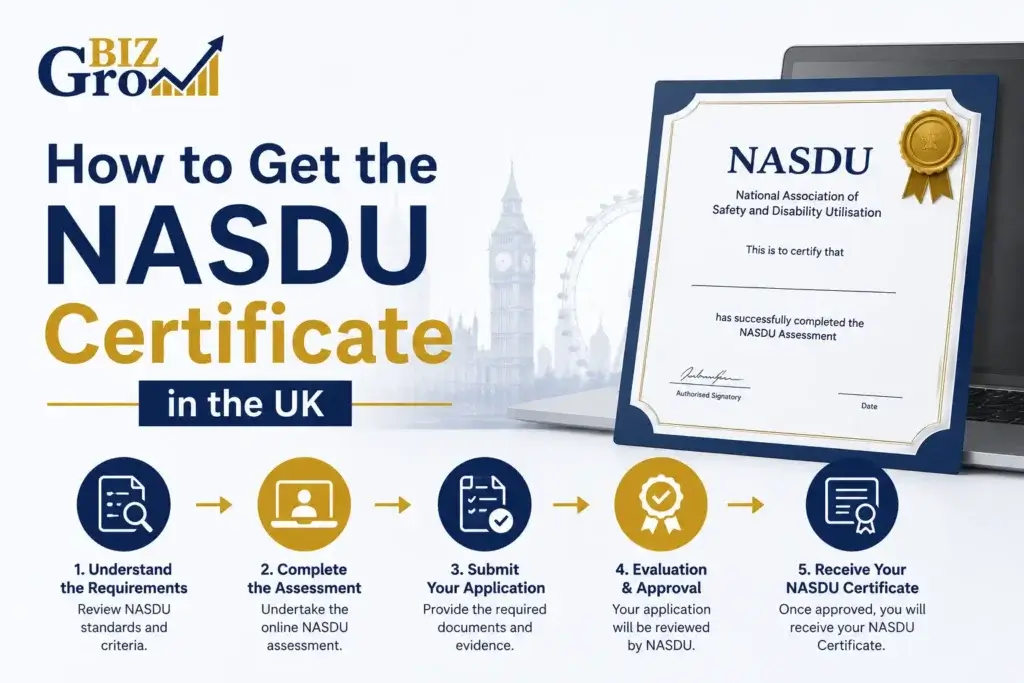
Step 1 | Meet the Entry Requirements
Before you can enrol in NASDU Level 2 training, you need to confirm you meet the entry requirements:
- You must be aged 18 or over
- You should hold an appropriate SIA licence (unless exempt) and be trained and competent in a general Security Officer role.
- You need a minimum Level 1 literacy standard
- You need a clean criminal record, relevant to working in licensed security
Learners who have proven GP dog handling experience as a Police or Prison Officer or a member of HM Armed Forces within the last 5 years may apply for Accreditation of Prior Learning (APL) of up to 35 GLHs. A minimum of 15 GLHs is required for the final assessment and examination.
If you do not yet hold an SIA licence, speak to your chosen training provider. A trainer may be able to offer the relevant security officer training alongside the dog handler training.
Step 2 | Find an Approved NASDU Instructor
Visit nasdu.co.uk and use the Approved Instructors and Trainers list to find a provider near you. Contact multiple providers, compare what they offer, and choose one with a strong track record and good support throughout the process.
Consider:
- Location and travel requirements
- Whether they provide a course dog or you need your own
- Course format spread over weeks or condensed
- Support provided during training and after assessment
Step 3 | Complete Your Training Programme
Attending all classes and completing all assignments is essential to fully prepare for the final assessment.
Your training will combine classroom theory with practical, hands-on sessions. You will work through all four units, roles and responsibilities, dog care, handling techniques, and search procedures. Your instructor will carry out ongoing assessments throughout the course.
Keep a record of all your training sessions. These records become part of your professional portfolio and may be required for future employment, compliance checks, or renewal.
Step 4 | Pass the Assessment
The mode of assessment is by practical ongoing assessment, question-and-answer sessions, and a written examination.
The written examination tests your knowledge of the legal framework, animal welfare, and operational procedures. The practical assessment evaluates your real-world ability to control your dog in operational scenarios, including patrol, search, handler protection, and bite-and-release.
It is important to remain calm and confident during the assessment and to follow all safety protocols.
The end-point assessment is conducted by an independent assessor. Pass this, and you have earned your NASDU certificate.
Step 5 | Receive Your NASDU Certificate
Once you pass, two certificates are issued:
- Your HABC Handler Certificate: a lifetime achievement document confirming your individual qualification
- Your NASDU Team Certificate: covering you and your specific dog, valid for 12 months
Achieving this qualification automatically entitles you to NASDU Team Membership.
You are now a NASDU-certified security dog handler. You can work in professional security dog roles, display your credentials to employers and clients, and operate in compliance with BS 8517 and UK industry standards.
How to Do a NASDU Check | Verifying a Certificate
A NASDU check is the process of verifying whether a handler holds a valid, current NASDU certificate.
If you are an employer, a security company, or a client procuring security dog services, verifying NASDU certification before deployment is essential.
Here is how:
- Contact NASDU directly at nasdu.co.uk or by telephone at 01483 224 320 to verify a handler’s or team’s certification status
- Ask the handler to present both their HABC Handler Certificate and their current NASDU Team Certificate
- Check the team certificate expiry date. If it has lapsed, the handler is not currently certified to deploy that dog
- For security companies, request copies of all certificates and maintain them on file as part of your compliance records
A handler’s individual certificate does not expire, but the team certificate does, every 12 months. Always check both. An individual certificate alone is not sufficient for active operational deployment.
If you are procuring canine security services for your business, always request a NASDU check as part of your due diligence process.
SIA Dog Handler Licence | Do You Need One?
As confirmed above, there is currently no standalone SIA licence for security dog handling. The SIA regulates security dog handlers through the existing licensing framework.
A relevant SIA licence will be required to work in the contract security industry.
For most security dog handlers in the UK, the required SIA licence is a Security Guard (Door Supervisor or Guarding) licence, depending on the operational context.
The SIA has consulted on developing more specific guidance for security dog handlers over the years, and the sector continues to advocate for clearer licensing provisions. For now, the combination of a valid SIA Security Guard licence plus a current NASDU team certificate remains the standard for fully compliant professional security dog work in the UK.
Always check the current SIA guidance at sia.homeoffice.gov.uk and NASDU guidance at nasdu.co.uk for the most up-to-date position.
NASDU Security Dogs | Industries and Sectors That Use Them
Several organisations use dog handlers in active roles, including the police, the Army, the RAF, search and rescue organisations, and private security firms.
In the private sector, NASDU-certified security dog teams are deployed across a wide range of industries:
- Construction sites: deterring theft of plant, materials, and equipment; protecting sites out of hours
- Industrial and logistics premises: warehouse and yard security, perimeter patrols
- Retail and commercial property: deterrence, crowd control, and perimeter management
- Events and venues: crowd management, access control, and threat deterrence at large events
- Housing and residential developments: protecting sites under construction and occupied developments
- Healthcare: protecting NHS sites, car parks, and facilities out of hours
- Utilities and infrastructure: protecting critical national infrastructure sites
- Public spaces: town centre management, licensed premises, and public transport hubs
Security dog teams provide a highly visible, highly effective deterrent. When deployed by NASDU-certified handlers working to BS 8517 standards, they are a credible, legally defensible security measure that clients across all these sectors trust.
How to Maintain and Renew Your NASDU Certificate
Your NASDU team certificate expires every 12 months. Maintaining your certification requires:
Annual Team Recertification: Each year, you and your dog must be reassessed by a NASDU-approved instructor to renew the team certificate. This ensures both handler and dog remain competent and operationally fit.
Continuation Training: BS 8517 recommends ongoing continuation training throughout the year. Many NASDU-approved companies run monthly training sessions with quarterly assessments. This keeps skills sharp and provides a documented training record.
Veterinary Records: Your dog must be maintained in good health. Current, up-to-date veterinary records are part of your compliance documentation and may be requested during audits or by clients.
Operational Records: Maintain records of all patrols, incidents, and training sessions. These records support compliance with BS 8517, insurance requirements, and any legal proceedings that may arise from an operational incident.
Key renewal tips:
- Book your renewal assessment at least 4 to 6 weeks before your team certificate expiry date
- Keep your dog’s training current throughout the year; do not let standards slip between assessments
- Ensure your SIA licence is also current and in date alongside your NASDU certificate
- Maintain all veterinary records and training logs continuously
If your team certificate lapses, you cannot legally deploy that dog in a professional contracted security role until it is renewed. Do not let it lapse.
How BizGrow Holdings Supports NASDU Certified Handlers
At BizGrow Holdings, we work across the UK security industry. We understand the standards that matter, and we help security businesses build operations that are genuinely compliant, professionally managed, and commercially competitive.
For businesses deploying security dog teams, compliance goes beyond just having NASDU certificates. Your wider business, your policies, your management systems, your contracts, and your accreditations all need to reflect the professional standard your clients expect.
Here is how BizGrow Holdings supports security businesses with NASDU-certified dog handlers:
- Compliance reviews: we check that your business’s use of security dogs meets BS 8517-1 requirements and your contractual obligations
- Policy development: We help you develop security dog deployment policies, welfare standards, and operational procedures
- SIA ACS support: we help security companies achieve SIA Approved Contractor Scheme approval, which requires compliance with BS 8517 for dog-handling services
- Contract review: We help you ensure your client contracts accurately reflect the standards and liabilities associated with security dog deployment
- Pre-qualification support: we help you satisfy CHAS, SafeContractor, and SSIP requirements that cover your dog-handling operations
- Training record systems: we help you build and maintain the documented training and certification records your business needs
- Client-facing compliance evidence: we help you present your NASDU certifications and BS 8517 compliance clearly to clients and procurement teams.
Whether you are a sole trader running a dog handling business or a larger security company with a canine division, BizGrow Holdings helps you operate professionally, compliantly, and competitively.
Visit bizgrow-holdings.com to speak with our compliance team today.
Conclusion | Start Your NASDU Certification Journey
The NASDU certificate is the gold standard for professional security dog handling in the UK. It is recognised by the SIA, aligned with BS 8517, assessed by independent qualified instructors, and renewed annually to ensure continuous competence.
For anyone serious about building a career or a business in security dog work, NASDU certification is not optional. It is the foundation of everything: your credibility with clients, your compliance with BS 8517, your protection under insurance, and your standing in the industry.
The path to your NASDU certificate is clear. Meet the entry requirements. Find an approved instructor. Complete your training. Pass your assessment. And maintain your team certificate annually.
If you want help building a NASDU-compliant security dog operation or if you need support with the broader compliance requirements for your security business, BizGrow Holdings is here to help.
Visit bizgrow-holdings.com today and take the first step.
FAQs About the NASDU Certificate in the UK
1. What is a NASDU certificate, and who needs it?
The NASDU certificate is the nationally recognised qualification for UK security dog handlers. Any handler working in contracted security with a dog needs a current NASDU team certificate alongside a valid SIA licence.
2. Is NASDU the same as an SIA dog handling licence?
No. The SIA licence covers your role as a security professional. The NASDU certificate covers your specialist dog-handling competence. Professional security dog handlers need both an SIA licence and a current NASDU team certificate.
3. How long does NASDU Level 2 training take?
NASDU Level 2 requires a minimum of 50 guided learning hours. Some providers deliver this over several weeks. Others offer condensed 5-day formats. The timeline also depends on whether you train with your own dog or a course dog.
4. How do I do a NASDU check on a handler’s certificate?
Contact NASDU directly via nasdu.co.uk or call 01483 224 320 to verify a handler’s certification status. Always check both the lifetime HABC handler certificate and the annual NASDU team certificate. The team certificate must be current.
5. Can sole traders or self-employed dog handlers get NASDU certified?
Yes. NASDU certification is open to individuals regardless of employment status. Sole traders and self-employed handlers can complete NASDU training and certification independently, then offer their services to security companies and clients as a NASDU-certified handler.