If you work in UK construction, facilities management, or security, you have almost certainly come across the term CHAS accredited contractor. More clients, local authorities, and principal contractors are now asking suppliers to prove their health and safety credentials before appointing them. Becoming a CHAS accredited contractor is one of the fastest and most trusted ways to do exactly that. This complete guide covers everything UK businesses need to know about CHAS accreditation in 2026.
What Is a CHAS Accredited Contractor?
A CHAS accredited contractor is a business that has passed an independent health and safety assessment carried out by the Contractors Health and Safety Assessment Scheme. The assessment confirms that the business has proper health and safety policies, risk assessments, training records, insurance, and management systems in place that meet nationally recognised standards.
When a contractor holds CHAS accreditation, it means an independent body has checked and verified their health and safety arrangements, not just taken their word for it. This distinction matters enormously to clients, buyers, and procurement teams who are responsible for appointing safe, competent contractors.
CHAS was established in 1997 by health and safety professionals and the Association of London Government to create a single, nationally recognised standard for health and safety compliance across multiple industries. Before CHAS existed, the process of approving contractors was inconsistent and time-consuming, with each organisation having its own safety requirements and forcing contractors to submit repetitive documentation and applications.
Today, more than 500 registered buyers across the UK accept CHAS accreditation as proof that a contractor meets legal requirements. This makes being a CHAS accredited contractor one of the most commercially valuable compliance credentials a UK business can hold.
What Does CHAS Stand For?
CHAS stands for Contractors Health and Safety Assessment Scheme. It is a UK-based accreditation scheme that assesses whether a business has appropriate health and safety arrangements in place before it is appointed to carry out work. CHAS was set up to cut through the hassle of multiple pre-qualification checks. Instead of filling in a different form for every client, you go through one CHAS assessment, and that result is then shared with over 2,500 CHAS clients across the UK.
CHAS is also a member of the Safety Schemes in Procurement forum, which means it is an SSIP-recognised scheme. When you get CHAS Standard or Advanced accreditation, you also receive SSIP accreditation. This means you can use your CHAS certificate to satisfy the SSIP requirements of many other clients too, which is known as deemed to satisfy. In practice, this saves contractors time and money since one assessment and one fee means recognition across a wide network of SSIP-accepting clients.
Is CHAS a Legal Requirement in the UK?
This is one of the most common questions asked about CHAS accreditation, and the answer is important to understand clearly.
Whilst there is no statutory requirement to hold CHAS accreditation, many clients in the construction industry insist that any contractors they engage hold an accreditation, either with CHAS or one of the other accreditation schemes.
CHAS accreditation itself is not a legal requirement. However, UK contractors still have legal duties to manage health and safety. CHAS helps demonstrate that your business has suitable health and safety arrangements in place.
In practice, the distinction between legally required and commercially essential is very narrow. More and more organisations, from local councils to private firms, now require CHAS or an equivalent accreditation before they will even consider you for a tender. If you are not CHAS accredited, you are simply not in the room.
For contractors working on CDM projects, the requirement becomes even clearer. On any CDM project involving five or more days, 20 or more workers, or 500 or more person-days, every contractor on site should hold CHAS or equivalent, since principal contractors check accreditation at the point of engagement.
CHAS Accreditation Levels Explained
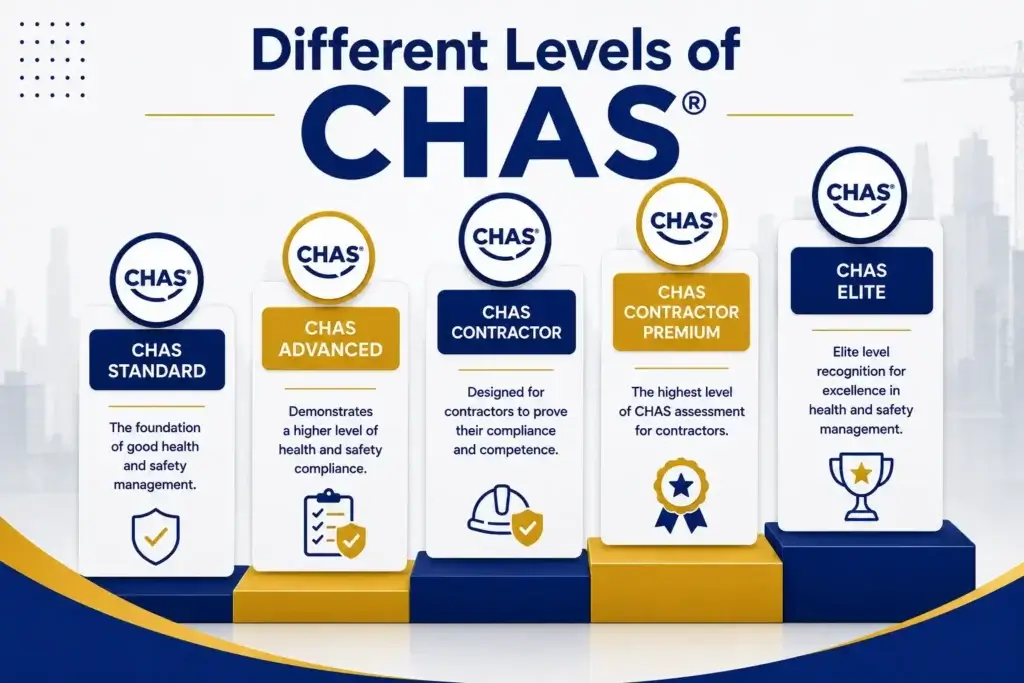
CHAS offers three membership levels, each covering a different depth of assessment. Choosing the right level from the start is important, since applying for a level that does not match what your clients require can mean going through the process again at a higher level shortly afterwards.
CHAS Standard
CHAS Standard is the entry-level accreditation and covers the SSIP core health and safety criteria. It is suitable for smaller contractors and sole traders who need to demonstrate basic health and safety competence to clients. CHAS Standard is often required in public sector tenders and is the most widely held level among UK contractors. It also grants SSIP recognition, which is accepted by hundreds of buying organisations across the country.
CHAS Advanced
CHAS Advanced builds on the Standard level by adding assessment across quality management, environmental management, equality and diversity, financial standing, and modern slavery. It Advanced aligns with the Common Assessment Standard, which is the industry-agreed benchmark increasingly required by major contractors and public sector frameworks. This is the level most commonly required by housing associations, NHS trusts, and mid-tier principal contractors.
CHAS Elite
CHAS Elite is the highest level and requires businesses to demonstrate compliance across nine areas of risk management, including health and safety, equality and diversity, and environmental management. It adds an on-site audit element to the desktop assessment, making it the most credible and thoroughly verified level of CHAS accreditation. For local authority and NHS framework work, CHAS Elite or equivalent is typically required.
Who Needs to Be a CHAS Accredited Contractor?
CHAS accreditation demonstrates that a contractor has appropriate policies, risk assessments, training arrangements and management systems in place. Any UK business that wants to work for clients who check health and safety credentials should seriously consider CHAS accreditation.
Businesses that most commonly need to be CHAS accredited contractors include:
- Building contractors and subcontractors
- Facilities management companies
- Security and guarding businesses
- Cleaning and maintenance providers
- Electrical, plumbing, and mechanical engineers
- Landscaping and groundworks businesses
- Construction consultants and project managers
Small contractors often need CHAS accreditation to work in the commercial construction market. If you want to work for main contractors, developers, housing providers, and local authorities, CHAS or equivalent becomes essential.
Documents Required to Become a CHAS Accredited Contractor
Preparing the right documents before applying is one of the most important steps in the CHAS process. Typical documents needed for CHAS accreditation include a health and safety policy, RAMS, training records, insurance certificates, accident reporting procedures, first aid arrangements, and evidence of competent health and safety advice.
A more complete list includes:
- A signed and dated health and safety policy reviewed within the last twelve months
- Risk assessments and method statements specific to your actual work activities
- Staff training records and competence evidence
- Valid public liability insurance certificate
- Valid employers liability insurance certificate
- Accident and near-miss reporting records
- Evidence of access to a competent health and safety adviser
- First aid arrangements and evidence of trained first aiders
- Health surveillance records where relevant to the work
At Advanced and Elite levels, you will also need environmental management policies, quality management procedures, equality and diversity policies, and modern slavery statements.
To improve your chances of passing CHAS the first time, make sure all documents are complete, current, consistent, and relevant to your work. Check RAMS, training evidence, insurance, accident procedures, and competent person details before submitting.
How to Get CHAS Accredited: Step by Step
The CHAS accreditation process is structured and manageable when you understand what is expected at each stage.
The process works as follows:
First, register your business on the CHAS portal at chas.co.uk and select the appropriate membership level for your business. Creating your account is quick, and entering your Companies House number during registration helps auto-populate many of your business details.
Second, complete the health and safety assessment questionnaire through the MyCHAS portal. This questionnaire is structured to guide you through all the areas being assessed. You can save your progress and return across multiple sessions, so you do not need to complete everything in one go.
Third, gather and upload all required supporting documents. Make sure every document is current, signed, and adapted to your actual business. Generic downloaded templates that have not been customised to your specific operations are one of the most common reasons assessors raise queries.
Fourth, submit your completed application and wait for a CHAS assessor to review your submission. Most applications are reviewed within a few working days if documentation is complete.
Fifth, respond promptly to any improvement requests from the assessor. Assessors may ask for additional evidence or clarification on certain points. Responding quickly at this stage keeps the process moving without unnecessary delays.
Finally, once your application is approved, your CHAS certificate is issued, and your business appears on the verified CHAS contractor database, which clients and buyers can search directly.
CHAS vs Other SSIP Schemes
Many UK businesses wonder how CHAS compares with other health and safety accreditations such as SafeContractor, SMAS, and Constructionline. All of these are SSIP member schemes, which means they assess against the same core health and safety criteria at their standard level.
The key differences come down to market recognition, sector strength, and additional services. CHAS is widely considered the most recognised and trusted SSIP scheme in the UK, with strong brand recognition across construction, facilities management, public sector procurement, and healthcare. SafeContractor has a particularly strong presence in facilities management and corporate clients. SMAS is commonly used in social housing and local authority work. Constructionline is dominant in the wider construction and housebuilding sectors.
For businesses that need to satisfy multiple clients across different sectors, holding CHAS alongside Constructionline or SafeContractor covers the widest possible range of buyer requirements. However, for most small and medium businesses just starting with pre-qualification accreditation, CHAS Standard is the most efficient and widely accepted starting point.
Common Reasons CHAS Applications Are Rejected
Understanding why applications fail helps businesses avoid the same mistakes and move through the process more efficiently.
Common reasons for rejection or delay include:
- A health and safety policy that is unsigned, undated, or not reviewed within the last twelve months
- Risk assessments and method statements that are clearly generic templates not adapted to actual work
- Insurance certificates that are expired or show insufficient levels of cover
- Missing evidence of accident reporting procedures or first aid arrangements
- No demonstration of access to a competent health and safety adviser
- Inconsistencies between questionnaire answers and uploaded documents
- Missing training records or competency evidence for key staff
Being thorough and making sure every document is current and business-specific before submitting gives your application the best possible chance of passing without unnecessary back-and-forth with the assessor.
Benefits of Becoming a CHAS Accredited Contractor
Achieving CHAS accreditation as a contractor delivers clear, measurable benefits that go well beyond simply having another certificate to display.
Key benefits include:
- Access to over 2,500 CHAS registered buyers across the UK including NHS trusts, local authorities, and major contractors
- SSIP recognition accepted by hundreds of additional buying organisations through the deemed to satisfy route
- Reduced need to complete repeated pre-qualification questionnaires for different clients
- Stronger credibility and competitive advantage in tender processes
- Improved internal health and safety systems, documentation, and procedures
- Reduced risk of workplace accidents, enforcement notices, and legal liability
- Annual renewal requirement that keeps your systems current and audit-ready at all times
- Access to exclusive CHAS member benefits including discounted insurance and legal advice services
When contractor safety fails, the consequences can include serious injury, project delays, enforcement notices, fines, and long-term damage to client relationships. Pre-qualification schemes such as CHAS provide a structured way to assess whether contractors meet recognised health and safety standards before they ever set foot on site. Holding CHAS accreditation shows your clients that you have already passed that check.
How BizGrow Holdings Helps UK Contractors Get CHAS Accredited
BizGrow Holdings supports UK contractors through the full CHAS accreditation journey, from understanding which membership level is right for their business to preparing all required documentation and submitting a clean, complete application.
The BizGrow Holdings team works directly with each client to review their existing health and safety documentation, identify gaps against CHAS assessment criteria, and build the policies, risk assessments, training records, and evidence needed to satisfy CHAS assessors first time. This structured, hands-on approach removes confusion, reduces the risk of assessor queries, and makes the whole process significantly faster and less stressful.
BizGrow Holdings also supports businesses with ISO 9001, ISO 14001, ISO 45001, SafeContractor, Constructionline, SIA ACS approval, and Cyber Essentials, making them the complete compliance partner for UK contractors that want to build a strong, joined-up accreditation portfolio without managing multiple consultancies at once.
Conclusion
Becoming a CHAS accredited contractor is one of the most practical and commercially valuable steps any UK business in construction, security, or facilities management can take. It proves your health and safety credentials to the clients that matter most, opens doors to contracts you could not access without it, and builds a stronger, safer, and more compliant business from the inside out.
With expert support from BizGrow Holdings, UK contractors can achieve CHAS accreditation confidently, efficiently, and right the first time, building the compliance foundation that supports real, lasting business growth in 2026 and beyond.
Frequently Asked Questions
Is CHAS accreditation worth it for small businesses?
Yes, most small businesses in construction and related sectors find CHAS accreditation essential for winning commercial contracts. Without it, many buyers will not even consider your application. It also improves your internal health and safety systems, which protects your business from costly incidents.
How long does CHAS accreditation last?
CHAS accreditation is valid for twelve months and must be renewed annually. Renewal requires updated documents and a reassessment through the MyCHAS portal. Starting the renewal process early helps avoid any gap in your accreditation status.
Can I check if a contractor is CHAS accredited online?
Yes, you can search the public CHAS contractor register directly at chas.co.uk. You will need the contractor’s company name or certificate number to verify their status. The result confirms whether the accreditation is currently active or expired.
How long does the CHAS accreditation process take?
Most applications are reviewed within a few working days once all documentation is complete and submitted. Delays usually happen when documents are missing, outdated, or require amendment. Having everything prepared properly before submitting speeds the process up significantly.
Does CHAS accreditation cover environmental and quality management?
CHAS Standard covers health and safety only. CHAS Advanced and Elite extend the assessment to include environmental management, quality management, equality and diversity, and other compliance areas. Choosing the right level for your clients’ requirements from the start avoids the need to upgrade shortly after initial accreditation.