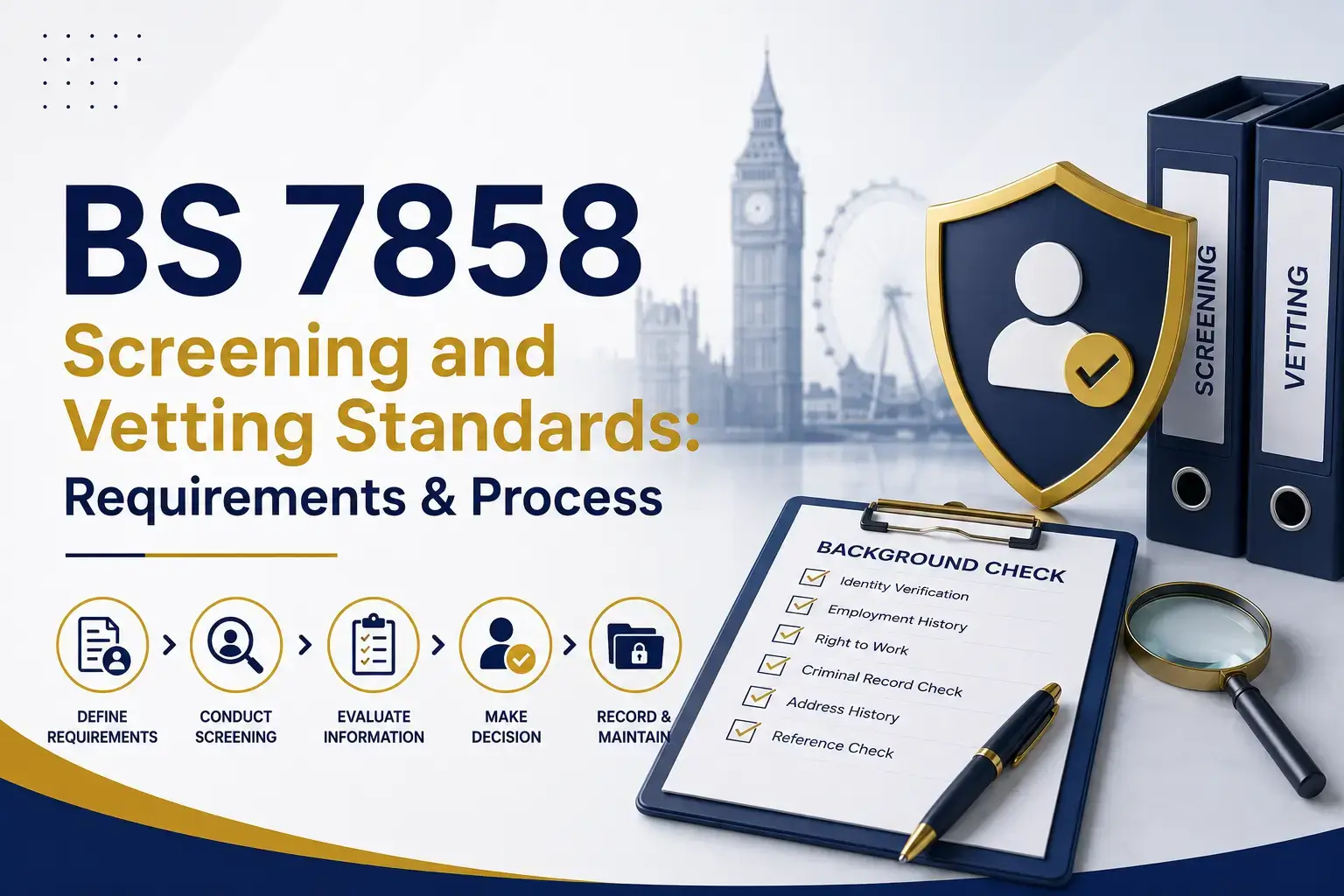
BS 7858 is the British Standard that defines best practice for the screening and vetting of individuals employed in security-sensitive roles. It is widely used across the UK security industry and is often a mandatory requirement for organisations providing guarding, key holding, CCTV monitoring, alarm response, and other security services.
The standard helps organisations ensure that individuals working in positions of trust are suitable, reliable, and properly vetted before being deployed. BS 7858 supports risk reduction, regulatory compliance, and professional accountability within security operations.
What Is BS 7858?
BS 7858 is a British Standard titled “Screening of individuals working in a secure environment: Code of practice.”
It sets out a structured framework for background screening checks to be completed on employees, contractors, and agency staff who work in security-sensitive environments.
The standard applies to both new starters and, in some cases, existing employees when roles change or risks increase.
BS 7858 is commonly referenced by:
- Security companies
- Facilities management providers
- Alarm receiving centres
- CCTV monitoring services
- Organisations handling sensitive assets, data, or premises
Why BS 7858 Screening Is Required
The purpose of BS 7858 screening is to reduce internal security risks by ensuring that individuals in trusted roles are suitable and transparent about their background.
It helps organisations:
- Prevent insider threats
- Protect clients, property, and information
- Meet contractual and regulatory obligations
- Demonstrate due diligence during audits and inspections
- Align with recognised UK security best practices
Many clients, insurers, and regulatory bodies expect BS 7858 compliance as a baseline requirement.
Who Needs BS 7858 Screening?
BS 7858 applies to individuals who:
- Have access to secure sites or restricted areas
- Handle keys, alarms, or security systems
- Monitor CCTV or alarm systems
- Work unsupervised in sensitive environments
- Are employed in guarding, mobile patrol, or response roles
It is relevant to both permanent employees and temporary or contract staff.
Core Requirements of BS 7858
BS 7858 sets out a clear list of checks that must be completed as part of the screening process. These checks must cover a minimum period and be supported by verifiable evidence.
1. Identity Verification
The individual’s identity must be confirmed using valid documentation.
This typically includes:
- Passport or national identity document
- Proof of current address
- Right to work in the UK
Identity verification ensures the person is who they claim to be.
2. Right to Work Check
Organisations must confirm that the individual has the legal right to work in the UK. This is a legal requirement and forms part of compliant employment screening.
3. Employment History (5-Year Check)
BS 7858 requires a minimum five-year employment history to be verified.
This includes:
- Previous employers
- Dates of employment
- Job roles
- Reasons for leaving
Any gaps in employment must be identified, explained, and supported with evidence.
4. Unemployment and Activity Gaps
All gaps in employment, education, or training during the five years must be accounted for.
Acceptable evidence may include:
- References
- Benefit records
- Educational certificates
- Written explanations supported by documents
Unexplained gaps are not acceptable under BS 7858.
5. Criminal Record Check
A criminal record check is a key part of the screening process.
For UK residents, this usually involves:
- A Basic DBS check (or higher where required)
For overseas residents:
- An equivalent criminal record check from the relevant country
The presence of a criminal record does not automatically disqualify an individual, but it must be assessed in line with risk and role suitability.
6. Character and Employment References
BS 7858 requires references to support the individual’s employment and character history.
References should:
- Be obtained from reliable sources
- Cover relevant periods of employment
- Be verified for authenticity
7. Financial Background Check (Where Applicable)
For roles involving access to high-value assets or sensitive systems, a financial check may be required.
This can include:
- Credit history review
- Bankruptcy or insolvency checks
The purpose is to identify potential financial vulnerability that could increase risk.
The BS 7858 Screening Process
The screening process follows a structured sequence to ensure consistency and compliance.
Step 1: Candidate Information Collection
The individual provides:
- Personal details
- Employment history
- Address history
- Identity documentation
Accuracy and completeness are essential at this stage.
Step 2: Verification and Evidence Gathering
The employer or screening provider verifies:
- Identity documents
- Employment references
- Right to work
- Criminal record checks
- Gap explanations
All checks must be documented and retained securely.
Step 3: Risk Assessment
Any findings, discrepancies, or disclosures are reviewed against:
- Role requirements
- Security risks
- Organisational policies
A decision is made on suitability based on evidence, not assumptions.
Step 4: Clearance Decision
Once all required checks are completed and assessed, the individual is either:
- Cleared for deployment
- Cleared with conditions
- Not cleared due to unresolved risks
The decision must be recorded and auditable.
Step 5: Record Keeping and Audit Readiness
BS 7858 requires:
- Secure storage of screening records
- Controlled access to sensitive data
- Availability of records for audits and inspections
Records must be maintained in line with data protection laws, including UK GDPR.
Ongoing Responsibilities Under BS 7858
BS 7858 is not a one-time exercise. Organisations must:
- Update screening if roles change
- Re-screen where risks increase
- Maintain accurate records
- Ensure processes remain consistent
Regular internal reviews help maintain compliance.
Relationship Between BS 7858 and Other Standards
BS 7858 often supports or complements other UK security requirements, including:
- SIA licensing
- ACS (Approved Contractor Scheme)
- ISO 9001 quality management
- ISO 45001 health and safety
- Client-specific vetting requirements
Together, these frameworks strengthen overall security governance.
Common Challenges in BS 7858 Screening
Organisations may face challenges such as:
- Incomplete employment histories
- Overseas checks are taking longer
- Poor record keeping
- Inconsistent processes across teams
Clear procedures and structured documentation help address these issues.
Importance of Compliance
Failure to meet BS 7858 requirements can result in:
- Failed audits
- Contract loss
- Regulatory scrutiny
- Reputational damage
Compliance demonstrates professionalism, accountability, and commitment to security best practices.
Frequently Asked Questions
1. What are BS 7858 Standards?
BS 7858 Standards are UK guidelines for screening individuals working in security-sensitive roles.
They ensure employees are trustworthy, reliable, and suitable for their position.
These standards are widely used across the UK security industry for compliance.
2. What is BS 7858 screening & vetting Process?
The BS 7858 screening & vetting Process involves background checks on employees.
This includes identity verification, employment history, and criminal record checks.
It ensures staff meet required security and compliance standards.
3. What is BS 7858 security screening & vetting?
BS 7858 security screening & vetting is a structured process to assess employee suitability.
It helps businesses reduce risks by verifying staff backgrounds.
It is essential for maintaining safety and trust in security roles.
4. What are BS 7858 screening Requirements?
BS 7858 screening Requirements include identity checks, 5-year employment history, and references.
It may also involve criminal record checks and credit history (if required).
These requirements ensure full compliance with UK security standards.
5. Is BS 7858 screening a mandatory requirement?
BS 7858 screening is not legally mandatory under UK law.
However, it is often required by clients and industry standards, especially in security roles.
In practice, it is essential for winning contracts and ensuring compliance.
Conclusion
BizGrow Holding‘s BS 7858 provides a clear and structured framework for screening individuals working in security-sensitive environments. By following its requirements and maintaining accurate records, organisations can reduce risk, meet industry expectations, and support secure operations.
Understanding the BS 7858 requirements and process is essential for any organisation involved in security services or trusted roles within the UK.