Running a business in the UK comes with real pressures.
Regulations are tightening. Risks are growing. And clients, investors, and regulators are asking harder questions about how businesses are managed and controlled. Internal audit consulting is one of the most effective ways to stay ahead of all of this. It gives your business an independent, expert view of how things are working and a clear roadmap for making them better.
Whether you run a growing SME or a larger organisation, this guide covers everything you need to know about internal audit consulting services in the UK: what they are, how they work, and why they matter.
At BizGrow Holdings, we provide internal audit consulting to UK businesses across a wide range of sectors. Let us walk you through it.
What Are Internal Audit Services?
Internal audit services are independent reviews of a business’s processes, controls, risks, and governance arrangements.
The purpose is to give business owners and senior leadership an honest, objective view of how well the organisation is being managed. Not just whether the numbers add up, but whether the right processes are in place, whether risks are being managed properly, and whether the business is operating efficiently and compliantly.
The Institute of Internal Auditors (IIA) defines internal auditing as “an independent, objective assurance and consulting activity designed to add value and improve an organisation’s operations.”
In practice, that means looking at how your business works from the inside, identifying weaknesses before they become problems, recommending improvements, and helping you build stronger systems and controls.
Internal audit services can be delivered by an in-house team, by an outsourced consultant, or through a co-sourcing arrangement where an external expert works alongside your existing team.
What Is the Role of an Internal Audit Consultant?
An internal audit consultant is an independent professional who reviews your business’s internal processes, risk management, and controls and tells you honestly what they find.
They are not there to find fault for the sake of it. Their job is to add value. They help you understand where your business is exposed, where processes are inefficient, and where you are at risk of regulatory or compliance failure.
Here is what an internal audit consultant typically does:
- Reviews your business processes, policies, and procedures
- Identifies risks and gaps in your internal controls
- Assesses how well your risk management framework is working
- Reviews compliance with relevant laws, regulations, and standards
- Evaluates financial controls and reporting accuracy
- Tests whether your procedures are being followed in practice, not just on paper
- Produces a clear written report with findings and prioritised recommendations
- Supports management in implementing improvements
A good internal audit consultant is not just a checker. They are a strategic adviser. They help you see your business more clearly and build it more securely.
Types of Internal Audit Consulting Services
Internal audit consulting is not one-size-fits-all. Different businesses need different types of reviews. Here are the main types of internal audit consulting services available in the UK:
Financial and Compliance Audits
These reviews focus on your financial controls, accounting processes, and compliance with financial regulations. They check that your financial reporting is accurate, that appropriate controls are in place to prevent fraud or error, and that your business is meeting its legal and regulatory obligations.
This type of audit is particularly important for businesses in regulated sectors, such as financial services, healthcare, charities, and public sector organisations.
Operational Audits
Operational audits look at how your business processes and activities work day to day. The focus is on efficiency, effectiveness, and risk.
Are your processes working as designed? Are resources being used well? And are there bottlenecks, duplication, or unnecessary complexity that cost time and money? An operational audit identifies these issues and recommends practical improvements.
IT and Cybersecurity Audits
With cyber threats growing and data protection regulations tightening, IT and cybersecurity audits have become increasingly important for UK businesses.
These reviews assess your IT infrastructure, data security practices, access controls, system reliability, and compliance with frameworks like UK GDPR, Cyber Essentials, and ISO 27001.
Risk Management Audits
A risk management audit reviews how your business identifies, assesses, and manages risk across all areas of operation.
It looks at whether you have a formal risk management framework, whether risks are being monitored regularly, and whether your risk appetite and controls are appropriate for the size and nature of your business.
Process and Performance Audits
These reviews focus on specific business processes, procurement, supply chain, HR, project management, or any other key function to assess whether they are working effectively and efficiently.
They are often used ahead of major changes, such as a merger, expansion, or significant investment.
What Are Internal Audit Standards in the UK?
Internal audit in the UK is guided by a clear set of internationally recognised professional standards.
The primary standard is the Global Internal Audit Standards published by the Institute of Internal Auditors (IIA) and adopted as of January 2025. These standards set out the principles, requirements, and expectations for the professional practice of internal auditing worldwide.
In the UK public sector, the Global Internal Audit Standards (with a UK Public Sector Application Note) replaced the previous Public Sector Internal Audit Standards (PSIAS) from 1 April 2025. This ensures UK public sector internal audit functions are aligned with global best practice.
The Chartered IIA is the professional body for internal auditors in the UK and Ireland. It provides guidance, training, and a Code of Professional Conduct to which all Chartered IIA members must adhere.
These standards cover:
- Independence and objectivity of the audit function
- Professional competence and due care
- Quality assurance and continuous improvement
- Risk-based audit planning
- Reporting and communication of findings
- Ethics and professional conduct
For businesses commissioning internal audit consulting services, working with consultants who follow these standards gives you confidence that the work will be thorough, objective, and professionally conducted.
What Are Internal Audit Procedures?
Internal audit procedures are the specific steps and methods an auditor uses to carry out an audit engagement.
They vary depending on the type and scope of the audit, but typically include:
- Planning, defining the scope, objectives, and risk areas of the audit
- Preliminary review gathering background information about the area being audited
- Risk assessment, identifying the key risks relevant to the audit scope
- Testing, examining evidence, sampling transactions, reviewing documents, and interviewing staff
- Analysis evaluating findings against the expected standard or control framework
- Reporting, documenting findings, conclusions, and recommendations in a clear written report
- Follow-up to track whether agreed actions have been implemented
Good internal audit procedures are proportionate, risk-based, and documented. They give the auditor and the client a clear record of what was done, what was found, and what action is recommended.
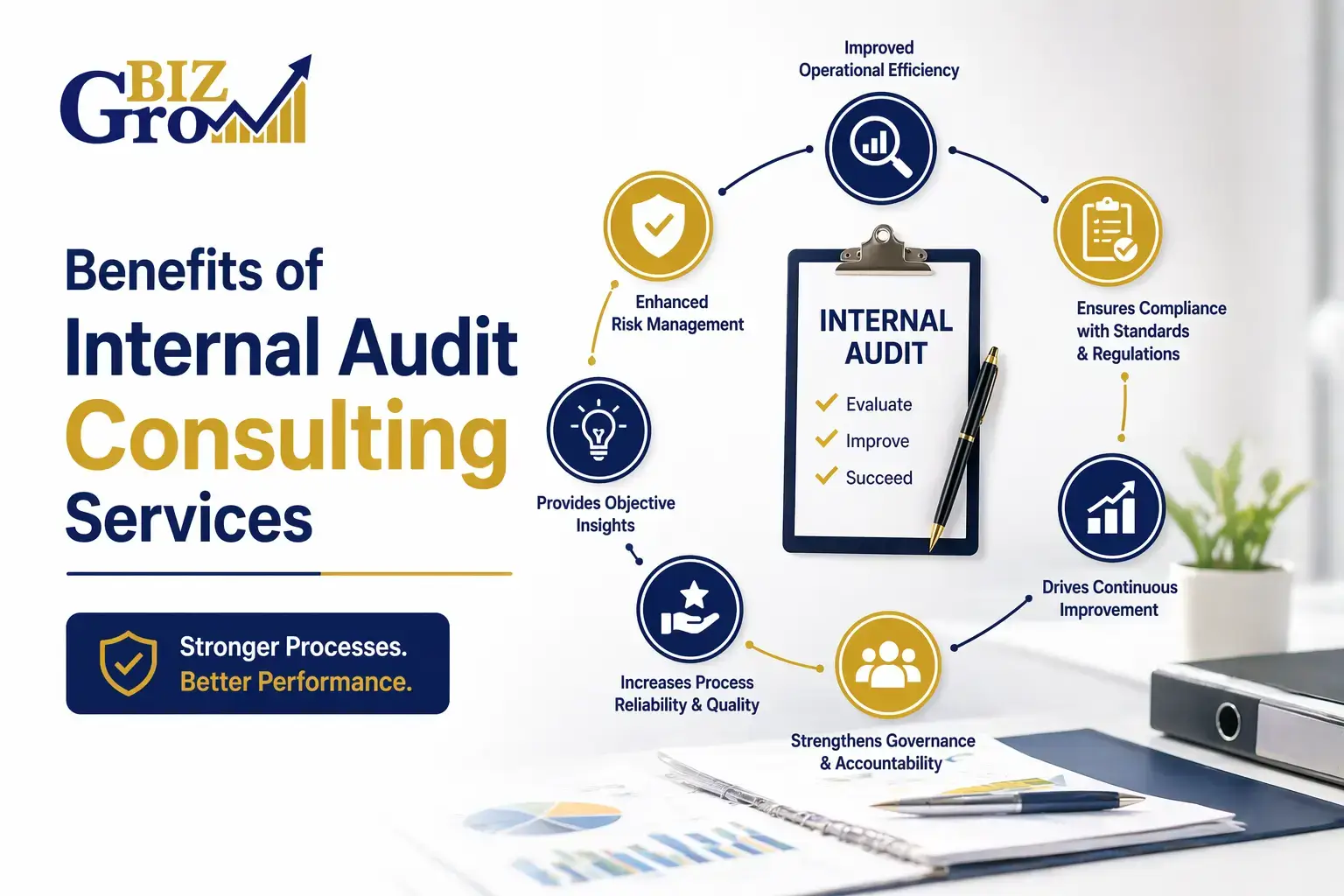
Top Benefits of Internal Audit Consulting Services
Now for the section that really matters. Here are the top benefits of using internal audit consulting services for your UK business:
Identify Hidden Risks Early
Most business risks do not arrive with a warning. They develop gradually in processes that are not followed correctly, controls that have gaps, or areas of the business that are not being monitored properly.
An internal audit consultant finds these risks before they become serious problems. Early identification gives you time to act before a small issue becomes a major liability, a regulatory breach, or a financial loss.
Improve Operational Efficiency
Businesses grow fast. Processes that worked when you had 10 staff may not work as well with 50. Systems that were set up years ago may no longer be fit for purpose.
An internal audit looks at how your operations actually work and identifies where time, money, or effort is being wasted. The recommendations that come from a good operational audit often pay for themselves many times over in efficiency gains.
Strengthen Compliance and Governance
UK businesses face an increasingly complex regulatory environment. GDPR, employment law, health and safety, financial regulations, sector-specific requirements, the list is long and growing.
An internal audit review helps you understand where your compliance gaps are and what you need to do to close them. It gives senior leadership and your board the assurance they need that the business is being managed properly and lawfully.
Save Time and Resources
Many businesses, especially growing SMEs, do not have the in-house expertise to conduct a thorough internal audit themselves. Hiring an external consultant gives you access to specialist knowledge without the cost and commitment of a permanent hire.
An outsourced or co-sourced internal audit is flexible. You pay for what you need, when you need it.
Get an Independent, Expert View
When you are running a business day to day, it is hard to see it objectively. Familiarity breeds blind spots.
An external audit consultant brings a fresh perspective. They are not involved in your day-to-day operations, not influenced by internal politics, and not motivated to protect the status quo. They tell you what they find honestly and professionally.
That independence is one of the most valuable things you can get from internal audit consulting.
Support Business Growth
If your business is growing, winning larger contracts, entering new markets, attracting investment, or pursuing accreditations, the quality of your internal controls and governance will come under scrutiny.
Investors, lenders, and major clients want assurance that a business is well-managed. Internal audit consulting helps you build the systems and evidence base that demonstrates exactly that.
Can Internal Audit Be Outsourced?
Yes, and it is increasingly common for UK businesses to do so.
Outsourced internal audit means you engage an external firm or consultant to carry out your internal audit function on your behalf. This is recognised and permitted under the Global Internal Audit Standards, which define outsourcing as “contracting with an independent external provider of internal audit services.”
There is also co-sourcing, where an external consultant works alongside your in-house team to provide additional expertise or capacity in specific areas.
Outsourcing is particularly suitable for:
- SMEs that do not have a dedicated internal audit function
- Businesses that need specialist expertise, such as IT, cybersecurity, or financial services knowledge that their in-house team does not have
- Organisations that want to avoid the cost and commitment of permanent staff
- Businesses preparing for a period of significant change or growth
The key requirement is that the outsourced function must remain independent and objective, working in the interests of the organisation, not the provider.
How to Do an Internal Audit | Simple Overview
If you are new to internal audit, here is a simple overview of how the process works:
Step 1 — Define the scope.
Decide what you are auditing: a specific process, department, risk area, or the whole business. Be clear about the objectives.
Step 2 — Plan the audit.
Identify the key risks in the area you are auditing. Decide what evidence you need to collect and how you will collect it.
Step 3 — Gather evidence.
Review documents, test transactions, interview staff, and observe processes in action. Record everything.
Step 4 — Analyse findings.
Compare what you find against the expected standard, your own policies, legal requirements, or industry best practice. Identify gaps and weaknesses.
Step 5 — Report.
Produce a clear written report with your findings, conclusions, and prioritised recommendations for improvement.
Step 6 — Follow up.
Agree on actions with management and track whether they are implemented.
This process applies whether you are doing a small, focused review or a comprehensive company-wide audit.
Internal Audit Checklist | Key Areas to Cover
When planning an internal audit, use this checklist as a starting point. Adapt it to your specific business and the scope of your review:
- Are health and safety policies and procedures current, documented, and followed?
- Financial controls are authorisation limits, reconciliations, and approvals in place and working?
- Data protection and GDPR compliance are personal data handling practices lawful and documented?
- HR processes contracts, right to work checks, disciplinary procedures, and training records
- Procurement and supplier management are purchases authorised, competitive, and properly documented?
- IT and cybersecurity controls include access controls, password policies, backup procedures, and incident response.
- Operational processes are key processes documented, followed, and monitored.
- Risk management is there a risk register? Is it maintained and reviewed regularly?
- Regulatory compliance are all sector-specific licences, certifications, and requirements current?
- Are governance board or management meeting records maintained? Are decisions properly documented?
This is not exhaustive, but it covers the core areas that most internal audit reviews will examine.
Examples of Internal Audit Consulting in Action
Here are three practical examples of how internal audit consulting makes a real difference for UK businesses:
Construction company preparing for a major contract. A mid-sized construction firm was bidding for a significant public sector contract. The client required evidence of strong financial controls and health and safety management. BizGrow Holdings conducted an operational and compliance audit, identified gaps in their procurement controls and H&S documentation, and supported the team in addressing them. The business won the contract and maintained a stronger governance framework going forward.
Growing retail business with compliance concerns. A retail business with 12 sites was struggling to ensure consistent processes across all locations. An internal audit identified inconsistencies in cash handling, training records, and GDPR compliance. The findings led to a company-wide process improvement programme that reduced errors and strengthened the business ahead of planned expansion.
Facilities management firm seeking ISO 9001 certification. A facilities management company wanted to achieve ISO 9001 certification. An internal audit review identified the gaps between their current systems and the standard’s requirements, allowing them to prepare a targeted action plan and achieve certification on their first external assessment.
How BizGrow Holdings Delivers Internal Audit Consulting
At BizGrow Holdings, we provide practical, independent internal audit consulting to UK businesses across a wide range of sectors, including construction, facilities management, security, retail, professional services, and the public sector.
We are not a large firm with a one-size-fits-all approach. We work closely with each client, understanding their business, their risks, and their priorities, then delivering genuinely useful audit work.
Here is what we offer:
- Financial and compliance audit reviews identifying control gaps and regulatory risks
- Operational audit: improving efficiency and effectiveness across your key processes
- Risk management reviews building and strengthening your risk framework
- IT and cybersecurity audit support assessing controls and compliance with UK GDPR and Cyber Essentials
- Health and safety compliance audit reviewing your H&S systems against legal requirements and accreditation standards
- Pre-accreditation internal audit, preparing your business for ISO 9001, CHAS, SIA ACS, and other certifications
- Outsourced and co-sourced internal audit flexible support for businesses without a dedicated in-house function
- Written audit reports with clear, prioritised recommendations
- Follow-up support to help you implement the agreed actions
We believe internal audit should be straightforward, honest, and genuinely helpful. Not a box-ticking exercise, but a real tool for improving your business.
If you want to find out how internal audit consulting can benefit your business, visit bizgrow-holdings.com and speak to our team today.
Conclusion | Why Internal Audit Consulting Matters
Internal audit consulting is not just for large corporations or heavily regulated industries.
Any UK business that wants to manage risk properly, operate more efficiently, stay compliant, and build the governance foundations for growth can benefit from it.
In 2026, the regulatory environment is more demanding than ever. Clients are asking harder questions. Supply chains are under greater scrutiny. And the cost of getting things wrong in financial penalties, reputational damage, or lost contracts has never been higher.
Internal audit consulting gives you the independent, expert view you need to stay ahead of those challenges.
BizGrow Holdings is ready to help. Visit bizgrow-holdings.com today to take the first step.
FAQs About Internal Audit Consulting Services
1. Can the internal audit provide consulting services?
Yes. The IIA defines internal auditing as both an assurance and a consulting activity. Internal auditors can provide advisory support, helping management improve processes, controls, and risk management alongside their traditional assurance role.
2. What is the difference between an internal audit and an external audit?
Internal audit is an ongoing review of a business’s processes, risks, and controls, carried out for the benefit of management and the board. An external audit is an independent review of financial statements, required by law for certain organisations, carried out for the benefit of shareholders and regulators.
3. How often should a business carry out an internal audit?
It depends on the size and complexity of the business and the risks involved. Many businesses conduct a full internal audit annually, with targeted reviews of specific areas more frequently. A risk-based approach, auditing the highest-risk areas first, is recommended.
4. Is internal audit consulting suitable for small businesses?
Yes. Small and medium-sized businesses often benefit most from outsourced internal audit consulting, as they gain access to specialist expertise without the cost of a permanent in-house function. The scope and scale of the audit are tailored to the size of the business.
5. How long does an internal audit take?
It depends on the scope of the review and the size of the business. A focused audit of a specific process or area might take a few days. A comprehensive company-wide review could take several weeks. BizGrow Holdings will agree on a clear timeline with you before any work begins.