If you work in UK construction, facilities management, or security, you have almost certainly come across the term RAMS. It appears on tender documents, site induction packs, and pre-qualification questionnaires across every sector where work carries a level of risk. But what does the RAMS abbreviation actually mean, and why does it matter so much for UK contractors? This guide explains everything clearly and simply.
What Is the RAMS Abbreviation?
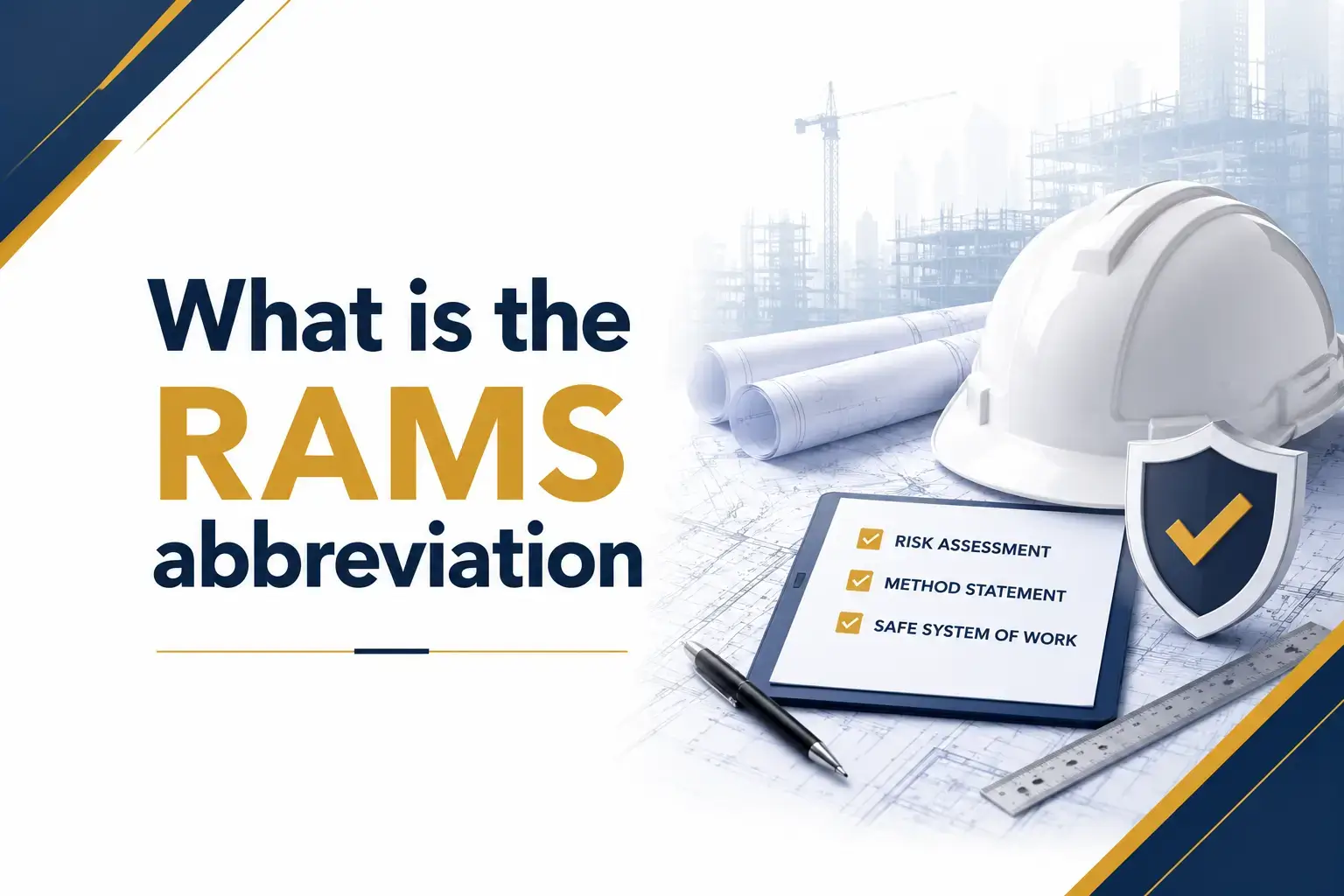
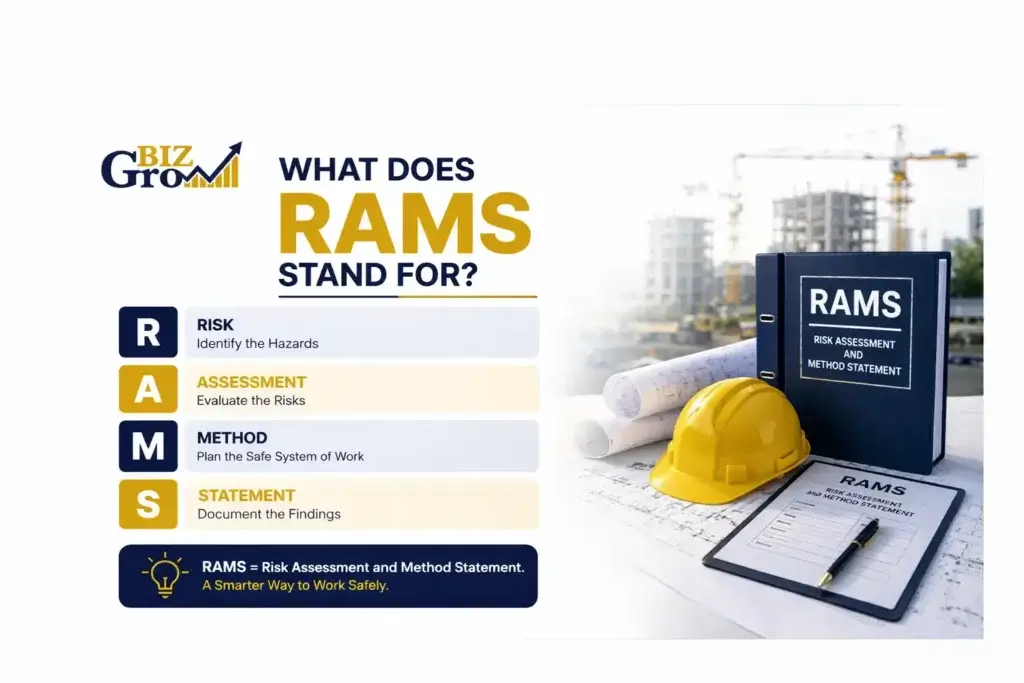
RAMS is an abbreviation that stands for Risk Assessment and Method Statement. It refers to two closely related health and safety documents that are almost always prepared together and submitted as a single combined package.
The RAMS abbreviation is one of the most widely used terms across the UK construction and high-risk industries. When a principal contractor, client, or procurement team asks for your RAMS before work begins, they are asking for documented proof that you have properly planned and risk-assessed the specific task you are about to carry out.
Together, the two parts of a RAMS document answer two fundamental questions:
- What could go wrong, and how will you control those risks?
- How will the work actually be carried out safely, step by step?
Without both answers clearly documented, most UK principal contractors will not allow work to begin on their sites.
What Is a Risk Assessment in RAMS?
The risk assessment is the first and most legally fundamental part of a RAMS document. A risk assessment is a structured examination of a specific work activity that identifies the hazards involved, evaluates the level of risk each hazard poses, and records the control measures to be implemented to eliminate or reduce those risks to an acceptable level.
Under Regulation 3 of the Management of Health and Safety at Work Regulations 1999, every employer is legally required to carry out a suitable and sufficient assessment of the risks arising from their work activities. This is not optional. It applies to every UK business regardless of size or sector.
A good risk assessment within a RAMS document should cover:
- Every significant hazard associated with the specific task being assessed
- Who could be harmed by each hazard, including workers, subcontractors, and members of the public
- The likelihood and severity of harm for each hazard
- The specific control measures that will be put in place before and during the work
- Any residual risk remaining after controls are applied
The risk assessment must be task-specific. A generic risk assessment copied from a template and not adapted to the actual work being done is unlikely to be accepted by a principal contractor or to satisfy an HSE inspector if something goes wrong.
What Is a Method Statement in RAMS?
The method statement is the second part of the RAMS document. While the risk assessment focuses on what could go wrong, the method statement explains how the work will actually be carried out, step by step, in a safe and controlled manner.
A method statement is not a legal requirement in the same direct sense as a risk assessment. However, it is considered best practice by the HSE, and it is contractually required on virtually every UK construction project. For certain high-risk activities such as demolition, the law requires written arrangements for safe systems of work before the task begins, which a method statement effectively provides.
A well-written method statement within a RAMS document should include:
- A clear description of the work activity being covered
- The sequence of operations, broken down into manageable steps
- The plant, equipment, and materials that will be used
- The personal protective equipment (PPE) required at each stage
- The names and roles of key personnel responsible for the work
- Emergency procedures in case something goes wrong
- Reference to relevant legislation, industry standards, and manufacturer guidance
The method statement gives everyone involved in the work, from site supervisors to individual operatives, a clear, structured guide to carrying out the task safely from start to finish.
Are RAMS a Legal Requirement in the UK?
This is one of the most commonly asked questions about the RAMS abbreviation. The answer is nuanced but important to understand.
The risk assessment element of RAMS is a direct legal requirement under the Management of Health and Safety at Work Regulations 1999. Every employer must carry out suitable and sufficient risk assessments for all significant work activities. This requirement applies regardless of whether a client or principal contractor has asked for it.
The method statement element is not explicitly required by name in UK legislation. However, it is endorsed by the HSE as best practice for planning and communicating safe systems of work, particularly for higher-risk or complex tasks. It is also contractually required under CDM 2015 and by the vast majority of principal contractors across UK construction.
In practice, for any contractor working on a UK construction site in 2026, RAMS are effectively mandatory. No principal contractor will allow work to start without them, and submitting work without adequate RAMS is grounds for being removed from the site immediately.
Who Needs to Produce RAMS?
Any UK contractor or employer carrying out work that presents a significant risk to health and safety needs to produce RAMS. This is particularly important in:
- Construction and civil engineering
- Demolition and structural work
- Facilities management and building maintenance
- Security and guarding operations
- Manufacturing and engineering
- Logistics and warehousing
In a construction context, principal contractors typically ask all subcontractors to submit RAMS before starting any activity on site. The principal contractor then reviews each RAMS submission to make sure the planned work aligns with the overall construction phase health and safety plan and does not create conflicts with other work happening on the same site at the same time.
Self-employed tradespeople are not exempt. If your work poses a risk to others, you need RAMS, even if you work alone.
When Should RAMS Be Produced?
RAMS should always be produced before work begins, not after. This is a point that catches some contractors out, since the pressure to start on site quickly can sometimes lead to RAMS being produced in a rush or after the task has already started.
RAMS should specifically be produced:
- Before starting any new high-risk task on a construction site
- Before mobilising onto a new client site for the first time
- When tendering for new work, since many procurement processes ask, for example, for RAMS as evidence of competence
- When the scope of work changes significantly during a project
- When a near miss or incident reveals that the original RAMS did not adequately address the risks encountered
The earlier RAMS are produced in the planning process, the more useful they are. Good RAMS inform the work rather than simply document it after the fact.
What Should a RAMS Document Include?
A properly prepared RAMS abbreviation document needs to contain specific information that gives both the contractor and the client confidence that the work has been thoroughly planned and the risks properly addressed.
Essential contents of a RAMS document include:
- Project information: the project name, site address, client name, principal contractor, and dates of planned activity
- Description of the work: a clear explanation of exactly what task or tasks are being covered by this specific RAMS
- Hazard identification: a comprehensive list of all hazards associated with the work, including physical, chemical, biological, ergonomic, and psychosocial hazards where relevant
- Risk evaluation: an assessment of the likelihood and severity of harm for each hazard, usually expressed as a risk rating
- Control measures: the specific steps that will be taken to eliminate or reduce each identified risk
- Method of work: a step-by-step sequence of operations explaining how the task will be carried out safely
- Plant and equipment: details of all machinery, tools, and equipment that will be used
- PPE requirements: a list of personal protective equipment required for each stage of the work
- Key personnel: the names and roles of the site supervisor, operatives, and any competent persons responsible for safety during the task
- Emergency procedures: what to do if something goes wrong, including first aid arrangements and emergency contact details
- Signatures: sign-off from the person who prepared the RAMS, the supervisor responsible, and confirmation that operatives have read and understood the document before starting work
Common Tasks That Require RAMS in Construction
While any significant work activity may require a RAMS document, certain tasks almost always require them on UK construction sites regardless of project size or duration.
Common tasks that require RAMS include:
- Working at height, including scaffold erection, roof work, and ladder use
- Excavation and trenching
- Demolition and structural alteration
- Hot works, including welding, cutting, and grinding
- Confined space entry
- Work near live electrical services
- Lifting operations using cranes or MEWPs
- Asbestos-related work
- Installation of heavy plant or equipment
- Work near water
For each of these tasks, the RAMS must be task-specific and must reflect the actual conditions at the specific site rather than a generic description of how the task is typically carried out.
Common Mistakes Contractors Make with RAMS
Many contractors produce RAMS that fail to satisfy principal contractors or HSE inspectors, not because their work practices are poor but because the documents themselves are inadequate. Understanding the most common mistakes helps contractors avoid them.
Common mistakes include:
- Using generic templates that have not been adapted to the specific task or site
- Listing hazards without providing specific, practical control measures for each one
- Failing to include a step-by-step method statement alongside the risk assessment
- Not having operatives sign the RAMS to confirm they have read and understood it before starting work
- Producing RAMS after work has already started
- Failing to review and update RAMS when site conditions or scope of work changes
- Using vague language such as “take care” or “be cautious” instead of specific control measures
- Missing key information such as emergency procedures, PPE requirements, or responsible persons
Principal contractors are increasingly rigorous about RAMS quality. Poor or incomplete submissions are now a common reason for work being stopped on site, which creates delays and damages contractor relationships that are difficult to repair.
How RAMS Support Accreditation and Compliance
RAMS are not just a site safety tool. They play a central role in almost every health and safety accreditation that UK contractors pursue. When applying for CHAS, SafeContractor, Constructionline, CQMS, or ISO 45001, assessors will ask to see examples of your RAMS as evidence that your business has a working, practical approach to health and safety management.
Generic, untailored RAMS abbreviation are one of the most common reasons accreditation applications are rejected or delayed. Assessors want to see RAMS abbreviation that are clearly specific to your actual work activities, since this demonstrates that your health and safety approach is genuine rather than just paper compliance.
Well-prepared, task-specific RAMS also support ISO 45001 certification, which requires documented evidence of hazard identification, risk assessment, and safe systems of work across your operational activities. This investment in quality RAMS preparation is directly beneficial to both your day-to-day site safety and your longer-term compliance and accreditation goals.
How BizGrow Holdings Helps UK Contractors with RAMS and Compliance
BizGrow Holdings supports UK contractors across construction, security, and facilities management with practical RAMS preparation as part of their wider health and safety and compliance consultancy service.
The BizGrow Holdings team helps businesses produce task-specific, auditor-ready RAMS that satisfy principal contractor requirements and support successful accreditation applications. Rather than providing generic templates, the team works directly with each client to understand their specific work activities and produce documentation that genuinely reflects how the work will be carried out safely on site.
BizGrow Holdings also supports businesses with CHAS, SafeContractor, Constructionline, CQMS, ISO 9001, ISO 14001, ISO 45001, SIA ACS approval, and Cyber Essentials, making it the complete compliance partner for UK contractors who want to build a strong, joined-up compliance portfolio without the complexity of managing multiple consultancies at once.
Conclusion
Understanding the RAMS abbreviation and what it means in practice is essential knowledge for any UK contractor. RAMS are not just paperwork. They are the documented proof that work has been properly planned, risks have been identified and controlled, and everyone involved knows exactly how the job will be carried out safely.
With expert support from BizGrow Holdings, UK contractors can produce RAMS that satisfy principal contractors, pass accreditation assessments, and demonstrate the kind of genuine compliance that serious clients and procurement teams expect to see in 2026 and beyond.
Frequently Asked Questions
Is a method statement the same as a RAMS?
No, a method statement is just one part of a RAMS document. RAMS combines both a risk assessment and a method statement into a single package. Together, they cover what could go wrong and how the work will be done safely.
Who is responsible for writing RAMS on a construction site?
The employer or contractor carrying out the specific work is responsible for producing their own RAMS. Input from supervisors and experienced operatives who actually do the work is essential. The principal contractor reviews submissions but does not write RAMS on behalf of subcontractors.
Can generic RAMS be used on a UK construction site?
Generic RAMS are rarely accepted by principal contractors or accreditation assessors. Every RAMS must be specific to the actual task and site conditions. Using untailored templates is one of the most common reasons RAMS submissions are rejected.
How often should RAMS be reviewed and updated?
RAMS should be reviewed before every new task or site and updated immediately if conditions change significantly during the work. They must also be reviewed following any near miss, incident, or change in scope. An outdated RAMS abbreviation that no longer reflects current site conditions is treated as no RAMS at all.
What happens if a contractor does not have RAMS on site?
Work can be stopped immediately by the principal contractor or HSE inspector until adequate RAMS are produced. Repeated failures can result in removal from the approved contractor list. In serious cases, the HSE can issue improvement notices or pursue prosecution under health and safety legislation.