If you want to work in the UK private security industry, becoming SIA licensed is the single most important step you can take. Without a valid SIA licence, working in most security roles is illegal. This guide explains exactly what it means to be SIA licensed, who needs one, and how to get yours step by step in 2026.
What Does SIA Stand For?
SIA stands for Security Industry Authority. It is the official government body responsible for regulating the private security industry across England, Scotland, and Wales. The SIA was established under the Private Security Industry Act 2001 to make sure that everyone working in security roles meets nationally recognised standards of training, conduct, and suitability.
The SIA issues licences to individuals, maintains a public register of licence holders, and takes enforcement action against those who work illegally without a licence. It also runs the Approved Contractor Scheme, which is the quality standard for security companies rather than individual workers.
What Does It Mean to Be SIA Licensed?
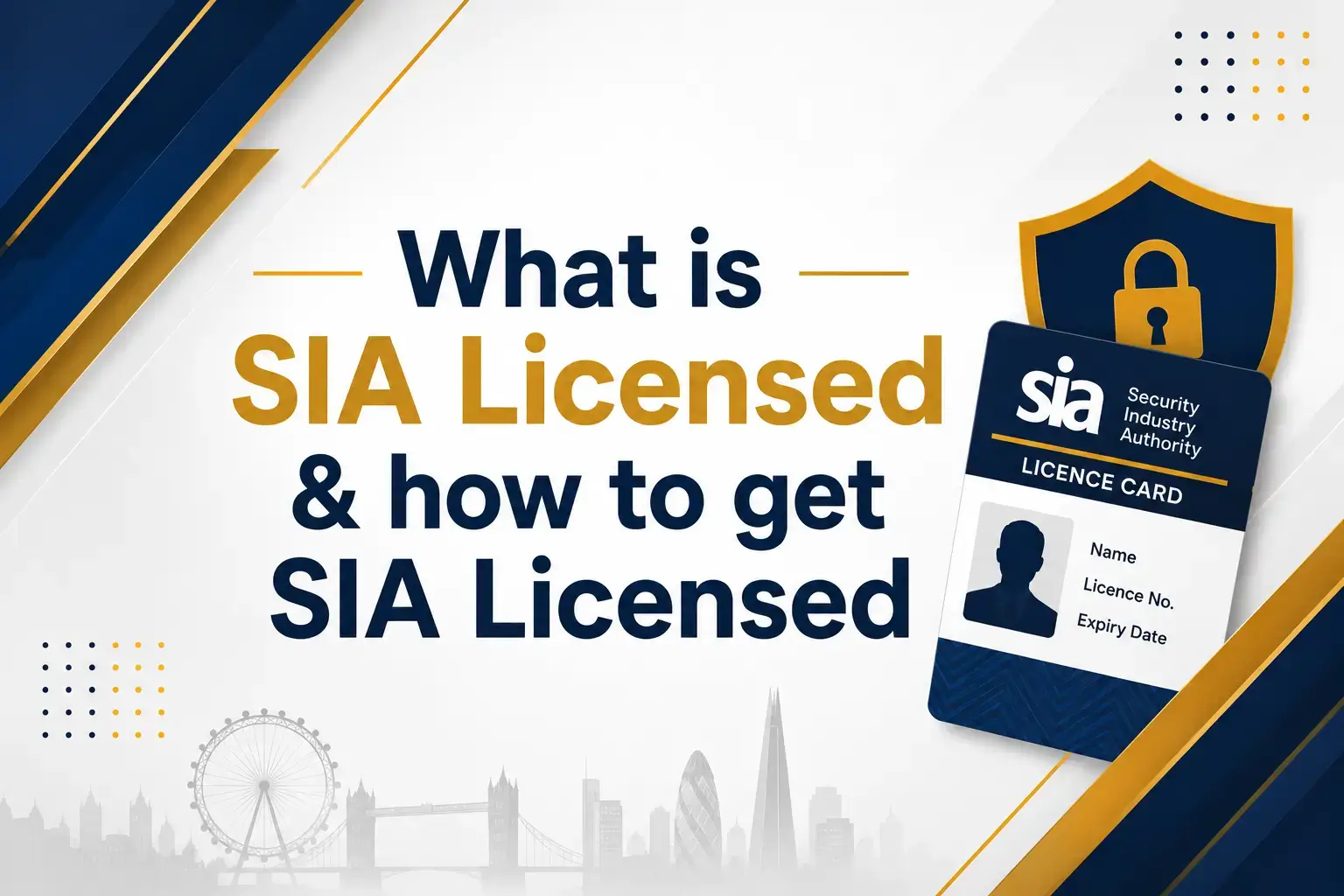
Being SIA licensed means you hold a valid licence issued by the Security Industry Authority that legally allows you to carry out specific security work in the UK. The licence comes in the form of a credit-card-sized badge with your photograph, name, licence number, licence category, and expiry date printed on it.
This badge must be worn visibly on the outer layer of your clothing at all times when you are on duty. Failing to display it is a separate criminal offence, even if your licence itself is valid.
Being SIA licensed tells employers, clients, and the public that you have passed the required training, cleared identity and criminal record checks, and met the SIA’s suitability standards. It is not just a formality. It is proof that you are a trained, vetted, and legally approved security professional.
Who Needs to Be SIA Licensed in the UK?
Anyone carrying out licensable security activities in the UK must hold a valid SIA licence. This applies to individuals working for a security company and, in most cases, to those working directly for a single employer in a security role.
Roles that require an SIA licence include:
- Security guarding at offices, warehouses, retail sites, and construction sites
- Door supervision at pubs, clubs, bars, and entertainment venues
- Close protection of individuals facing personal security risks
- CCTV monitoring in public spaces
- Key holding and alarm response
If your role involves protecting people, property, or premises as part of the UK private security industry, you almost certainly need to be SIA licensed before you can legally start work.
Types of SIA Licences Available
There are several SIA licence types, each covering specific security activities. Choosing the right one before starting training is essential, since the wrong licence type means you cannot legally carry out the role you are being hired for.
Security Guard Licence
The Security Guard licence covers static and mobile guarding at locations such as offices, retail stores, warehouses, and construction sites. It focuses on access control, patrolling, incident reporting, and general site protection. This is the most common entry-level licence for people starting a security career in the UK.
Door Supervisor Licence
The Door Supervisor licence allows the holder to work at licensed premises such as pubs, nightclubs, and event venues, as well as to carry out general security guarding work. This makes it the most versatile SIA licence available. Many people choose this route specifically because one licence covers two types of work, which opens up more job opportunities from day one.
Close Protection Licence
The Close Protection licence allows individuals to provide personal protection to specific clients such as executives, celebrities, politicians, and high-net-worth individuals. This is one of the most demanding and specialist SIA licences, requiring advanced training in threat assessment, route planning, surveillance awareness, and emergency response. From April 2026, close protection licence holders must also complete mandatory refresher training before renewal.
CCTV Operator Licence
The CCTV Operator licence, formerly known as the Public Space Surveillance licence, is required for anyone actively monitoring CCTV systems in public spaces as part of their job. This covers operators working in town centres, transport hubs, shopping centres, and public buildings. It does not apply to staff monitoring private internal CCTV solely within a single private premises.
Key Holder Licence
The Key Holder licence covers individuals who hold keys to client properties and respond to alarm activations outside normal business hours. This role is often combined with mobile patrol duties and requires a high level of trust, since the holder has direct, unsupervised access to secured client sites.
Eligibility Requirements to Become SIA Licensed
Before applying for an SIA licence, you must meet a set of basic eligibility criteria. These are checked carefully during the application process, so confirming them early saves time and avoids wasted effort.
To be eligible, you must:
- Be at least 18 years old
- Have the legal right to work in the UK
- Hold the correct accredited qualification for your chosen licence type
- Pass a criminal record check through the Disclosure and Barring Service
- Pass an identity verification check
- Be able to communicate clearly in English
The SIA assesses each application individually. Having a previous conviction does not automatically result in refusal, but the type of offence, how long ago it occurred, and the sentence given are all considered carefully using the criteria set out in the SIA’s Get Licensed booklet, updated in May 2026.
How to Get SIA Licensed in the UK: Step by Step
Complete Your First Aid Qualification
The first step, before anything else, is completing a recognised first aid qualification. For Security Guard and Door Supervisor routes, this is typically an Emergency First Aid at Work certificate. For Close Protection, a higher Level 3 First Aid at Work qualification is required.
This step catches many new applicants off guard, since most assume training comes first. In reality, training providers will not accept you onto an SIA course without a valid first aid certificate already in place. Getting this done early keeps the rest of the process moving smoothly.
Enrol on an Approved SIA Training Course
Once your first aid certificate is secured, you can enrol on the relevant SIA-approved training course for your chosen licence type. Training providers must be accredited by recognised awarding bodies such as Highfield Qualifications or City and Guilds.
Typical courses last between four and six days, depending on the licence type. They combine classroom learning with practical exercises and scenario-based assessments. For 2026, all SIA training incorporates updated content, including conflict management, counter-terrorism awareness under Martyn’s Law, safeguarding, and emergency response procedures.
Only the theoretical elements of some courses can be delivered online. Practical assessments must always be completed in person at an approved training centre.
Pass Your Exams and Assessments
At the end of your course, you will sit written multiple-choice exams alongside practical assessments. These test your understanding of real-world security situations, not just theoretical knowledge.
Passing these assessments earns you the qualification needed to move forward with your SIA licence application. Without a pass certificate from an accredited provider, your application cannot proceed regardless of how well you do in other areas.
Create Your SIA Online Account
Once training is complete, visit the official GOV.UK portal and create an SIA online account. This account is where your entire application will be managed from start to finish. You will need a working email address and a UK mobile number for two-factor authentication.
If you have held an SIA licence before, always use your existing account rather than creating a new one. Duplicate accounts trigger additional checks that cause unnecessary delays.
Submit Your Application and Documents
Through your SIA online account, complete the application form covering your personal details, address history for several recent years, employment background, and training information. Every detail must be accurate and consistent with your supporting documents.
You will need to upload:
- A valid passport or photocard driving licence
- Two proofs of address dated within the last three months
- Your National Insurance number or recent payslip
- Your original SIA-endorsed training certificate
- Full five-year address history with no unexplained gaps
- Declaration of all convictions, cautions, and relevant criminal matters
Pay the application fee before submission. This fee is non-refundable in all circumstances, so double-checking everything before submitting is essential.
Pass Identity and Criminal Record Checks
After submission, the SIA runs identity verification and a DBS criminal record check. You will receive instructions to present original documents at a participating Post Office branch to complete identity verification in person.
If you have lived outside the UK for six continuous months or more in the last ten years, you must provide a certified criminal record check from that country. This requirement was extended from five to ten years as of December 2025, so overseas applicants need to plan this carefully in advance.
How to Check SIA Licence Status in the UK
Anyone can check an SIA licence using the free Register of Licence Holders on GOV.UK website. This tool is used by employers, clients, and members of the public to verify whether a person currently holds a valid and active SIA licence.
To check an SIA licence, you need the person’s surname and their licence number, which appears on the front of the badge. The result confirms whether the licence is currently active, expired, or revoked.
Employers have a legal duty to carry out this check before deploying any member of staff in a licensable security role. Using this tool before hiring protects businesses from the serious legal consequences of unknowingly employing an unlicensed worker.
New SIA Rules You Must Know in 2026
Several significant changes came into effect in 2026 that every SIA-licensed professional must be aware of.
Key changes include:
- Licence fee increase: From April 2026, the SIA licence fee is £204 per licence. If applying for more than one licence in the same application, a 50% discount applies to the additional licence from June 2026.
- Extended overseas criminality checks: Anyone who has lived outside the UK for six or more continuous months in the last ten years must provide overseas criminal record certificates. This was previously five years.
- Mandatory refresher training: Door Supervisors and Security Guards must complete SIA-approved refresher training before renewing their licence. Close Protection operatives will also face this requirement from April 2026.
- Stricter reporting timescales: SIA licence holders must report new convictions, cautions, charges, or relevant disciplinary investigations within two days of the event. This was previously twenty-one days.
- Martyn’s Law: The Terrorism (Protection of Premises) Act 2025 is now law. Counter-terrorism awareness is increasingly embedded into SIA training content across all licence types.
Common Mistakes That Delay an SIA Licence Application
Many applications are delayed not because of serious problems but because of simple, avoidable mistakes. Understanding these in advance can save weeks of waiting.
Common causes of delay include:
- Starting training before the first aid qualification is complete
- Incomplete or inconsistent address history
- Using an outdated or expired proof of address
- Providing inconsistent personal details across documents
- Not declaring previous convictions, even minor ones
- Missing overseas criminality checks for time spent abroad
Honesty throughout the process is always the better approach. Concealing convictions almost always results in a longer review and a worse outcome than declaring them openly.
How Long Does It Take to Get SIA Licensed?
Most applications are processed within 25 working days of full submission, which typically means three to five weeks from the date everything is submitted correctly. The SIA commits to processing 80% of new applications within this timeframe and frequently exceeds it for clean applications.
Delays are usually caused by incomplete documents, overseas checks, or convictions that need individual assessment. Starting the process with all documents prepared and accurate is the single most effective way to keep your application moving quickly.
How BizGrow Holdings Supports SIA Licensed Security Businesses
BizGrow Holdings works with security businesses across the UK to help them build fully compliant, well-managed teams of SIA-licensed professionals. While BizGrow Holdings does not deliver SIA training directly, they support the security companies that employ licensed staff to stay compliant, structured, and ready for growth.
Through SIA Approved Contractor Scheme support, BizGrow Holdings helps security businesses build the management systems, staff vetting records, training documentation, and operational policies that ACS assessors expect to see. ACS approval is increasingly demanded by large clients and procurement teams before awarding contracts, and it is one of the strongest ways a security company can demonstrate that its SIA-licensed team is properly managed and maintained.
BizGrow Holdings also supports businesses with ISO 9001, ISO 14001, ISO 45001, and Cyber Essentials certification, giving security companies a complete, joined-up compliance foundation that clients, auditors, and tender boards trust.
Conclusion
Being SIA licensed is the legal foundation of any security career or security business in the UK. Whether you are entering the industry for the first time, renewing an existing licence, or building a team of licensed professionals, understanding the process and the 2026 rule changes puts you in the strongest possible position.
With expert compliance support from BizGrow Holdings, security businesses can make sure their licensed teams are properly managed, their systems are fully compliant, and their company is positioned to win bigger contracts with confidence for years to come.
Frequently Asked Questions
Is it illegal to work in security without being SIA licensed?
Yes, working in a licensable security role without a valid SIA licence is a criminal offence. It can result in a fine and a prison sentence. Employers who knowingly use unlicensed staff also face serious legal consequences.
How long is an SIA licence valid for?
Most SIA licences are valid for three years from the date of issue. After this, a renewal is required to continue working legally. Starting the renewal process early helps avoid any gap in work eligibility.
Can I check if someone is SIA licensed online?
Yes, the free Register of Licence Holders on GOV.UK allows anyone to check a licence using a surname and licence number. The result shows whether the licence is active, expired, or revoked. Employers should always carry out this check before deploying staff.
Do I need a first aid certificate before getting SIA licensed?
Yes, a valid first aid qualification is required before starting most SIA training courses. For most routes, this is an Emergency First Aid at Work certificate. Training providers will not accept you without it.
Can a business apply for an SIA licence on behalf of an employee?
Yes, an employer can agree to apply for and pay for an employee’s licence through the SIA online system. The SIA will contact the employer directly for payment once the application is submitted. The licence itself is still issued to the individual, not the business.