For UK security companies, compliance is not just paperwork. It is a way to prove that your business is safe, professional, ethical, and ready to work with trusted clients.
One important standard in the UK security industry is COP 119 certification. It is especially important for companies that provide labour in the security and events sector. This includes businesses that supply security officers, event staff, door supervisors, mobile patrol teams, CCTV staff, and other security workers.
COP 119 helps demonstrate that your company adheres to proper checks, fair employment practices, legal working rules, and strong operational controls. It also supports security companies that work with, or want to work with, SIA Approved Contractors.
In this guide, BizGrow Holdings explains what COP 119 means, who needs it, what it covers, and how your company can achieve certification step by step.
What Is COP 119?
COP 119 is a Code of Practice for labour provision in the security and events industries. It focuses on how security labour is supplied, managed, checked, and controlled.
In simple terms, COP 119 helps ensure that security workers are provided in a legal, fair, and professional manner.
It covers important areas such as:
- SIA licence checks
- Right to work checks
- Worker screening
- Employment status
- Working Time Regulations
- Minimum wage compliance
- Holiday pay and worker rights
- Training and supervision
- Supplier and subcontractor control
Certification bodies such as SSAIB describe COP 119 as a way to show commitment to best practice, social responsibility, and good governance in labour provision. It also gives contractors more confidence that labour is being sourced and managed to recognised industry standards.
This is why COP 119 certification is valuable for security businesses in the UK. It proves that your company does not just provide staff. It provides staff through a controlled and compliant system.
What Does COP 119 Stand For?
COP stands for Code of Practice.
So, COP 119 means Code of Practice 119. In the security industry, it is linked with the provision of labour in the security and events sector.
You may also see it written as:
- COP119
- COP 119
- NCP 119
- National Code of Practice 119
The aim is the same. It helps security companies prove that their labour supply chain is properly managed.
This is very important because the security industry often uses subcontractors, temporary staff, event staff, and labour providers. Without clear systems, problems can happen. These may include poor screening, incorrect employment status, weak supervision, fake licence checks, or unfair worker treatment.
COP 119 gives your company a clear framework to reduce these risks.
Who Needs COP 119 Certification in the UK?
COP 119 certification is useful for many UK security businesses, especially those that provide or manage security labour.
It is most relevant for:
- Security guarding companies
- Event security providers
- Labour suppliers to security companies
- Door supervision providers
- Mobile patrol companies
- Keyholding and response companies
- CCTV monitoring staff providers
- Subcontractors working with ACS companies
- Security companies preparing for SIA ACS
If your business supplies workers to another security company, COP 119 can help prove that your workers are legally checked and properly managed.
If your company already works with SIA ACS-approved contractors, they may ask for evidence that your labour supply process is compliant. This is because ACS companies must manage their supply chains carefully and show proper due diligence.
The SIA Approved Contractor Scheme is a quality assurance scheme for private security businesses, and companies apply voluntarily to become approved contractors. COP 119 can support this wider compliance journey by giving structure to labour provision and subcontracting controls.
COP 119 Requirements | What Does It Cover?
COP 119 certification covers the key parts of labour provision. It checks whether your company has proper systems, records, policies, and evidence.
It is not only about having documents. It is about proving that your business actually follows those documents in daily operations.
Below are the main areas it covers.
Management and Supervision Standards
Good management is one of the most important parts of COP 119 certification.
Your business must show that workers are managed properly from recruitment to deployment. This means there should be clear responsibility within the company. Managers and supervisors should know their duties.
Your company should have systems for:
- Checking worker details
- Monitoring SIA licences
- Managing subcontractors
- Recording working hours
- Handling complaints
- Reporting incidents
- Reviewing performance
- Keeping accurate records
Supervision is also important. Security officers should not be sent to sites without proper support. They should know who to contact, how to report issues, and what procedures to follow.
Strong supervision protects the worker, the client, and your company.
Training and Competence Requirements
COP 119 also looks at worker competence.
A security worker must have the right licence, knowledge, and training for the role they are doing. For example, a door supervisor should not be deployed without the correct SIA licence. A CCTV operator should be suitable for CCTV-related work.
Your company should keep records of:
- SIA licence checks
- Role-specific training
- Site induction
- Health and safety training
- Emergency procedures
- Assignment instructions
- Competence reviews
Training should not be treated as a one-time task. It should be reviewed when roles change, sites change, or client requirements change.
This helps your business reduce mistakes and deliver a more professional service.
Operational Procedures
COP 119 certification requires clear operational procedures.
These procedures show how your company runs its security labour process. They help make sure that everyone follows the same standard.
Your procedures may include:
- Recruitment process
- Vetting and screening
- Right to work checks
- SIA licence monitoring
- Payroll and working hours
- Subcontractor approval
- Worker deployment
- Incident reporting
- Client communication
- Internal audits
COP 119 also focuses strongly on legal and ethical labour practices. For example, SSAIB highlights areas such as BS 7858 screening, Working Time Regulations, minimum wage, right to work checks, and clear employment status.
This means your business must be able to prove that workers are not being misused, underpaid, wrongly classified, or deployed without proper checks.
Equipment and Vehicle Standards
Although COP 119 mainly focuses on labour provision, equipment and vehicles can still matter when they affect worker safety and service delivery.
For example, if your company provides mobile patrols, response officers, or event teams, you may need to show that workers have suitable equipment for their role.
This may include:
- Uniforms and ID badges
- Radios or communication tools
- Patrol devices
- Body-worn cameras, when used
- Site assignment instructions
- Safe and suitable vehicles
- Vehicle insurance and checks
- Emergency contact systems
The goal is simple. Workers should have the right tools to do the job safely and professionally.
Poor equipment can create risk. Poor vehicle checks can create risk. Weak communication can create risk. COP 119 encourages companies to control these risks before they become serious issues.
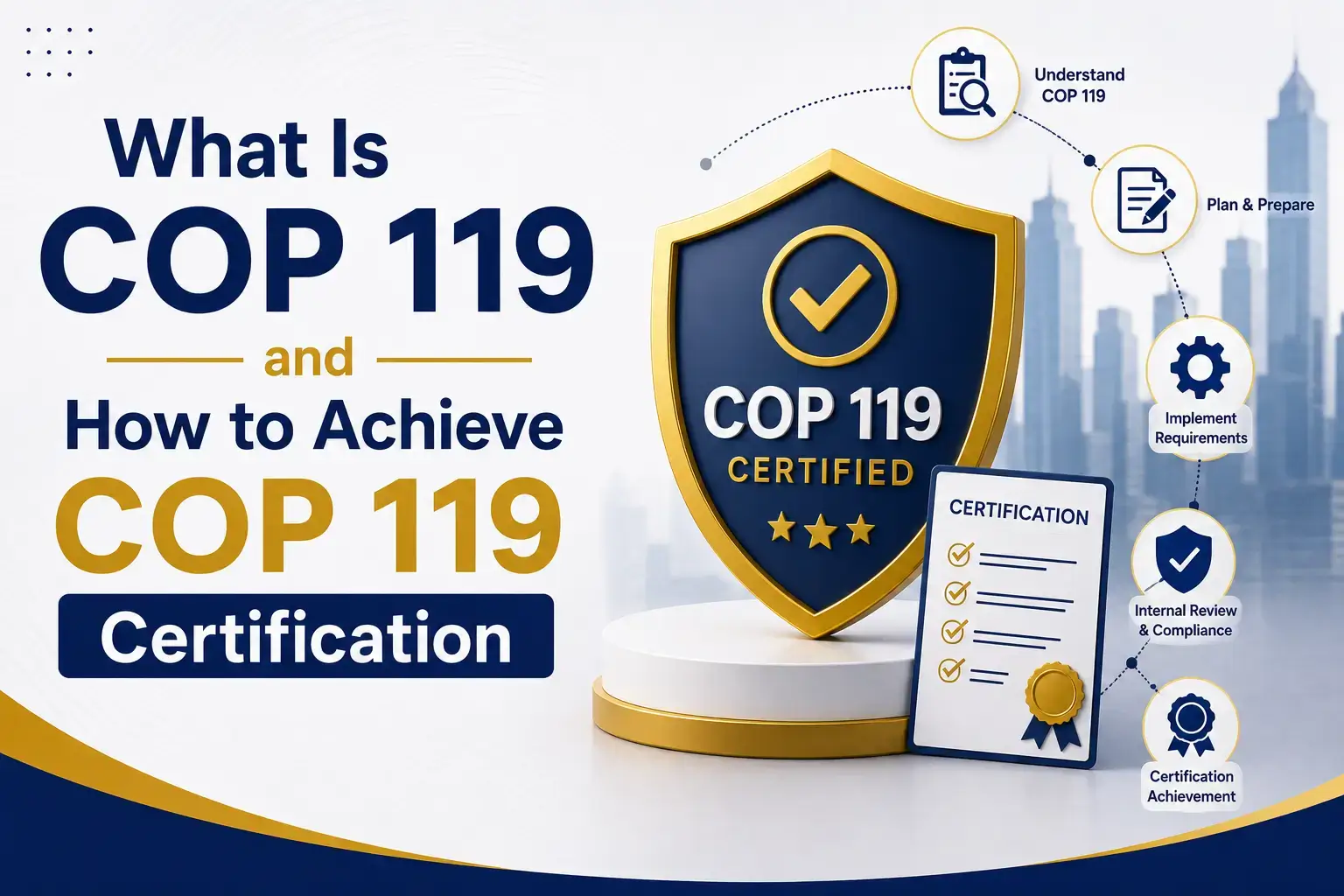
How to Achieve COP 119 Certification | Step by Step
Achieving COP 119 certification becomes easier when you follow a clear process.
Here is a simple step-by-step approach.
Step 1: Understand the COP 119 requirements
First, your management team should understand what COP 119 expects. This includes labour checks, worker rights, screening, supervision, contracts, payroll controls, and subcontractor management.
Step 2: Review your current system
Next, check what you already have. Look at your policies, forms, records, contracts, worker files, licence checks, and training records.
This helps you find gaps before the audit.
Step 3: Fix missing documents and records
If your records are weak, update them. If your policies are missing, create them. If your worker files are incomplete, complete them.
Common gaps include:
- Missing right to work evidence
- No regular SIA licence monitoring
- Weak screening records
- No subcontractor approval process
- Poor training evidence
- Unclear employment status records
Step 4: Train your team
Your managers and supervisors must understand the system. If they do not know how to use the procedures, the system will fail during the audit.
Training should cover recruitment, deployment, supervision, record keeping, and compliance checks.
Step 5: Run an internal audit
Before applying for certification, carry out an internal audit. This helps you test your system.
Check sample worker files. Review payroll evidence. Review licence records. Check incident reports. Make sure the system works in real life.
Step 6: Choose a certification body
After your system is ready, you can apply through a certification body that offers COP 119 or NCP 119 assessment.
Step 7: Complete the external assessment
The assessor will review your policies, procedures, records, and evidence. They may sample worker files and check whether your company follows the required controls.
Amtivo notes that assessment duration can depend on the number of workers being used, because some checks are proportionate, such as sampling screening files.
Step 8: Correct any non-conformities
If the assessor finds gaps, you must correct them. Once the evidence is accepted, your certification can be approved.
COP 119 and SIA ACS | How They Work Together
COP 119 and SIA ACS are connected, but they are not the same.
SIA ACS is a wider quality assurance scheme for private security companies. It checks whether a security business is fit and proper and meets the required quality standards.
COP 119 focuses more specifically on labour provision in the security and events sector.
This means COP 119 is very useful when your business supplies labour, uses subcontractors, or works within a labour supply chain.
ACS companies are expected to manage their suppliers and subcontractors properly. COP 119 can support that by giving clear evidence that labour is being supplied in a compliant way.
So, if you already have SIA ACS, COP 119 may still help if you provide labour to other companies or use subcontracted workers. If you are preparing for ACS, COP 119 can also strengthen your compliance structure.
How BizGrow Holdings Helps You Get COP 119 Certified
BizGrow Holdings helps UK security companies prepare for COP 119 certification with clear, practical, and professional support.
We understand that many security business owners are busy running operations. You may not have time to create policies, organise worker files, review subcontractor records, or prepare audit evidence.
This is where BizGrow Holdings can help.
Our team can support you with:
- COP 119 gap analysis
- Compliance document preparation
- Policies and procedures
- Worker file review
- SIA licence check process
- BS 7858 screening guidance
- Training record structure
- Internal audit support
- Subcontractor management system
- Certification preparation
- Ongoing compliance support
We do not just give generic templates. We help you build a system that fits your business and supports your audit journey.
If you are planning for COP 119 certification, SIA ACS, ISO standards, or other security compliance accreditations, BizGrow Holdings can guide you from preparation to assessment readiness.
For guidance, visit BizGrow Holdings at https://bizgrow-holdings.com/ and speak with our team about your certification goals.
Conclusion
COP 119 certification is an important standard for UK security companies that provide labour in the security and events sector.
It helps your business prove that workers are checked, trained, supervised, and managed properly. It also supports ethical labour practices, legal compliance, and stronger client confidence.
For companies working with SIA ACS-approved contractors, COP 119 can be especially useful. It shows that your labour supply process is controlled and professional.
The best way to achieve certification is to prepare early. Review your documents. Check your worker files. Train your team. Fix gaps before the audit. Then work with a professional consultancy that understands the UK security industry.
BizGrow Holdings can help your company prepare for COP 119 certification with practical support, clear documents, and expert guidance.
Frequently Asked Questionss
What is COP 119 certification in the UK?
COP 119 certification shows that a security company follows good labour provision practices. It covers checks, screening, supervision, worker rights, and compliance records.
Is COP 119 a legal requirement for security companies?
COP 119 is not a legal requirement for every security company. But it is very useful for companies supplying labour or working with ACS-approved contractors.
How long does COP 119 certification take?
The timeline depends on your current documents, records, and worker files. If your system is already organised, the process can be much smoother.
What is the difference between COP 119 and BS 7858?
COP 119 covers labour provision and compliance systems. BS 7858 focuses on security screening and vetting of people in secure roles.
Do I need COP 119 if I already have SIA ACS?
You may still need COP 119 if you supply labour or manage subcontracted workers. It can support ACS compliance by showing stronger labour supply control.