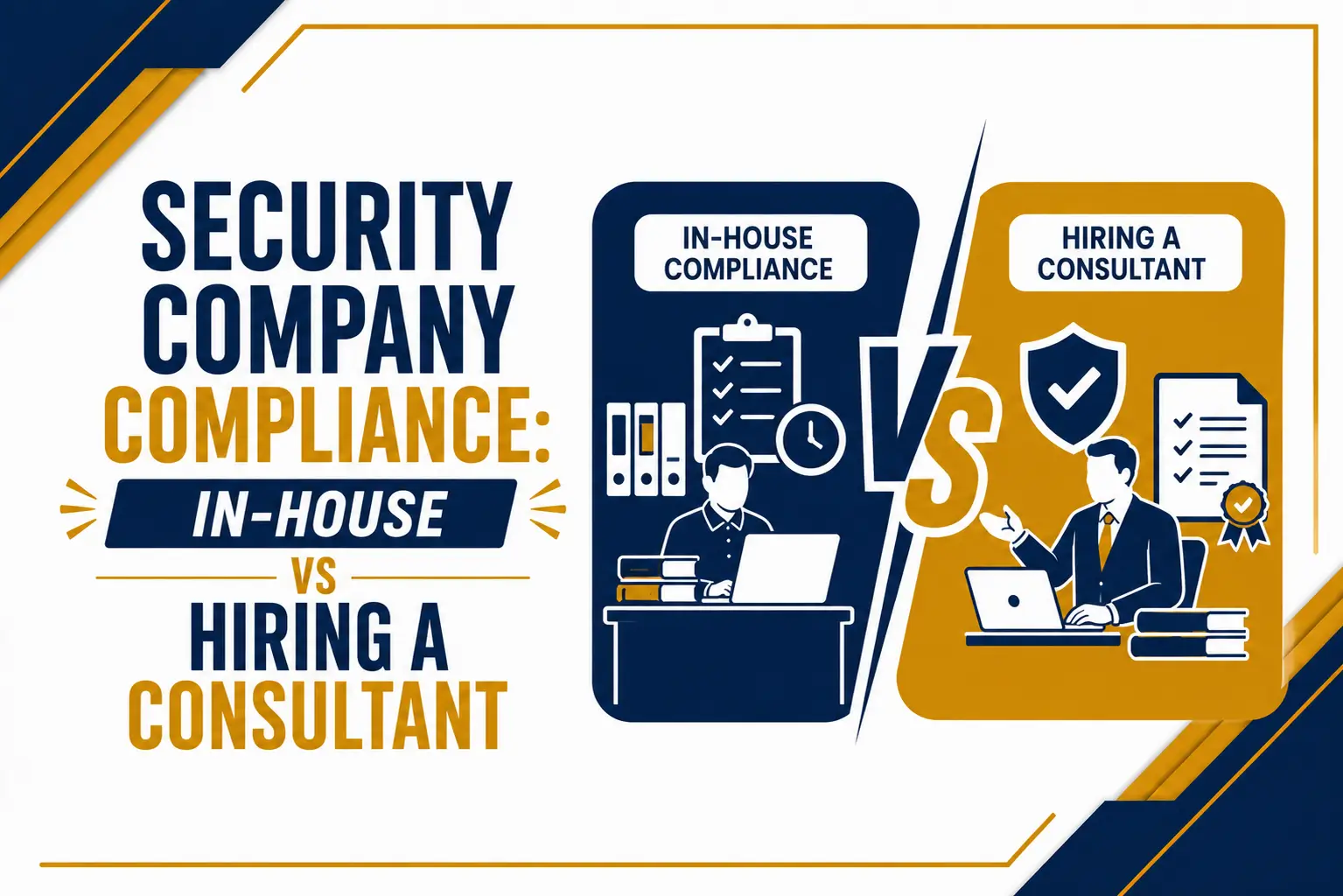
Every UK security company must stay compliant with SIA ACS, ISO standards, and other industry rules. But who should actually manage this? Should you build an in-house team, or does hiring a consultant make more sense? This guide breaks down both options in simple words. It covers what each approach involves, the real pros and cons, and how to decide what best fits your security business. Moreover, hiring a consultant often changes how quickly and confidently a security company reaches certification. Therefore, whether you run a small security firm or a growing operation, this guide will help you make a clear, confident decision about hiring a consultant versus managing compliance yourself.
What Does In-House Compliance Mean for a Security Company
In-house compliance means managing everything internally. Your own staff handles documentation, audits, and accreditation renewals, without outside help. Consequently, your business avoids the cost of hiring a consultant, at least on the surface. However, this approach also means your team needs strong knowledge of SIA ACS, ISO standards, and other requirements. Furthermore, staff must stay updated as regulations change, which takes real time and effort. Therefore, many security companies eventually realise that hiring a consultant saves them from this ongoing burden, while still keeping their compliance systems accurate, current, and fully audit-ready throughout the year.
Who Manages Compliance Internally
Usually, one or two staff members take on this responsibility alongside their regular duties. As a result, compliance often becomes a secondary task, not their main focus.
Staying Updated on Changing Regulations
SIA ACS and ISO requirements change over time. Therefore, internal staff must actively track updates, or risk falling behind on current standards.
Documentation and Record-Keeping Responsibilities
In-house teams handle all paperwork themselves, from policies to audit records. As a result, accuracy depends entirely on internal attention to detail.
Time Investment Required
Managing compliance internally takes significant time. Meanwhile, this time often gets pulled away from core business operations and client work.
Long-Term Sustainability of In-House Compliance
Over time, keeping compliance fully in-house becomes harder to sustain. Eventually, many businesses consider hiring a consultant to fill these growing gaps.
Building a Compliance Team Within Your Business
Building an internal compliance team takes real time and effort. You need staff who understand security regulations deeply, not just general business admin. Otherwise, gaps start appearing in your compliance systems fairly quickly.
A basic in-house compliance setup usually includes:
- A dedicated compliance officer or manager
- Ongoing staff training on updated standards
- Internal audit processes
- Document management systems
However, without proper structure, in-house teams can struggle to keep up with changing requirements. Consequently, small mistakes often go unnoticed until an actual audit reveals them. Therefore, many security companies compare the cost of building this internal structure against hiring a consultant instead. Ultimately, hiring a consultant often removes this burden entirely, giving your business expert support without the ongoing internal training and management effort.
What Does Hiring a Consultant Involve
Hiring a consultant means bringing in outside experts who specialise in security compliance. They guide you through accreditation, audits, and renewals, step by step, so nothing gets missed along the way. Consultants already understand SIA ACS, ISO standards, and other frameworks deeply. Therefore, hiring a consultant means less guesswork and fewer mistakes during the entire process.
Getting Expert Guidance From Day One
When you start hiring a consultant, they first review your current setup. As a result, you know exactly where you stand before moving forward.
Support Throughout the Accreditation Process
Consultants stay involved at every stage, not just at the beginning. Consequently, you get consistent guidance from application through to final approval.
Reduced Risk of Costly Mistakes
Since consultants know the requirements inside out, they catch issues early. This way, hiring a consultant helps you avoid delays caused by simple errors.
Ongoing Compliance Support After Certification
Good consultants don’t disappear after certification. Instead, they continue supporting renewals and updates, keeping your business audit-ready year after year.
What a Security Compliance Consultant Typically Handles
A good consultant doesn’t just fill out paperwork. Instead, they actively manage your entire compliance journey, from start to finish, so your business stays on track throughout the process.
Typical consultant responsibilities include:
- Gap analysis of your current systems
- Building audit-ready documentation
- Guiding staff through training requirements
- Managing accreditation renewals
- Supporting you during actual audits
Furthermore, consultants often spot issues that internal teams might overlook, simply because they work across multiple businesses and see common patterns. As a result, problems get identified and fixed before they become bigger issues during an audit. This hands-on support often makes hiring a consultant a faster, more reliable path to certification. Ultimately, businesses save valuable time and reduce stress, while gaining confidence that every requirement is properly covered from the very beginning.

Key Differences Between In-House and Consultant-Led Compliance
The biggest difference between In-House and consultant-led compliance comes down to expertise and time. In-house teams need to learn compliance from scratch, while consultants already bring years of experience to the table. In-house compliance also demands ongoing staff time. Meanwhile, hiring a consultant lets your team focus on daily operations instead of paperwork and admin work. Another key difference is adaptability. Consultants stay updated on changing regulations, since it’s their full-time job. In-house teams, however, may miss updates unless they actively research them themselves.
| Factor |
In-House Compliance |
Hiring a Consultant |
| Expertise level |
Builds knowledge over time |
Brings years of experience immediately |
| Staff time required |
High, ongoing commitment |
Low, frees up internal team |
| Speed to certification |
Often slower |
Typically faster |
| Awareness of updates |
Depends on active research |
Stays current as a full-time focus |
| Risk of errors |
Higher, especially early on |
Lower, due to specialist knowledge |
| Cost structure |
Internal salaries and training |
Consultancy fees |
In short, both paths can lead to compliance, but hiring a consultant often reduces the time, risk, and effort involved for busy security companies.
Pros and Cons of Managing Compliance In-House
Managing compliance in-house comes with real trade-offs. While it offers control, it also demands time, expertise, and constant attention that many security companies underestimate at first.
Advantages of an Internal Compliance Team
- Full control over your compliance processes
- Staff understand your business deeply, day to day
- No dependency on outside availability
Challenges Security Companies Face Going In-House
- Requires significant training investment
- Staff may lack specialist accreditation knowledge
- Higher risk of missing updated requirements
- Slower certification process without expert guidance
However, many security companies underestimate how much time in-house compliance actually takes. As a result, staff often juggle compliance alongside their regular duties, which can lead to delays and missed details. Therefore, before choosing this route, it’s worth asking whether your team truly has the time and expertise to manage compliance well, or whether hiring a consultant might offer a more reliable path forward.
Pros and Cons of Hiring a Compliance Consultant
Hiring a consultant brings clear advantages, but it also comes with a few things worth considering before you commit.
Advantages of Outsourcing Compliance
- Access to specialist, up-to-date knowledge
- Faster path to accreditation
- Reduced risk of failed audits
- Frees up your internal team for daily operations
Things to Consider Before Outsourcing
- You need to choose a consultant with proven security industry experience
- Communication and collaboration are still important
- Ongoing support should continue past initial certification
Ultimately, hiring a consultant works best when you choose a partner who understands security compliance specifically, not just general business standards. Therefore, taking time to research the right fit pays off in the long run.
Which Option Suits Your Security Company Best
The right choice depends on your business size and goals. Smaller security companies often benefit more from hiring a consultant, since building an in-house team can be costly and time-consuming. Larger companies with dedicated resources may manage some compliance in-house, while still using consultants for complex accreditations like SIA ACS or ISO certification.
Ask yourself these questions:
- Do we have staff with real compliance expertise?
- Can we keep up with changing regulations internally?
- How quickly do we need certification?
- Is our team already stretched thin with daily operations?
For most growing security companies, hiring a consultant offers a more reliable, efficient path forward.
What BizGrow Offers
When it comes to hiring a consultant, businesses want more than just basic guidance. That’s why BizGrow Holdings offers a complete, structured support system: covering every stage of your compliance journey.
- Full Consultancy: Expert guidance from start to finish
- Documentation & QMS Portal Setup: We manage all your paperwork
- Dedicated Project Manager: One point of contact for seamless communication
- Gap Analysis: We work on every minute detail to cover all the gaps
- Document Evaluation: We evaluate each document carefully to avoid any discrepancy
- Training on Assessment Documents: We provide proper training on your documents
- Systematic Step-by-Step Procedure: Each process is handled carefully and systematically
- Fast-Track Certification Guidance: Helping you move through the process efficiently, without unnecessary delays
- Direct Access to Your Questions: All your questions are answered properly
- Complete Coaching: Discussion with our Senior Manager to fill out the gaps
- Compliance Review Support: Ensuring your systems align with current industry and audit requirements
- 90-Day Support & Delivery: Step-by-step assistance for smooth certification
- Ongoing Improvement Advice: Helping you strengthen processes for future audits and renewals
- Internal Audit: Ensuring compliance before the final audit
- External Audit Attendance: We stand by you during the audit process
- Reliable Customer Support: Ongoing help for 12 months
Ultimately, this level of support is exactly why hiring a consultant like BizGrow Holdings often makes more sense than managing everything alone. Instead of piecing together compliance in-house, you get a dedicated team guiding you through every single step.
Final Checklist: In-House or Consultant?
Before deciding, run through this quick checklist:
- Does your team have proven SIA ACS or ISO expertise?
- Can you dedicate enough time to compliance internally?
- Do you need faster certification for upcoming contracts?
- Would outside support reduce your risk of failed audits?
If you answered “no” to any of these, hiring a consultant may be the smarter choice for your security company.
FAQs
1. Is it better for a security company to hire a consultant or manage compliance in-house?
Hiring a consultant usually works better for most security companies. It offers faster certification and reduces the risk of failed audits.
2. How much time does in-house compliance take for a security company?
In-house compliance can take significant staff time and training. Many businesses underestimate how demanding this process really is.
3. Can a small security company handle SIA ACS compliance alone?
It’s possible, but challenging without prior expertise. Hiring a consultant often makes the process smoother and faster.
4. What are the risks of managing security compliance internally?
Risks include missed updates, incomplete documentation, and failed audits. Expert guidance helps reduce these risks significantly.
5. Can BizGrow Holdings help even if I already have an in-house compliance team?
Yes, we can support your existing team with expert guidance. We help strengthen your systems and prepare you for successful audits.