Here is a question small business owners across the UK ask all the time.
Can we really compete with larger companies on a PQQ and actually win?
The answer is yes. And more often than most small businesses realise.
Many suppliers fail at the PQQ stage not because they lack capability, but because they do not prepare properly.
Size is rarely the deciding factor. Preparation is. The right accreditations, the right documentation, and the right answers to the right questions are what separate the businesses that pass a PQQ from the ones that do not.
This guide explains exactly what a PQQ involves, why small businesses can absolutely compete, and what you need in place to pass a PQQ with confidence.
At BizGrow Holdings, we help UK small businesses get PQQ-ready, building the systems, accreditations, and documentation that procurement teams want to see.
What Is a PQQ?
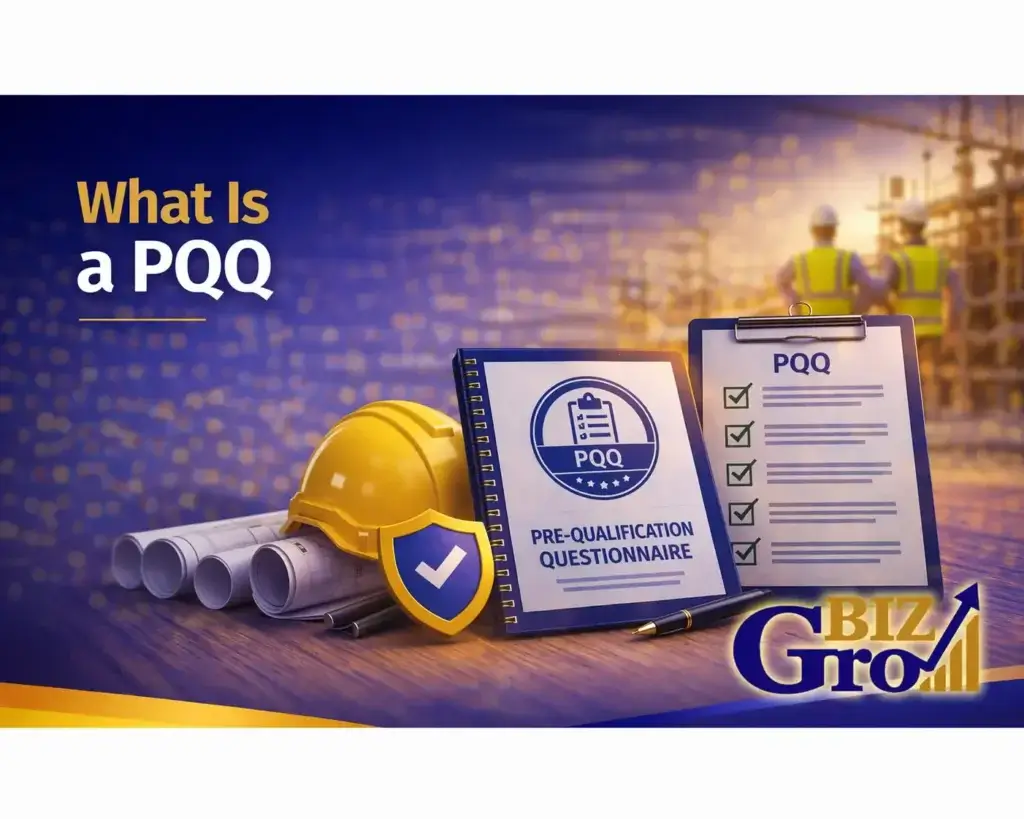
A Pre-Qualification Questionnaire (PQQ) is a structured assessment tool used by buyers to screen potential suppliers and contractors before inviting them to tender or work on a project. It acts as the first gate in the procurement or tendering process, helping buyers shortlist capable, compliant, and low-risk vendors while saving everyone time, effort, and money.
PQQ stands for Pre-Qualification Questionnaire, and it does exactly what it says. This is typically the first stage of a tender process and helps the buyer filter through organisations that are more suited to deliver upon their requirements and needs, allowing a select few to be invited to tender.
A PQQ is a formal questionnaire that asks potential suppliers for details about company background and structure, financial health and viability, relevant industry experience and capacity, legal and regulatory compliance credentials, insurance and certifications, and health, safety, environmental, and sustainability policies.
You may also see PQQs referred to as:
- The SQ Selection Questionnaire the more common term in central government procurement
- PSQ Procurement Specific Questionnaire introduced under the Procurement Act 2023
- Stage 1 Tender used by some public sector bodies
The shift from PQQ to SQ, and now to PSQ, is driven by one clear goal: making public procurement simpler, fairer, and more efficient for suppliers. It is about moving away from repetitive paperwork.
Secondary keywords: PQQ UK, pre-qualification questionnaire UK, SQ tender, pass a PQQ small business, PQQ requirements UK, procurement PQQ.
Can Small Businesses Really Pass a PQQ?
Yes. Absolutely.
The Government recommends that Pre-Qualification Questionnaires be removed for low-value contracts under £111,676 in value, meaning it has never been easier for micro and small businesses to get involved in public sector tendering.
And for higher-value contracts where a PQQ is required, size is not what procurement teams are filtering for. They are filtering for compliance, competence, and risk. A small business that is CHAS accredited, holds ISO 9001, has clean financials, and can demonstrate relevant experience is a stronger PQQ submission than a large business with poor documentation.
Get the basics right: safety, finances, and policies. Align them to procurement language, and reuse them across competitions. Get those right, and your PQQ becomes a fast pass to the quality and price stage, where you actually win work.
The playing field is more level than most small business owners believe. What matters is being genuinely ready.
What Clients Actually Look for in a PQQ
Understanding what buyers are actually assessing helps you focus your preparation on what matters.
PQQs cover the status of your organisation, your finances, how you manage quality, your environmental, social and health and safety policies, and case studies and testimonials.
Procurement teams are looking for evidence across these core areas:
- Compliance: Do you hold the right accreditations and certifications?
- Financial stability: Is your business financially sound and low risk?
- Experience: Can you demonstrate relevant, recent project experience?
- Capacity: Can you actually deliver what is being asked for?
- Ethics: Do you have modern slavery, anti-bribery, and equality policies in place?
- Health and safety: Do you take your duty of care seriously, and can you prove it?
Case studies are where you can really show off. The other requirements are usually set as standard, but case studies are where you can really display your experience who you have worked with previously and how it went.
A small business that covers every one of these areas clearly and with real evidence will score well against a larger business that submits vague, generic answers.
Common Reasons Small Businesses Fail a PQQ
Most PQQ failures are avoidable. Here are the most common reasons:
- Missing accreditations: no CHAS, SafeContractor, or SSIP accreditation when the PQQ requires it
- Outdated policies: a Health and Safety Policy that has not been reviewed in two years
- No ISO certification: some PQQs require ISO 9001 or ISO 45001 as a minimum
- Expired insurance: Employer’s Liability or Public Liability insurance is not current
- Weak financial standing: turnover or balance sheet that falls below the threshold
- No case studies or references: unable to demonstrate relevant experience
- Generic answers: copying and pasting the same responses without tailoring to the specific contract
- Missing equality, diversity, or modern slavery policies: increasingly required across all public sector PQQs
- No carbon reduction plan: relevant for larger public sector contracts where environmental commitments are scored
Every contract is unique, and you need to tailor your answers. Copying and pasting from a previous PQQ puts you at an immediate disadvantage. Answer every question with specifics, not generalities.
How to Pass a PQQ | What You Need in Place
Health and Safety Accreditation
Using CAS or CHAS as your single source of truth, completing it once with evidence for each section and keeping it current means you avoid retyping the same answers for every council, NHS trust, or university tender.
CHAS, SafeContractor, or SMAS accreditation satisfies the health and safety section of most PQQs at a stroke. Holding one of these means procurement teams can verify your H&S compliance instantly without needing you to provide separate documentation every time.
For public sector contracts, CHAS Elite (Common Assessment Standard) is increasingly required under government PPN 03/24.
Quality Management Evidence
ISO 9001 certification is one of the most effective ways to satisfy the quality management section of a PQQ. It shows procurement teams that your business has independently verified quality systems in place.
ISO 9001 certification also covers elements that many PQQs ask about separately: process management, non-conformance handling, customer satisfaction, and continuous improvement.
Financial Standing
Buyers assess your financial health to check that you are not a risk to the project. Most PQQs ask for:
- Annual turnover often requires a minimum threshold relative to contract value
- Last two to three years of filed accounts
- Evidence of financial probity: no CCJs, insolvency proceedings, or serious financial irregularities
If your turnover is lower than the threshold, consider whether the contract is appropriately sized for your business or whether a joint venture or consortium approach is more appropriate.
Insurance Documentation
Most PQQs require minimum coverage of £10 million for public liability and £2 million for employer’s liability, with valid insurance certificates submitted with your application.
Always check the specific insurance thresholds in the PQQ you are completing. Have your certificates ready in PDF format, clearly showing your company name, level of cover, and expiry date.
References and Case Studies
Case studies and testimonials are where you can really show your experience. These are your chance to display who you have worked with previously and how it went.
Prepare three to five strong case studies in advance. Each one should describe the project, the challenge, what you delivered, and a measurable outcome. Get written references from clients where possible, especially from any public sector or large private sector contracts you have delivered.
How Accreditations Help You Pass a PQQ
The single most effective way to pass a PQQ faster and more consistently is to hold the right accreditations before you apply.
Accreditations do the work for you. Instead of writing lengthy answers about your health and safety systems, you submit your CHAS certificate, and it is verified. Instead of providing detailed quality management documentation, your ISO 9001 certificate confirms you have an independently audited system.
The accreditations that make the biggest difference in PQQ submissions:
- CHAS Standard, Advanced, or Elite: satisfies health and safety pre-qualification across most UK procurement frameworks
- SafeContractor approval: particularly valued in facilities management and commercial sector PQQs
- ISO 9001: quality management system, increasingly required in the public sector and NHS procurement
- ISO 14001: environmental management, required in sustainability-focused PQQs
- ISO 45001: health and safety management system, valued alongside CHAS
- Cyber Essentials: required for contracts involving digital systems or data handling
Map your policies to procurement language. Link your H&S plan to CDM 2015 duties. Tie your environmental plan to your Carbon Reduction Plan if relevant.
PQQ Tips for Small Businesses
Here are the most practical tips for small businesses approaching a PQQ:
- Read every question carefully: then read it again before answering
- Answer exactly what is asked: not what you wish they had asked
- Tailor every answer: reference the specific contract, sector, and client requirements
- Use procurement language: align your answers to CDM, PPN 03/24, PAS 91, and other frameworks the buyer references
- Present clearly: clear typeface, bullet points, and logical structure create a good first impression
- Focus on the small things: clear presentation, line spacing, and bullet points all matter.
- Quantify where possible: numbers, percentages, and measurable outcomes are more persuasive than general statements
- Do not leave blanks: if a question does not apply, explain why briefly rather than leaving it empty
- Start a PQQ library: store your best answers, policies, case studies, and certificates so renewal and reuse are fast
How BizGrow Holdings Helps Small Businesses Pass a PQQ
At BizGrow Holdings, we help UK small businesses build the compliance foundation they need to pass a PQQ against any competitor, large or small.
Here is what we do:
- CHAS accreditation support: getting you CHAS Standard, Advanced, or Elite approved
- SafeContractor and SMAS accreditation: expanding your recognised H&S compliance across multiple client types
- ISO 9001, ISO 14001, and ISO 45001 certification: building and certifying your management systems
- Health and Safety Policy and RAMS development: current, tailored, and PQQ-ready
- Modern slavery, anti-bribery, and equality policy development: covering the compliance questions that trip businesses up
- PQQ document review: checking your policies and certificates against the specific PQQ requirements before you submit
- Case study development: helping you present your experience in a format that scores well
- Ongoing compliance management: keeping your accreditations and documentation current so every future PQQ is faster
We work with businesses across security, construction, facilities management, cleaning, and specialist services. We have helped small businesses win contracts against significantly larger competitors because they were better prepared.
Visit bizgrow-holdings.com or contact us at info@bizgrow-holdings.com to find out how we can help your business pass a PQQ.
Conclusion
Small businesses can absolutely pass a PQQ against larger competitors. The playing field is far more level than it looks.
What wins is not size. What wins is preparation, the right accreditations, the right documentation, the right answers, and the right presentation.
Be precise and consistent. Use clear, factual answers with supporting evidence. Reference real examples. Align responses to the scoring criteria. Quantify capabilities where possible. Get those right, and your PQQ becomes a fast pass to the quality and price stage, where you actually win work.
BizGrow Holdings is here to help you get there. Visit bizgrow-holdings.com today.
Frequently Asked Questions
1. What is a PQQ in UK procurement?
A PQQ Pre-Qualification Questionnaire is the first stage of a tender process where buyers assess whether a supplier meets minimum standards before inviting them to tender. It covers compliance, financials, experience, insurance, and policies.
2. Is a PQQ the same as an ITT?
No. A PQQ precedes the ITT (Invitation to Tender). You pass the PQQ first, then get invited to submit a full tender. The PQQ filters suppliers. The ITT is where you compete on quality and price.
3. What accreditations help you pass a PQQ?
CHAS, SafeContractor, SMAS, ISO 9001, ISO 14001, ISO 45001, and Cyber Essentials all carry significant weight in PQQ submissions. They independently verify your compliance and reduce the documentation burden at the PQQ stage.
4. How long does a PQQ take to complete?
A well-prepared business with all documents ready can complete most PQQs in a few hours. Businesses without current policies, accreditations, or case studies in place may take days or weeks to gather everything needed.
5. Can a sole trader pass a PQQ?
Yes. Sole traders can and do pass PQQs, particularly for lower-value contracts. The key is having the right insurance, relevant experience, up-to-date policies, and, where required, SSIP accreditation such as CHAS.