ISO often comes up at work. Maybe a client asked for it. Maybe a tender needs it. However, many UK business owners still ask the same thing. What does it really mean? This guide explains the ISO standard and its purpose. First, readers will learn what ISO is. Next, it explains why it matters. After that, it covers the seven principles, popular standards, and the steps to certification. In short, every point stays simple and clear. By the end, any business owner will know if an ISO standard fits the business.
What Is an ISO Standard?
An ISO standard is a set of agreed rules. These rules show the best way to do a task. In addition, the rules cover quality, safety, security, and more. Think of it as a shared recipe. For example, every business follows the same proven steps. As a result, customers get the same good result every time. ISO standards are voluntary. No one forces a business to use ISO standards. Still, many firms choose them because the standards build trust fast. Today, ISO has published over 25,000 standards. Indeed, the standards cover almost every industry. Examples include food, health, energy, IT, and construction.
What Does ISO Stand For?
ISO stands for the International Organization for Standardization. The name is long. Therefore, people use the short form. Interestingly, “ISO” is not a direct abbreviation. It comes from the Greek word isos. That word means “equal.”
Here is why that matters:
- The short name works in every language.
- It shows the goal of equal rules for everyone.
Who Develops ISO Standards?
ISO is an independent group based in Geneva, Switzerland. It has members from over 160 countries. Each country sends one national body. In the UK, the national body is the British Standards Institution (BSI). Also, BSI takes part in the process for UK businesses. Experts from industry, government, and research write each standard. Then members vote on it. Therefore, every ISO standard reflects wide agreement.
The Purpose of ISO Standards
The main purpose of ISO standards is simple. ISO standards make products, services, and systems safe, reliable, and consistent. Without shared rules, every company works in its own way. As a result, errors, delays, and confusion grow. Moreover, buyers cannot compare suppliers fairly. ISO fixes this problem. First, it gives everyone a clear base to work from. Consequently, businesses save time and reduce mistakes. Next, here are the three main goals of ISO.
Improving Quality and Consistency
Quality is the heart of many ISO standards. In particular, the standards help a business set clear steps for every job. The team then knows what to do. As a result, output stays steady.
Key points:
- Clear processes reduce errors.
- Staff follow the same steps each time.
- Customers get a dependable product.
Supporting Safety and Compliance
Some ISO standards focus on safety. For example, ISO 45001 protects workers. Likewise, ISO 22000 protects food. These standards also help businesses meet UK laws. In addition, the standards show that a firm takes risk seriously. Therefore, regulators and clients feel more confident in the work.
Enabling International Trade
ISO standards work across borders. For instance, a product made in the UK can meet the same rule as one made in Japan. This removes barriers. Likewise, it helps UK exporters win global buyers. Besides that, overseas partners trust a recognised standard more than an unknown process.
The 7 Principles of ISO Standards
The seven principles come from the ISO 9000 family. First, the principles guide quality management. However, many other standards use the same ideas. Think of the principles as a compass. The principles point a business in the right direction. Furthermore, the principles apply to firms of any size. Next, here are the seven principles.
Customer Focus
Customers sit at the centre. Therefore, the aim is to meet customer needs and exceed them. For example, a business can:
- Ask for feedback often.
- Fix complaints fast.
- Learn what buyers expect next.
Leadership
Leaders set the direction. In addition, leaders share a clear goal with the team. When leaders show commitment, staff follow. In short, strong leadership creates a culture of quality.
Engagement of People
Skilled, involved people drive results. Therefore, businesses should train staff and listen to staff. Staff who feel valued work with more care. Also, staff spot problems early.
Process Approach
Every activity is a process. Linking the processes forms one system. This view makes work clear. As a result, teams find weak spots and fix them with ease.
Improvement
Good firms never stop improving. Indeed, even small changes add up over time. First, set goals. Then measure progress. Finally, adjust the plan. This cycle keeps a business strong.
Evidence-Based Decision Making
Facts beat guesses. Therefore, data guides each choice. For instance, a business can track sales, errors, and survey scores. Consequently, decisions carry less risk.
Relationship Management
Suppliers and partners shape success. So managers should manage those relationships carefully. Good relationships bring steady supply and shared growth. Strong links also help a business handle change.
Most Popular ISO Standards
ISO has thousands of standards. Yet UK firms use a small group most often. Each one solves a different need. Below are the four that appear most often. First, choose the one that fits the goals. Also, many firms combine two or more.
ISO 9001 Quality Management
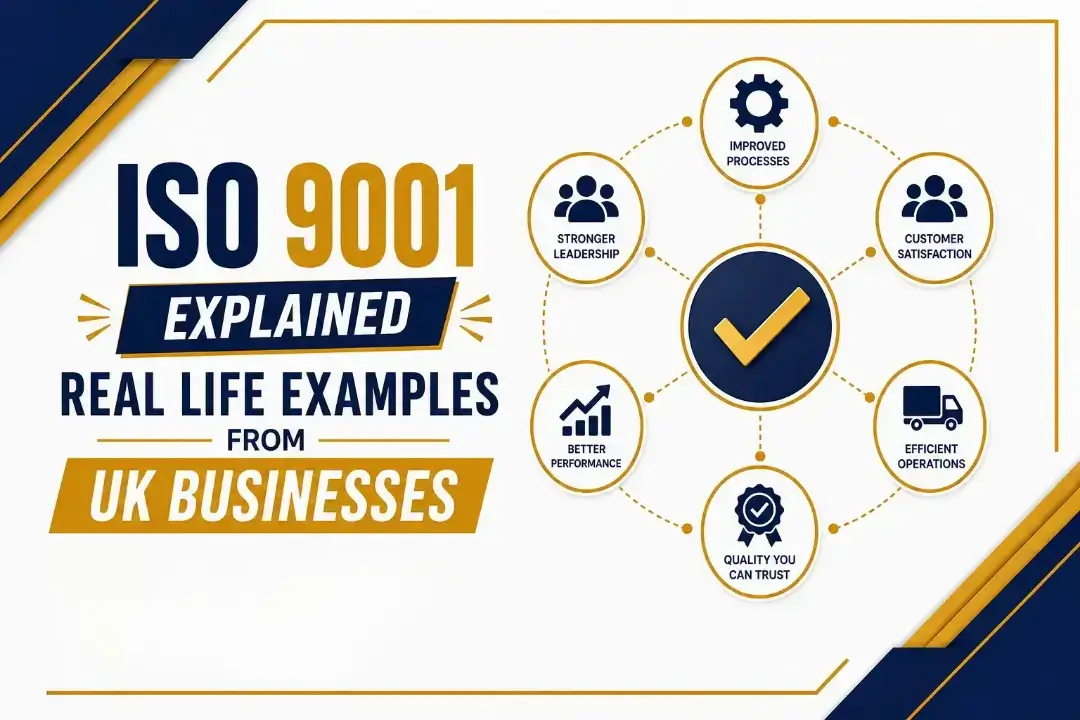
ISO 9001 is the best known. It sets the rules for a quality management system. It suits any business. Whether a firm sells goods or services, the standard helps it deliver with consistency. Furthermore, it often appears in UK tenders.
ISO 14001 Environmental Management
ISO 14001 helps a business manage its impact on the planet. For example, it covers waste, energy, and pollution. Many UK buyers now ask about green credentials. Therefore, this standard gives a clear, proven answer.
ISO 27001 Information Security
ISO 27001 protects data. In particular, it covers how a business handles, stores, and shares information. Cyber threats grow each year. So this standard matters for IT firms, finance teams, and any business with client data.
ISO 45001 Health and Safety
ISO 45001 keeps workers safe. Moreover, it helps find hazards and cut risks. Fewer accidents mean fewer delays. In addition, it shows staff that the business cares about wellbeing.
How an ISO Standard and Its Purpose Help UK Businesses
Now the ISO standard and its purpose are clear. Next, here are the real gains for a UK firm. Many owners think ISO is just paperwork. In fact, it brings clear business value. It improves how a business works every day. Besides that, it shapes how others see the firm. Overall, here are the main benefits.
Win More Contracts and Tenders
Many UK public bodies ask for ISO certificates. Similarly, large private firms do the same. Without one, a firm may lose the chance to bid. However, with one, the firm stands out. Hence, certification can open new doors.
Build Customer Trust
A certificate proves that a firm follows a recognised system. As a result, buyers do not need to take a firm’s word for it. Trust leads to repeat sales. Likewise, it supports a strong brand.
Reduce Risk and Waste
ISO helps find problems early. Then teams fix problems before they grow. As a result, the firm saves time and money. Many firms also see a clear drop in rework and complaints.
Is ISO Certification Mandatory in the UK?
No, ISO certification is not a legal rule in the UK. Each business chooses whether to apply. However, some sectors expect it. For example, construction, defence, and public sector suppliers often need it. In these cases, the buyer sets the rule, not the law. Some laws also relate to the same topics. For instance, health and safety law applies to every UK employer. In addition, an ISO standard can help meet those duties in a structured way. Therefore, ask one question. Do clients or tenders require it? If yes, certification is a smart move. Even if no, it can still give a business an edge over rivals.
How to Get ISO Certified in the UK
The path is clear when broken down. Most firms follow three main stages. Moreover, each stage builds on the last. Many owners also wonder about cost. However, it depends on size, sector, and the chosen standard. So a proper review comes first. Here are the stages.
Choose the Right Standard
First, start with the main goal. Does the business need quality, security, safety, or green credentials? Next, check tenders and client needs. Then pick the standard that fits. If the choice feels unclear, an expert can guide the process.
Gap Analysis and Implementation
Next, compare current work with the standard. This review is a gap analysis. It shows what a business already does well. Also, it shows what is missing. After that, the team builds the missing parts. For example, the team writes policies, trains staff, and sets up records.
Choose a UKAS-Accredited Certification Body
Finally, an outside auditor checks the system. Pick a body that UKAS accredits. UKAS is the UK Accreditation Service. This step matters. Indeed, an accredited certificate carries more weight with buyers. Moreover, the certificate proves the audit was fair and independent.
ISO 9001 Update: What to Expect in 2026
ISO 9001 is getting its first major update since 2015. People call the new edition ISO 9001:2026. In fact, ISO planned to publish it in September 2026. The change is an evolution, not a rebuild. Therefore, core ideas, such as the process approach and risk-based thinking, stay in place.
Experts expect a few key shifts:
- Clearer leadership duties.
- Stronger focus on ethics and integrity.
- Better links to digital tools.
Meanwhile, certificates for ISO 9001:2015 stay valid during a transition period. Experts expect this period to last about three years. However, the final rules come from accreditation bodies. So always check the official ISO website for the latest news. If a business plans to certify soon, ask an adviser about the new edition first. That way, the business builds the system once and builds it right.
Why Choose BizGrow Holdings for ISO Support
ISO can feel heavy at the start. That is where BizGrow Holdings helps. BizGrow Holdings guides UK businesses through every step. First, the team keeps the process simple and clear. In addition, the focus stays on real results, not extra paperwork.
Support includes:
- A clear review of current systems.
- Help choosing the right standard.
- Practical support to build the system.
- Guidance to prepare for the audit.
BizGrow Holdings believes in plain advice and steady support. As a result, clients feel confident from day one. Ready to start? Visit BizGrow Holdings and speak with the team today.
FAQs
1. Can a small business get ISO certified?
Yes, ISO standards suit firms of every size. Also, a small team can use a simple system. The standard scales to fit the business.
2. How long does an ISO certificate last?
Most ISO certificates last three years. During that time, auditors visit once a year to check progress. After three years, the business renews.
3. What is the difference between ISO compliance and ISO certification?
Compliance means a business follows the standard alone. In contrast, certification means an outside body checks the business and issues a certificate. Therefore, buyers trust certification more.
4. What affects the cost of ISO certification?
Several factors shape the cost. These include company size, number of sites, and the chosen standard. As a result, a short review helps plan with confidence.
5. Is ISO the same as BSI?
No, they are different groups. ISO is the global body. However, BSI is the UK national body and takes part in ISO’s work.
Conclusion
An ISO standard is a shared set of rules. Its purpose is to improve quality, safety, and trust. In addition, it helps UK firms trade at home and abroad. The seven principles guide the whole system. Meanwhile, popular standards like ISO 9001 and ISO 27001 meet specific needs. Certification is optional. Still, it often helps a business win more work. Now the ISO standard and its purpose are clear. Next, review the business goals and check what clients expect. Then choose the standard that fits and start small. As a result, a strong system grows one step at a time.