Many UK security firms hear about BS 10119 and then ask the same thing. Does the standard apply to them? Checking BS 10119 eligibility sounds like a big task. Yet it takes only a few simple questions and a few minutes. Here is the first thing to know. BS 10119 has no official pass-or-fail eligibility test. Instead, eligibility comes down to one practical question: does the standard fit what the business does? For example, a firm that supplies staff to other security companies usually says yes. Likewise, a firm that buys in extra staff often says yes too. The answer is also easy to find. First, a short self-check shows where a business stands. Then a free readiness assessment turns that answer into a score and a clear action plan. As a result, firms know their next step within minutes.
What Is BS 10119?
BS 10119 is the British Standard for the provision of labour to the security and events sectors. BSI published the 2026 edition in June 2026. It is a code of practice, so it gives best-practice advice rather than a strict pass-or-fail list. However, independent bodies can still certify a business against it. The standard covers bought-in labour. This means extra staff that one company supplies to another to support a security or events workforce.
It looks at how a company:
- Recruits workers
- Screens workers
- Trains workers
- Manages workers on assignment
These workers may hold an SIA licence, or they may not. Either way, the standard still applies.
What Does BS 10119 Eligibility Mean?
What does BS 10119 eligibility really mean? No authority issues an “eligible” or “not eligible” result. The phrase simply points to two questions:
- Does BS 10119 apply to this business?
- How ready is the business to meet it?
The first question depends on what the firm does. For example, supplying labour to security or events clients points to yes. Likewise, buying labour from other suppliers also points to yes. However, running only with permanent staff and no such contracts often points to “not yet”. The second question depends on evidence. Examples include screening files, licence checks, training records, and payroll proof. Strong evidence means high readiness. On the other hand, gaps mean the firm needs more work first.
Which Security Firms Need BS 10119?
The need depends on the role a firm plays in the labour chain. Three groups matter.
Labour Providers
Labour providers supply extra staff to other security or events companies. For them, BS 10119 applies directly. They include firms that supply guards, door supervisors, stewards and crowd management staff. A provider has to prove that it screens, trains and legally employs its people, and that it checks SIA licences where they apply. Without that proof, buyers hesitate. In fact, large contracts tend to go to suppliers with clear evidence. Besides, providers often sit several steps down a long chain. One weak record can then cause trouble for the contractor above them. Therefore, strong systems protect the provider and the client at once.
Contractors Who Buy In Labour
Contractors that buy in extra staff also need to pay attention. BS 10119 gives them a clear way to judge suppliers. It also shows what good supply looks like. Consider a guarding contractor that borrows extra officers for a busy weekend. If one of those officers lacks a valid licence, the client blames the contractor first. In other words, the supplier’s mistake still lands on the contractor’s reputation.
So buyers often check a few basics before they accept bought-in staff:
- Screening and vetting process
- Licence and training evidence
- Payroll and right-to-work proof
- Clear contract terms on responsibility
Checking these basics early prevents surprises on site. Therefore, buyers that ask for proof upfront protect their clients and their own reputation.
Firms That May Not Need It Yet
Some firms can wait. A business that uses only permanent staff and never supplies or buys in labour may not need BS 10119 today. The same often holds for a firm with no plans to bid for tenders that mention it. Even so, markets move fast. Clients may start to ask about labour controls in the future. Therefore, an early look takes little time and prevents a rush later. Also, staying informed helps when a tender suddenly names the standard.
How to Check BS 10119 Eligibility for Free
A free check takes five simple steps. Each step builds on the last.
- Define what the firm does. First, decide whether it supplies labour, buys in labour, or both. Then note every service and every type of contract.
- Review contracts and tenders. Look for BS 10119 or COP 119 in current contracts, new tenders, and client questionnaires. Also note any request for labour-provision evidence.
- Work through the checklist. The next section lists the key questions. Most firms finish it in a few minutes.
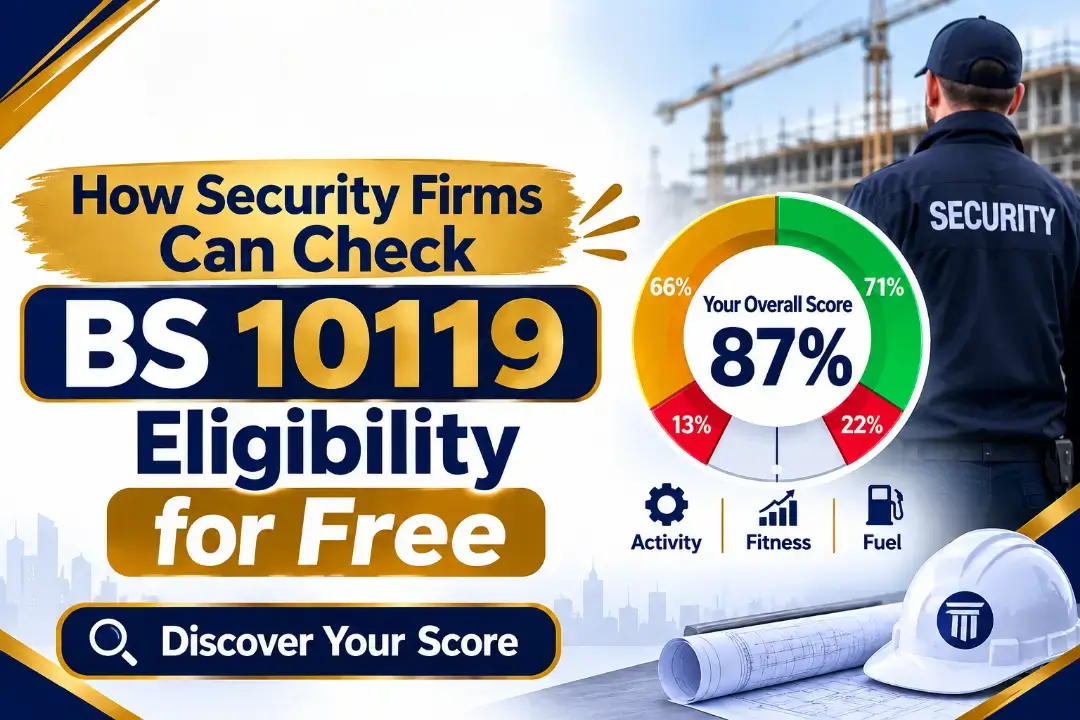
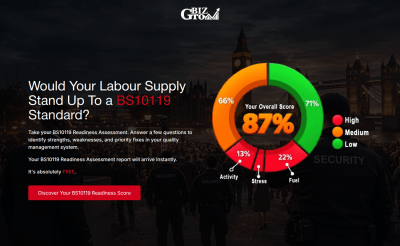
- Take the free readiness assessment. BizGrow Holdings offers a free BS 10119 assessment. It returns an overall readiness score, ratings across five key areas, a summary of compliance gaps, and recommended next steps.
- Read the results and decide. A high score means the firm can prepare for certification. However, a lower score simply shows where to start.
Honest answers matter most. A generous guess hides real gaps, and hidden gaps surface during an audit or a client review. So it helps to answer from the records, not from memory. Preparation also helps. Before starting, gather the screening files, licence records, training matrix, and main contracts. Then each question takes seconds instead of minutes. As a result, the whole check stays quick, and the score reflects reality.
BS 10119 Eligibility Checklist
Answer yes or no to each question.
Fit questions
- Does the business supply staff to other security or events companies?
- Does the business buy in extra staff from another supplier?
- Do any clients or tenders mention BS 10119 or COP 119?
- Does the business bid for contracts that need labour-provision evidence?
Readiness questions
- Does the business keep a screening file for every worker?
- Does it check SIA licences and record the result?
- Does it hold training records for all staff?
- Does it keep proof of right to work and correct pay?
- Do written contracts state who is responsible for what?
- Could it show these records to a client within a day?
How to read the answers? First, look at the fit questions. A yes to any of them means the standard probably applies. Next, count the yes answers in the readiness group. Most yes answers show a good base. In contrast, several “no” answers point to gaps that need attention first. A checklist gives a quick view only. However, the free assessment goes further, because it scores each area and lists what to fix.
What the Free Assessment Shows
The free assessment turns a vague worry into clear numbers. After a short set of questions, a business receives a report on its readiness.
The report covers four main things:
- An overall readiness score
- Ratings across five key assessment areas
- A summary of potential compliance gaps
- Recommended next steps
Each part has a job. The score gives a quick snapshot. Then the area ratings show which parts of the business are strong and which are weak. After that, the gap summary names what is missing. Finally, the next steps turn the findings into a plan. A score works as a guide, not a verdict. It does not replace an audit, and it does not grant certification. Still, it gives a firm a baseline to improve from. Many firms also share the report with directors and managers, because a clear score makes it easier to agree on priorities.
Next Steps After the Check
A score only helps when action follows it. Five steps make the result useful.
- Close the biggest gaps first. Screening, licence checks, training records and payroll proof usually come first.
- Write the missing policies. Cover recruitment, screening, supply of labour and complaints.
- Update contracts. Make sure they state who is responsible for checks and records.
- Run an internal audit. Find problems before an outside assessor does.
- Consider certification. If clients or tenders ask for it, an independent certification body can audit the business against the standard.
Small firms can take these steps in stages. For instance, start with the areas that carry the most risk. Then work through the rest. In the end, steady progress beats a rushed push before a deadline.
Common Mistakes to Avoid
Firms often repeat the same errors:
- Assuming the standard only matters to large companies
- Answering the check from memory instead of from records
- Treating the score as a certificate
- Ignoring the buyer side of the labour chain
- Keeping screening and licence records in different places
- Waiting for a client to ask before checking
- Copying policies that do not match how the business really works
Most of these mistakes come from rushing or from guesswork. Therefore, a calm review with real documents fixes almost all of them. Besides, an outside expert can spot gaps that internal teams no longer see.
Free BS 10119 Check with BizGrow Holdings
BizGrow Holdings is a UK compliance consultancy with 13+ years of certification experience. The team helps security firms check where they stand and prepare with confidence. To begin, take the Free BS 10119 assessment.
Services include:
- Free BS 10119 readiness assessment
- BS 10119 gap analysis and scoping
- Documents and evidence for assessors
- Internal audits and audit preparation
- SIA ACS, BS 7858 and COP 119 support
- ISO 9001, ISO 14001 and ISO 45001
First, the team reviews the results and finds the gaps. Then it builds the documents and supports the firm through to readiness. Also, every business is different, so the team explains the cost on a free call.

FAQs
Does BS 10119 have to be used in all projects?
No law requires all security firms to follow it. It is a code of practice. However, clients and tenders may request it, so always review each tender carefully.
Does BS 10119 replace an SIA licence?
No. Officers still need valid SIA licences where the law requires them. Instead, BS 10119 adds rules on how firms carry out and record those checks.
Is a free eligibility check considered certification?
No. The check shows fit and readiness only. Certification needs an independent audit by a certification body. The free result simply shows where to begin.
How long does the free eligibility check take?
Most firms finish it in a few minutes. Having screening files and contracts nearby speeds it up. Honesty matters more than speed.
Can a business take the check more than once?
Yes. Firms often retake it after fixing gaps. A higher score shows real progress. It also helps track improvement over time.