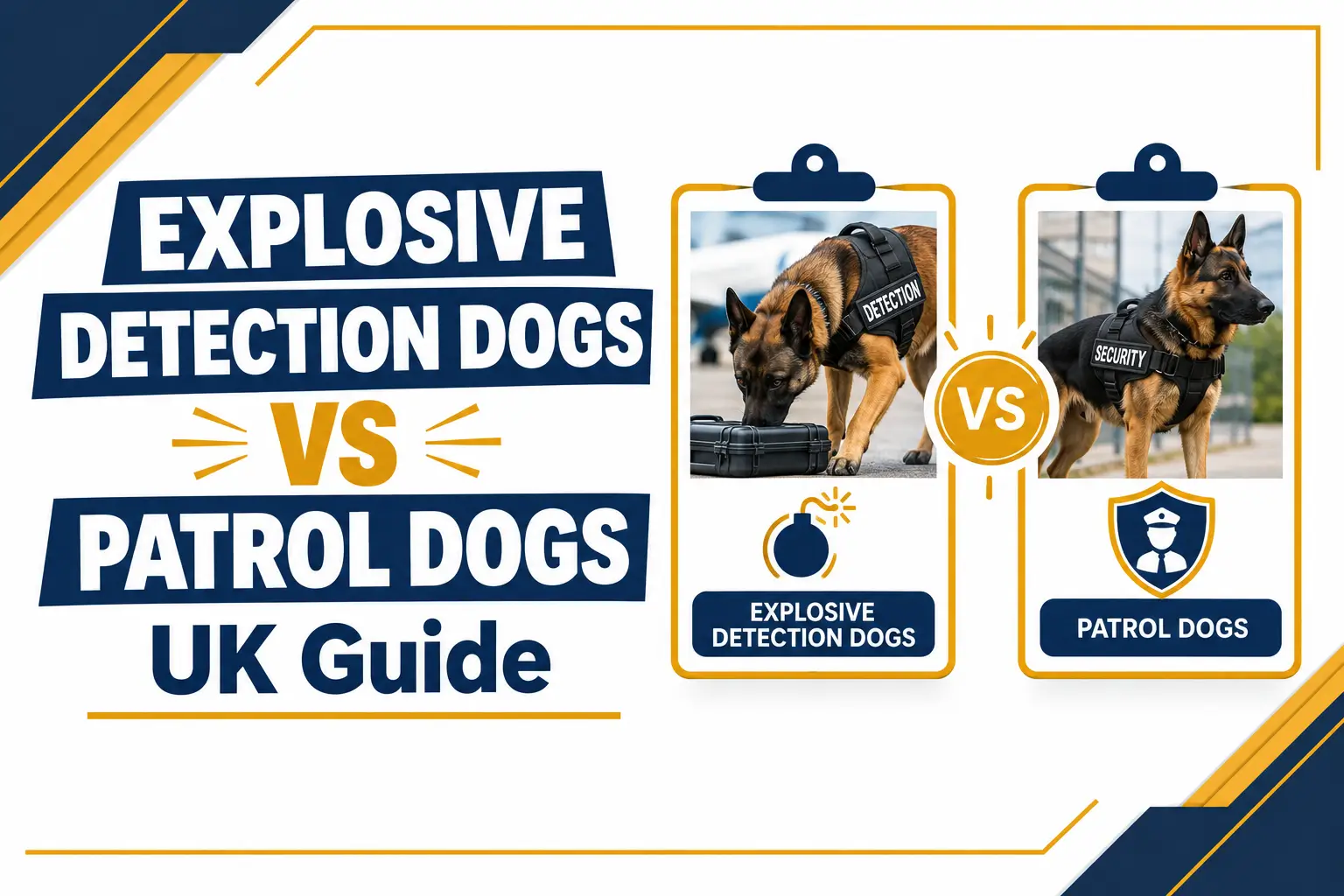
If you’re considering a K9 security team for your business, you’ve probably come across two very different types of dogs: explosive detection dogs and patrol dogs. Many people assume they’re interchangeable. However, they’re not. Each type serves a completely different purpose. Therefore, choosing the wrong one could leave a real gap in a security setup, especially if the site faces specific risks that one type can’t cover. Explosive detection dogs and patrol dogs work in very different ways, with separate training paths and separate roles on site. Understanding this distinction matters more than most business owners realise. After all, the wrong choice doesn’t just waste resources. It can leave real gaps in exactly the areas a business is trying to protect.
What Are Explosive Detection Dogs?
Explosive detection dogs work like biological sensors. Their entire job focuses on finding hidden hazards, not confronting people or patrolling grounds.
These dogs go through a special training process called imprinting. Basically, the dog learns to link a specific scent with a reward until that response becomes completely reliable in real working conditions.
Breeds like Labradors and Spaniels commonly take on this role, mainly because of their strong sense of smell and calm nature. So, once trained, these dogs typically show one of two behaviours when they detect something:
- Passive indication: sitting or freezing near the source, to avoid disturbing anything dangerous
- Active indication: scratching or barking, more common for less risky substances
In the UK, explosive detection dog teams often work under NCTAS-P, a government-backed scheme that the Home Office and Counter Terrorism Policing built together.
Beyond the core scent work, explosive detection dogs also bring several practical benefits to a security operation:
- They check large areas quickly, without disrupting normal site activity
- They work quietly, often behind the scenes or at checkpoints
- They stay focused even in busy, noisy places
- They reduce the need for slower, manual searches
So, when comparing explosive detection dogs vs patrol dogs, detection teams clearly focus on precision and prevention, rather than visible deterrence.
What Are Patrol Dogs?
Patrol dogs work in a completely different way. Instead of detecting hidden hazards, they act as a visible, physical presence on site. Their job focuses on deterrence and protection. So, a confident, well-trained patrol dog walking a site often stops trouble before it even starts, simply through presence alone.
Training for patrol dogs typically covers:
- Obedience training: recall, directional commands, and controlled walking
- Agility training: so they can handle obstacles like walls or fences
- Controlled bite training: always under strict handler direction
In the UK, private patrol dog handlers typically hold a Level 2 General Purpose Security certificate. They earn this after completing structured training and showing proper handling knowledge. So, when looking at explosive detection dogs vs patrol dogs, patrol teams clearly focus on visible protection, rather than quiet, behind-the-scenes detection work.
Explosive Detection Dogs vs Patrol Dogs — Key Differences
Let’s compare both roles clearly, side by side.
| Factor | Explosive Detection Dogs | Patrol Dogs |
|---|---|---|
| Purpose | Find hidden hazards | Deter threats and physically protect |
| Working Style | Work quietly and precisely | Work visibly and actively |
| Environment | Checkpoints or search locations | Open sites, grounds, or events |
| Training Focus | Scent recognition through imprinting | Obedience, agility, and controlled response |
| Certification Level | Higher-level NASDU certificates | General purpose pathway |
So, while both roles fall under K9 security, they solve very different problems. Detection dogs specialise in finding what you can’t see, while patrol dogs focus on protecting what you can. Therefore, when comparing explosive detection dogs vs. patrol dogs, the right choice always depends on what your business actually needs to manage: hidden risks or visible protection.
Training Requirements for Each Role
Here’s something important many business owners miss: detection and patrol training aren’t simply different levels of the same course. Instead, they’re entirely separate qualification streams.
Detection Dog Training
Detection dog handlers typically pursue specialist certificates, depending on their focus area. For example, explosives detection usually sits at a higher qualification level than general drug or tracking detection. Therefore, a handler can’t simply “upgrade” from one to the other. Each path demands its own dedicated training.
Patrol Dog Training
Patrol dog handlers, meanwhile, follow the general purpose pathway. This focuses on obedience, site searching, and controlled protection work. So, while the training feels less specialised than detection work, it still demands real discipline and consistency from both dog and handler.
Why the Qualification Level Matters
Since explosives detection carries higher risk, it naturally requires a higher qualification level. As a result, businesses handling sensitive environments should always confirm which certification level their provider actually holds, rather than assuming all detection dogs qualify equally.
No Shortcuts Between Streams
Because detection and patrol training stay completely separate, a dog can’t casually move from one role to the other. Each stream builds specific skills from the ground up, so switching later usually means starting fresh.
Ongoing Standards, Not One-Time Certification
Regardless of which path a dog and handler follow, responsible providers don’t stop training once qualification is achieved. Instead, they run regular operational assessments to keep standards consistent over time. This way, businesses can trust that their K9 team stays sharp, not just qualified on paper.
Which Sites Actually Need Detection Dogs?
Not every business needs explosive detection capability. However, certain environments benefit significantly, especially where public safety carries higher stakes.
- Airports and transport hubs: where large volumes of people and luggage move through daily
- Large public events and festivals: where crowds gather in open, high-risk settings
- Government or high-risk venues: where the consequences of missing a threat run far higher
- Sites handling deliveries or vehicles regularly: where hidden threats could easily slip through unnoticed
If a business operates in any of these areas, especially with upcoming legislation increasing security expectations at public venues, detection dogs offer a genuine layer of protection.