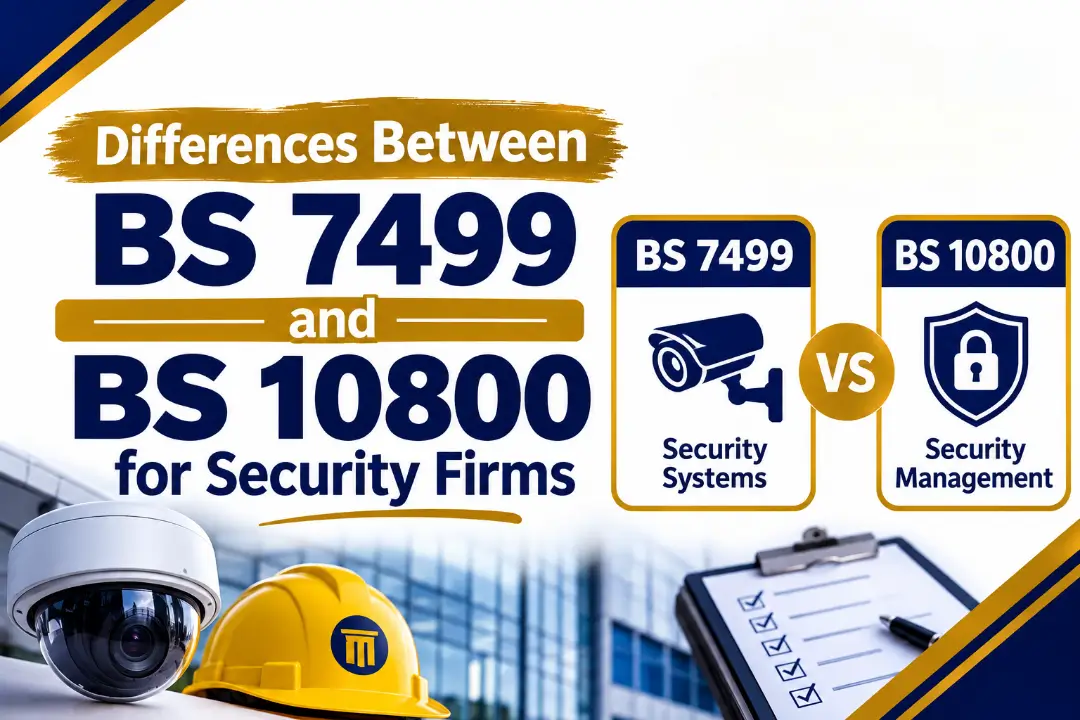
BS 7499 and BS 10800 almost always appear together in security tenders. Because of this, many owners think they are the same standard. They don’t. One shapes the whole company. The other shapes a single service. Most guarding firms need both. BS 10800 asks how a security business runs from the top down. BS 7499 zooms in on static guarding, meaning the officer standing at a client’s site. Between them, buyers get a view that runs from boardroom policy to the front door. A muddled grasp of the two carries a price. Policies get written against the wrong standard. An audit point slips through. A bid falls over for want of one document. Each mistake looks small, but together they cause trouble. Clear roles also make SIA ACS preparation calmer, and tender questions stop feeling like guesswork.
What Is BS 10800?
BS 10800 governs the highest level of security services in the UK. It is like the beginning of all security companies. As a code of practice, it does not provide a simple pass-or-fail outcome but offers recommended approaches. These include the ways a company deals with employees, work organization, and quality protection. Other security standards are based on it. So the rules start the same for all three firms: a guarding firm, a patrol firm, and a cash-in-transit firm. Then each one fills in the information that corresponds to his/her work.
Firms that sell security services form its main audience. Still, an in-house security team can borrow it too. At heart, the standard answers one question: how should a security company run itself? Good answers there make every later step easier.
What Is BS 7499?
BS 7499 is the British Standard for static guarding. A static guard remains at a particular location, e.g. an office, a shop, a warehouse or a school. It is a code of practice; as such, it provides guidance on good practice, and not a pass or fail test. Think of a guard at the front desk of an office. That’s no solitary guard. There is an extensive set of rules behind each shift, and BS 7499 prescribes such rules. It sets standards for the daily management, staffing, and operation of a guarding service by a company. It examines the on-site situation from first to last shift.
Topics include:
- Each site will have instructions for an assignment.
- Site records and log books
- Control room activity
- The training of officers and their competence.
- Key management
- Interpersonal skills with clients.
Regardless, BS 7499 can’t be used alone. It references BS 10800 several times and refers the reader back to it throughout the rest of the document. Those base rules are necessary first because the guarding detail makes sense only on top of these base rules. Its scope does not cover some of the services. Each of the following has its own standard: Cash-in-transit, CCTV, door supervision, and mobile patrols.
BS 7499 and BS 10800: Key Differences
There is a history of both standards, and they are used for different things. There are three contrasts.
Scope:
BS 10800 casts a wide net. It contains all of the security services. BS 7499 only deals with static guarding. For example, a company that provides guards and mobile patrols. Both services are covered by BS 10800. BS 7499 is used for the guarding side. The patrols follow BS 7984-3. That division maintains a focus on each document. Service standards do not need to repeat the rules; they are stored in a single place: BS 10800. Each service standard contributes only that which is necessary for the provision of that service. Scope boils down to a count. BS 10800 applies to all services, and BS 7499 applies to one service.
Focus:
BS 10800 looks at the company. It poses questions about planning, identifying risks, recording, and improving. Think governance. Analysis of the guarding service is presented in BS 7499. It queries a firm on its selection, training, instructions, and supervision of officers on the premises. Think daily delivery. The serious incident highlights the gap. Now suppose that a client asks how the company deals with one. BS 10800 influences the business plan for the business as a whole. The officer on the scene is influenced by BS 7499. These viewpoints are not mutually exclusive. A good plan can go bad because officers don’t follow it, and good officers are stymied by general company rules.
Who Needs These Certifications
Every security firm can use BS 10800, and in-house teams can use it as well. BS 7499 fits firms that supply static guards, although in-house guarding teams can follow it too.
| BS 10800 | BS 7499 | |
|---|---|---|
| Covers | All security services | Static guarding only |
| Main focus | Company management | Guarding operations |
| Who uses it | Every security firm | Firms with static guards |
| Works with | Service standards | BS 10800 |
| Mobile patrols | General rules apply | Not covered |
Most guarding companies end up following both.
How BS 7499 and BS 10800 Work Together
Think of BS 10800 and BS 7499 as one team. BS 10800 is like a company rulebook, and BS 7499 is a chapter within it. In fact, BS 7499 often refers back to BS 10800, for example, on documented information or what subcontractors need to use. Therefore, companies are advised to examine both together, as this minimizes effort. First, BS 10800 helps a firm develop its policies. Then, on-site procedures follow BS 7499, so documents stay neat, and audits run smoothly. Moreover, the two share a history, since material once in BS 7499 is now in BS 10800. Finally, the 2026 updates are bringing them even closer together.
BS 7499, BS 10800, and the SIA ACS
Approved Contractor Scheme) are voluntary schemes specific to private security companies. There is a strong value for buyers in being linked to approved contractors. ACS criteria refer to BS 10800. They also refer to BS 7499 for guarding firms. The Membership Rules of the trade bodies are similar. So, a guarding company seeking ACS approval must have both standards running in the system.
Assessors don’t want to be promised anything; they want proof. Typical checks include:
- Written policies and procedures
- Records of staff screening and training
- Records of staff screening and training
- Reports and assignment directions
- Audits and corrective actions
Standards evolve. Before scheduling an assessment, companies should review the new SIA guidelines. It is much easier to make that assessment due to strong records of BS 7499 and BS 10800.
Mobile Patrols and Other Services
There are numerous security companies that sell other services as well as security. There is an umbrella of standards for each additional service under the BS 10800 standard. Mobile patrols are covered by BS 7984-3, but not by BS 7499. There are other standards for the management of CCTV, cash-in-transit and door supervision. The tender is affected. A firm that provides guards and mobile patrols has to be certified with BS 10800, BS 7499, and BS 7984-3. A firm that performs only patrols does not have to comply with BS 7499. The fix is quick. Identify all of the services sold by the firm, associate each service with the corresponding standard, and then link the list of services offered to the list of client needs. Gaps become apparent very quickly.
2026 Updates to BS 7499 and BS 10800
BSI has revised both standards. The 2026 editions respond to the review of the Manchester Bombing Inquiry and to wider changes in the sector. They also pull the two documents closer together.
BS 10800:2026 puts more weight on:
- Risk and threat assessment
- Business continuity
- Counter-terrorism awareness
- Information sharing
- Supplier checks
- Learning from incidents
- Staff welfare and wellbeing
BS 7499:2026 updates guarding topics such as:
- Assignment instructions
- Site records
- Control room activity
- Officer training and competence
- Key management
For security firms, the message is clear. Buyers want more than a guard at the gate. They want proof that a firm plans, trains, and reviews its work. So firms should check which edition each client names, then update their documents to match.
How to Prepare in 5 Steps
A clear plan makes the work easier. Five steps cover most of it.
- List the services. Write down every service the firm sells, then match each one to its standard.
- Get the right editions. Buy the latest BS 10800 and BS 7499 from BSI, and check which edition each client names.
- Run a gap check. Compare current policies and records with each standard, and mark what’s missing.
- Fix the paperwork. Write or update policies, assignment instructions, site records, and training files. Keep one version of each document.
- Audit before the assessor does. Run an internal audit, fix any findings, then keep the records ready.
Small firms can take this in stages. Starting with the services that bring in the most work usually makes sense. Staff files also deserve early attention. Auditors often sample them, and tidy records build trust fast.
Common Mistakes to Avoid
Firms keep making the same errors:
- Treating the two standards as an either-or choice
- Following BS 7499 without reading BS 10800
- Working from old editions
- Copying templates that don’t fit the firm
- Keeping site records that don’t match assignment instructions
- Skipping internal audits
- Forgetting that mobile patrols need their own standard
Most of these come from rushing. A slow, steady review pays off, and an outside expert can spot gaps that internal teams stop seeing.
Expert Support for UK Security Firms
BizGrow Holdings is a UK compliance consultancy with 13+ years of certification experience. The team helps security firms prepare for audits and win more contracts.
Services include:
- SIA ACS support
- BS 7499 and BS 10800 preparation
- BS 7858 vetting, BS 10119 and COP 119
- ISO 9001, ISO 14001 and ISO 45001
- Internal audits and training
The team starts by finding the gaps. Then it sets up the documents and supports the firm through the audit. Every business is different, so the team explains the cost on a free call. Book a free consultation today.
FAQs
How can a security firm prove it follows BS 10800 and BS 7499?
Both are codes of practice, so the codes themselves don’t issue a certificate. Firms prove compliance through audits, such as an SIA ACS assessment. Always ask the client which proof it accepts.
Do in-house security teams need these standards?
The standards mainly target contracted providers. In-house teams can still follow them, though. Doing so gives them clear rules, records, and training.
Is the 2013 edition of BS 7499 still valid?
No. BSI withdrew the 2013 edition, and later editions replaced it. A 2026 revision now exists as well. Always check BSI for the latest edition.
Do subcontractors need to follow BS 10800?
It depends on the contract. BS 10800 asks security providers to manage subcontractors carefully. Main providers therefore often ask subcontractors for matching records.
How does BS 7858 link to these standards?
BS 7858 covers staff screening in secure environments. Security firms use it alongside BS 7499 and BS 10800. Clean vetting files then support all three.