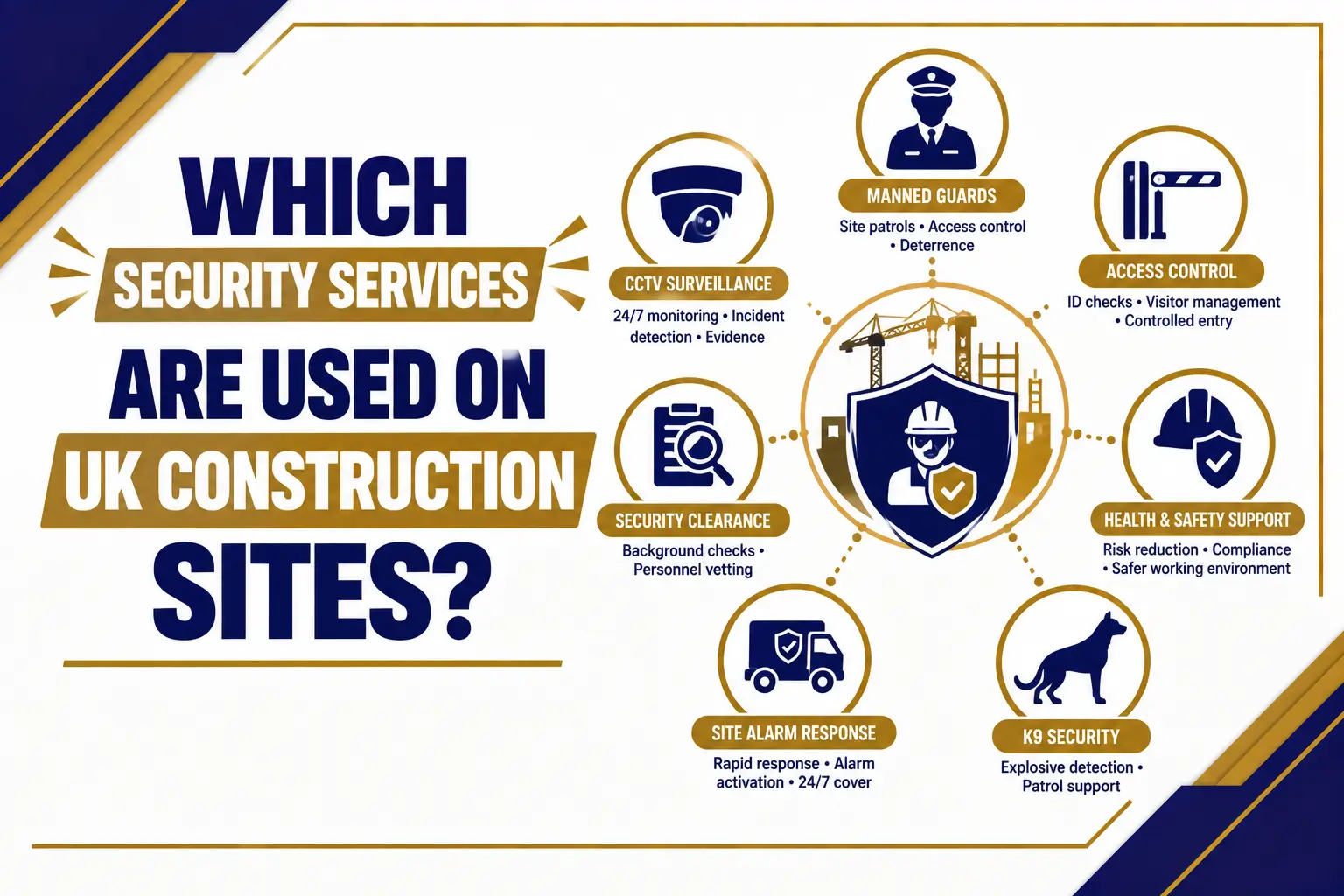
Construction site security protects more than tools and materials. It also keeps workers and the public safe, and it helps projects finish on time. Even so, many UK sites pick security services without a clear plan.
In fact, most sites use a mix of services. For example, a small build may need only a patrol and an alarm. In contrast, a large project may need guards, CCTV towers and access control together.
This guide explains each service in plain English. First, it shows why construction site security matters. Then, it covers the main services, how to choose between them and which licences to check. Finally, it adds a checklist and common mistakes to avoid.
Why Construction Site Security Matters in the UK
Building sites attract thieves for good reason. For example, they hold costly machines, tools, copper, fuel, and materials. In addition, many sites sit empty at night and at weekends. Poor construction site security causes more than theft. Strangers can also hurt themselves on site, and as a result, the project faces safety problems. Moreover, fires, damage, and illegal dumping cause more delays.
Good construction site security protects four things:
- Equipment and materials: less theft and damage
- People: fewer injuries to workers and the public
- Schedule: fewer delays and repeat work
- Reputation: more trust from clients and insurers
Because of this, many insurers and clients expect a clear security plan. So, plan security at the start of the project, not after the first break-in.
Main Security Services Used on UK Construction Sites
Strong construction site security rarely relies on one service alone. Instead, sites combine several services. Here are the main ones, from people to technology.
Static Manned Guarding
Static guards stay on site for a full shift. They often work at the gate or site office. In addition, they check people and vehicles that come in and out. Guards also log deliveries, record incidents, and stop anyone without a pass. Because thieves can see them, they often walk away before a crime starts. For this reason, guards are the most visible part of construction site security.
Sites choose guards when:
- The project holds costly machines or materials
- The site needs night and weekend cover
- The site gets many deliveries and visitors
However, guards do not suit every site. Instead, smaller builds may prefer patrols or remote monitoring.
Mobile Patrols
A patrol officer drives between sites and checks each one at random times. As a result, thieves cannot guess when the next visit will happen. Patrols suit small and medium sites. They also suit companies with several sites in one area. For example, officers check gates, fences, locks and lights. Then, they report anything unusual. Patrols have one limit, though. They cannot watch the site all the time. For this reason, many sites add an alarm or CCTV to build stronger construction site security.
Mobile CCTV Towers and Remote Monitoring
Fixed cameras rarely work on a building site, because power and internet change often. However, mobile CCTV towers solve this problem. Solar panels or batteries power them, and they carry cameras, lights, and sensors. A control room watches the live video. If someone enters after hours, the operator can speak through a loudspeaker. Then, if the person stays, the operator calls the police or a keyholder. Many towers now use smart detection. It spots people and vehicles and ignores animals and shadows. Moreover, remote monitoring suits large, open, or faraway sites. Because the cameras record video, they also help with insurance claims.
Keyholding and Alarm Response
A keyholder holds the site keys. When an alarm goes off, the keyholder goes to the site, checks it, and locks it up. As a result, keyholding adds a fast response to construction site security.
This service works well with:
- Alarms on site cabins and compounds
- CCTV towers with remote monitoring
- Emergency callouts at night
For example, a keyholder can lock a gate that someone left open or reset an alarm after a false alert. Therefore, the site manager does not need to travel in the middle of the night. Also, check the response time in the contract, because a slow response weakens the whole plan.
Access Control and Site Sign-In
Access control decides who comes in and when. It starts at the gate and covers site cabins, stores, and compounds. In short, it forms the base of most construction site security plans.
Common tools include:
- Gate staff and vehicle marshals who check passes and guide vehicles
- Barriers, turnstiles,s and badge readers
- Digital sign-in and sign-out systems
- Delivery booking and vehicle checks
In addition, access control helps with safety. For example, in an emergency, the site manager knows exactly who is on site. As a result, evacuations and roll calls become faster and more reliable.
Fencing and Lighting (Perimeter Protection)
The boundary of the site is the first line of defence. A strong fence slows thieves and gives other services time to respond.
Typical measures include:
- Strong fencing or solid site boards (hoarding)
- Lighting at gates and stores
- Motion sensors
- Clear signs that warn about CCTV and security
Besides that, good housekeeping helps. For example, keep ladders, tools and scaffolding away from the fence so thieves cannot climb them. Also, check the fence every day, because gaps appear quickly on busy sites.
Security Dogs
Some large or high-risk sites use security dog handlers. The handler and dog walk the site, usually at night. In addition, the dog warns thieves off and helps cover wide areas. However, dogs are less common than guards or CCTV, because the work needs special skills. For this reason, check that the supplier follows NASDU standards and keeps clear records for each dog. Here, NASDU compliance support explains what dog teams need to prepare.
Fire Watch
Fire watch officers walk the site while hot works or other risky jobs are running. (Hot work means work with sparks or flames, such as welding.) For example, they look for sparks, smoke, and heat. Then, they raise the alarm and help with the first response. Fire watch also matters in later build stages. Wood frames, insulation, and stored materials raise the fire risk. Therefore, many Construction sites add fire watch during these stages. However, fire watch does not replace a fire risk assessment. Instead, it supports it. Sites should also keep fire exits, extinguishers, and alarms in working order.
How to Choose the Right Construction Site Security Service
No single service fits every project. So, match construction site security to the real risk. First, start with a site security risk assessment (a simple check of what could go wrong). Then, use this table as a quick guide.
| Service | Best for | Main limit |
|---|---|---|
| Static guards | Large sites with costly materials and heavy traffic | Needs staff all the time |
| Mobile patrols | Small and medium sites | Gaps between visits |
| CCTV towers | Open sites with no power or internet | Needs a good signal and a monitored control room |
| Keyholding | Alarm response at night | Depends on response time |
| Access control | Busy sites with many visitors | Needs staff or systems to run it |
| Fencing and lighting | Every site | Needs daily checks |
| Security dogs | Wide, high-risk sites | Needs NASDU standards and trained handlers |
| Fire watch | Hot works and late build stages | Covers fire risk only |
Site Size and Location
Big sites need more cover. Meanwhile, faraway sites need stronger remote monitoring. In contrast, busy city sites often need access control, because many people pass nearby.
Project Stage
Risk changes over time. For example, early stages hold machines and groundwork, while later stages hold fittings, copper, and fuel. Therefore, review the plan at every stage.
Value of Plant and Materials
The higher the value, the more cover a site needs. For example, a site with costly machines may need guards and CCTV together. In contrast, a site with low-value materials may need only a patrol and an alarm.
Night and Weekend Risk
Sites feel most at risk when nobody works there. For this reason, many projects focus on nights, weekends and holidays. So, cover these times first, and then add day-time services if the risk needs them.
Security Licences and Standards for Construction Sites
Before hiring a construction site security supplier, check its proof. In fact, good suppliers show their licences and standards. Here is what to ask for.
SIA Licences
The SIA (Security Industry Authority) gives licences to people who do certain security jobs. For example, security guards on site need a valid SIA licence. In addition, some keyholding and CCTV jobs need one too, depending on the work. Therefore, ask to see licences, and check them on the SIA’s online register. Also, check that the licence type matches the job.
BS 7499 and BS 7858
BS 7499 is a code of practice for guarding and mobile patrol services. Meanwhile, BS 7858 covers background checks on security staff. Together, they show that a supplier runs a tidy and safe business.
SIA ACS
The Approved Contractor Scheme (ACS) is the SIA’s quality scheme, and it is voluntary. It checks how a security company runs its business. For example, it looks at staff screening, training, insurance, finances and complaint handling. In fact, ACS matters for three reasons. First, it proves that independent assessors checked the company’s systems. Next, it gives buyers more trust, because approved companies appear on the SIA’s public register. As a result, many main contractors prefer approved suppliers, and some tenders ask for ACS. For construction site security, this means a safer choice. Approved suppliers usually manage licences, records and training better. Therefore, always ask a supplier if it holds ACS approval.
SafeContractor, CHAS and Constructionline
Main contractors often ask suppliers for health and safety proof. For this reason, schemes such as SafeContractor, CHAS and Constructionline help here. As a result, a security supplier with these approvals clears checks faster. For the full list of standards, read Security Company Compliance Checklist UK.
Construction Site Security Checklist
Use this list to review construction site security before work starts. First, tick each item. Then, keep proof for every tick.
- Do a site security risk check
- Fence and light the whole site boundary
- Control every entrance and keep a sign-in record
- Choose guards, patrols or CCTV towers to match the risk
- Check supplier SIA licences and insurance papers
- Ask for BS 7499, BS 7858 and ACS proof
- Give every officer written site instructions
- Lock tools, fuel and valuables in a lit area
- Agree alarm and response steps in writing
- Review the plan at each project stage
Finally, brief all site staff. In addition, everyone should know how to report a security problem.
Common Construction Site Security Mistakes
Many sites repeat the same errors in construction site security:
- Relying on one service alone
- Accepting the first quote without checking proof
- Skipping SIA licence checks
- Leaving gaps in fencing and lighting
- Leaving tools and fuel outside overnight
- Giving officers no written instructions
- Never reviewing the plan
- Having no clear plan for alarms
Most of these mistakes come from poor planning. So, check the risk first. Also, give one person the job of looking after site security. As a result, small gaps do not turn into big problems.
How BizGrow Holdings Can Help
BizGrow Holdings is a UK compliance and accreditation consultancy. We help security companies prove their standards to construction clients and main contractors. In short, we support suppliers who want to deliver trusted construction site security.
Our services include:
- SIA ACS consultancy
- BS 7858, BS 7499, BS 10800 and BS 10119 support
- NASDU and COP 119 compliance
- SafeContractor, CHAS, SMAS, WorkSafe, and Constructionline support
- ISO 9001, ISO 14001 and ISO 45001 support
- Internal audits and QMS software
First, we check your gaps. Next, we prepare your documents. Then, we guide you through the audit. Because the cost depends on your company size and the standards you need, contact us for a clear quote. Browse our services or contact our team today.
FAQs
Does a construction site need a CCTV warning sign?
Yes. Put up clear signs that say CCTV is on and who runs it. Also, add a contact number so the site follows UK data protection rules.
Who is responsible for construction site security?
The principal contractor (the main contractor in charge) usually leads. For example, CDM 2015 asks them to take sensible steps to keep strangers off site. However, clients and other contractors also play a part, so agree on roles in writing.
What should a site do after a break-in?
Report it to the police and keep the crime reference number. Next, write down what happened and tell the insurer. Then, review the security plan to close the gap.
Can a site buy night cover only?
Yes. Many sites buy night and weekend cover only, because most risk comes when nobody is there. However, check the daytime risk too, such as deliveries and visitors. Then, choose cover to match.
How often should a site review its security plan?
Review it at every project stage and after any incident. Also, review it when the site layout changes. Then, update the written plan.