BS 7858 screening is one of the most important checks for UK security companies. It helps employers make sure that people working in security-sensitive roles are suitable, reliable, and properly vetted before they start work.
For security businesses, this is not just paperwork. It protects clients, staff, property, data, and contracts. It also helps companies stay ready for audits and meet the expectations of clients, insurers, and industry bodies.
In the UK security industry, BS 7858 is widely used for roles such as security guarding, CCTV monitoring, key holding, alarm response, mobile patrols, and other trusted positions. GOV. The UK describes BS 7858 as the British Standard for screening individuals working in secure environments, and SIA guidance states that ACS-approved contractors must ensure their pre-employment screening conforms to BS 7858.
At BizGrow Holdings, we help UK security companies understand compliance requirements, prepare for SIA ACS, improve documentation, and build stronger screening systems.
What Is BS 7858 Screening?
BS 7858 screening is a structured background checking process. It is used to assess people for roles where trust, safety, and security are very important.
The standard is designed for people working in a security environment. This can include employees, contractors, agency workers, and sometimes subcontractors. It is used before employment starts or before a person is placed into a sensitive role.
BS 7858 helps employers check important details such as:
- Identity
- Right to work in the UK
- Employment history
- Address history
- Criminal record information
- Financial background where needed
- References
- SIA licence details where relevant
The aim is simple. A company should know who it is hiring, where the person has worked, and whether there are any risks that need to be reviewed.
This does not mean every candidate with a problem is automatically rejected. It means the employer must assess the risk properly and keep clear records.
Why BS 7858 Matters for UK Security Companies
Security companies work in positions of trust. Their staff may protect buildings, control access, handle keys, monitor CCTV, manage alarms, or work around vulnerable people and valuable assets.
Because of this, clients expect proper vetting. A weak screening process can create serious problems.
Poor vetting can lead to:
- Failed audits
- Lost contracts
- Client complaints
- Security breaches
- Poor staff records
- Compliance issues
- Damage to business reputation
BS 7858 helps reduce these risks. It gives security companies a clear process to follow. It also helps prove that the company has taken reasonable steps before placing someone into a trusted role.
For SIA Approved Contractor Scheme businesses, this becomes even more important. SIA guidance says pre-employment screening must conform to BS 7858 for approved contractors to remain compliant. It also says that if screening is outsourced, the company is still responsible for making sure the process meets the standard.
This is why security companies should not treat vetting as a simple admin task. It should be part of the company’s compliance system.
Is BS 7858 Screening a Mandatory Requirement?
This is a common question.
BS 7858 screening is not always a legal requirement for every UK business. However, in the security industry, it is often required by clients, contracts, audit bodies, and SIA ACS expectations.
For SIA-approved contractors, the SIA has clearly stated that pre-employment screening must conform to BS 7858 to remain an approved contractor.
So, while the standard may not apply to every business by law, it can become essential in practice.
For example, a security company may need BS 7858 screening because:
- It wants to gain SIA ACS approval
- It wants to maintain ACS approval
- A client contract requires it
- An insurer expects it
- The company works in high-risk sites
- Staff handle keys, alarms, or CCTV
- The company wants better audit records
For a new security company, implementing BS 7858 early is a smart decision. It helps build a professional foundation from the start.
Who Needs BS 7858 Vetting?
BS 7858 vetting is mainly used for people working in security-sensitive roles.
This can include:
- Security guards
- Door supervisors
- CCTV operators
- Key-holding staff
- Mobile patrol officers
- Alarm response officers
- Control room staff
- Close protection staff
- Supervisors and managers in security roles
- Staff with access to sensitive client sites
- Contractors working in secure environments
It can also apply outside traditional security roles. For example, some organisations use BS 7858 for staff who handle confidential data, work in restricted areas, or have access to valuable assets.
The key question is this:
Does the role involve trust, access, safety, or security risk?
If yes, BS 7858 screening may be required or strongly recommended.
BS 7858 Screening Requirements
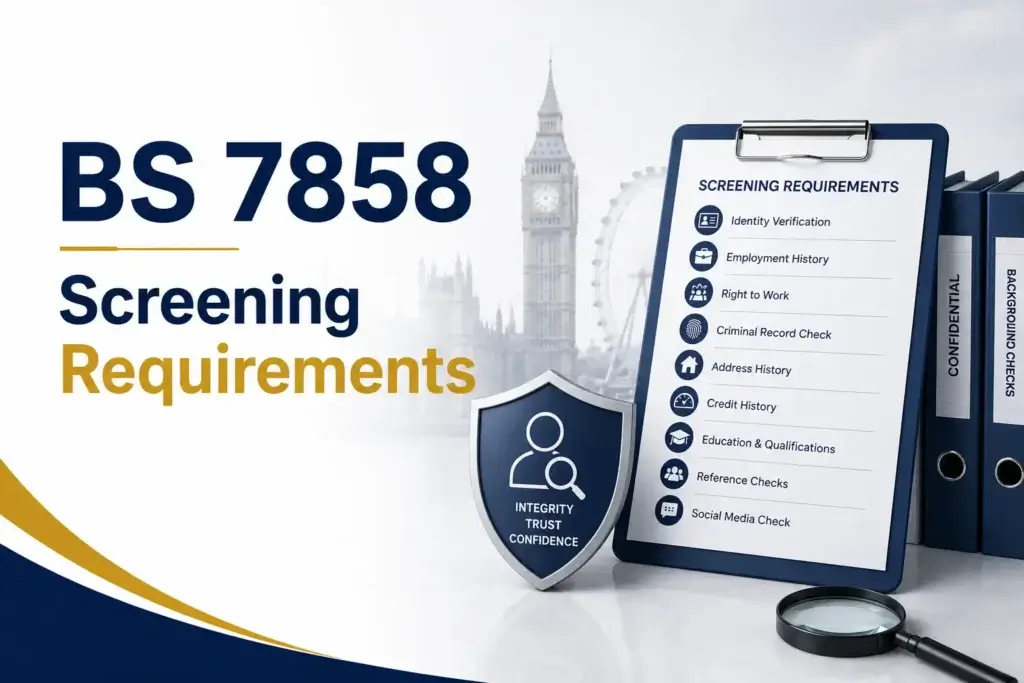
BS 7858 screening includes several checks. Each check helps build a full picture of the candidate’s background.
The process should be documented properly. The company must be able to show evidence during audits or client reviews.
Identity Verification
The first step is to confirm the candidate’s identity.
This means checking that the person is who they say they are. The employer should verify official documents and record the evidence.
Common identity documents may include:
- Passport
- UK driving licence
- National identity card
- Birth certificate
- Biometric residence permit, where applicable
Identity checks are very important. If identity is not confirmed properly, the rest of the screening process becomes weak.
Right to Work Checks
Every UK employer must check that an employee has the legal right to work in the UK.
This is separate from BS 7858, but it is still part of a strong pre-employment process.
Right to work checks may involve checking original documents, online share codes, or Home Office guidance, depending on the candidate’s status.
A security company should keep clear evidence of the check. This protects the business if there is ever an audit or investigation.
Employment History Checks
BS 7858 screening normally requires a detailed employment history check. This helps the company understand what the candidate has been doing before joining.
The employer should verify previous employment, education, self-employment, unemployment, or any other activity during the required period.
Employment history checks help identify:
- Gaps in work history
- False job claims
- Unverified employment
- Inconsistent dates
- Missing information
- Possible risk areas
Security companies should not just collect information. They must verify it where possible.
Criminal Record Checks
Criminal record checks are an important part of security vetting.
The level of check depends on the role and legal eligibility. In many cases, this may include a Basic DBS check. Some roles may require a higher level if allowed by law.
A criminal record does not always mean the person cannot work. The employer should review the offence, role, risk level, time passed, and relevance to the job.
The decision should be fair, consistent, and documented.
Financial Probity Checks
Financial checks may be used to identify financial risks that could affect a person’s suitability for a sensitive role.
This can be relevant where staff have access to money, valuable goods, keys, systems, or sensitive information.
A financial issue does not always mean rejection. The employer should consider the risk and the role.
The key is to make a fair and evidence-based decision.
SIA Licence Checks
For regulated security roles, the SIA licence must be checked.
This confirms that the individual holds the correct licence for the work they will perform.
For example, a CCTV operator should have the correct public space surveillance licence. A door supervisor should have the correct door supervisor licence.
SIA licence checks should be recorded and reviewed regularly.
Address History Checks
Address history is used to help verify where a person has lived.
This supports identity checks, criminal record checks, and general background screening.
A complete address history can also help identify gaps or inconsistencies in the candidate’s information.
Character References
Character references may be used to support the screening process, especially where employment evidence is limited.
References should be genuine and verifiable. SIA guidance also warns that electronic references need extra checks to confirm the source is genuine. Employers should record how the reference source was verified.
This is an area where many companies make mistakes. A reference should not simply be accepted without checking who provided it.
What Types of Checks Are Included in BS7858 Vetting?
BS7858 vetting includes a combination of personal, employment, legal, and risk-based checks.
The main checks include:
- Identity verification
- Right to work check
- Address history verification
- Employment history check
- Education or activity verification
- Gap explanation and evidence
- Criminal record check
- Financial probity check where needed
- SIA licence check where relevant
- Character or employment references
- Final risk assessment
- Screening file completion
These checks should be completed in a structured way.
The company should also keep a screening file. SIA guidance says that where screening is outsourced, the provider should give a file that accounts for every stage of the process, not just a simple certificate.
This is very important for audit readiness.
What Documents Are Required for BS7858 Pre-Employment Checks?
The documents required can depend on the role and the candidate’s background. However, most BS 7858 screening files will need clear evidence.
Common documents include:
Proof of Identity
This may include a passport, driving licence, birth certificate, or another accepted identity document.
The document should be valid and clearly linked to the candidate.
Proof of Address
Proof of address helps confirm where the candidate lives.
Examples may include:
- Utility bill
- Bank statement
- Council tax letter
- Tenancy agreement
- Official government letter
The document should normally be recent and match the candidate’s current address.
Right to Work Documents
Right to work evidence may include a UK passport, immigration status share code, biometric evidence, or other accepted documents.
Employers should follow the current UK right to work guidance.
Employment History Evidence
This may include employer references, payslips, P45S, HMRC records, contracts, or written confirmation from previous employers.
The aim is to confirm what the person was doing during the screening period.
SIA Licence Details
If the role requires an SIA licence, the company should record the licence number, role type, expiry date, and verification result.
Reference Information
References may be from previous employers, education providers, professional contacts, or other reliable sources.
The source should be checked and recorded.
What Is the Standard BS7858 Screening Procedure in the UK?
A good BS 7858 process should be simple, clear, and consistent.
Every candidate should go through the same structured process. This helps reduce mistakes and shows fairness.
Step 1: Collect Candidate Information
The company should collect all basic details from the candidate.
This includes name, date of birth, address history, employment history, identity documents, right to work evidence, and references.
The candidate should also give consent for the checks.
Step 2: Verify Identity and Address
The company should check identity documents and confirm address history.
This step helps prevent false applications and protects the employer from risk.
Step 3: Check Employment History
The employer should verify the candidate’s work history.
This includes previous jobs, unemployment, education, self-employment, or any other activity.
Dates should be checked carefully.
Step 4: Review Gaps in Employment
Any gaps should be explained.
A gap does not automatically mean the person is unsuitable. But it must be recorded and supported where possible.
For example, a gap may be due to study, caring responsibilities, illness, travel, or unemployment.
The important thing is that the explanation is clear and documented.
Step 5: Complete Criminal and Financial Checks
The company should complete the required criminal record check and financial check, where applicable.
Any findings should be reviewed fairly.
The decision should be based on risk, role, and evidence.
Step 6: Record the Screening Decision
Once all checks are complete, the company should record the final decision.
The outcome may be:
- Suitable for the role
- Suitable with conditions
- Further review required
- Not suitable due to risk
This decision should be kept in the screening file.
BS 7858 Vetting Timeline
The BS 7858 screening timeline can vary.
Some checks may be completed quickly. Others may take longer, especially if previous employers are slow to respond or if the candidate has worked overseas.
Common reasons for delay include:
- Missing documents
- Incomplete employment history
- Slow references
- Overseas checks
- Unclear address history
- Gaps with no evidence
- Wrong contact details for previous employers
Security companies should plan. They should not wait until the last minute before checking new staff.
A strong process helps reduce delays and avoid costly compliance mistakes.
Common BS 7858 Screening Mistakes
Many security companies fail audits because their screening files are incomplete.
The mistake is not always the check itself. Often, the problem is missing evidence.
Common mistakes include:
- No clear vetting policy
- Missing right to work evidence
- Incomplete employment history
- Gaps not explained
- References not verified
- SIA licence checks not recorded
- No risk assessment
- Poor file storage
- Screening done differently for each candidate
- Outsourced screening is not monitored
SIA guidance makes it clear that outsourcing screening does not remove the company’s responsibility. The business must still make sure the process conforms to BS 7858.
This means business owners must understand what is happening, even if a third party is doing the checks.
Guidance on Implementing BS7858 Standards for a New Security Company
For a new security company, BS 7858 can feel complicated. But it becomes easier when the company builds a proper system from day one.
Here are the key steps.
Create a Vetting Policy
Your company should have a clear vetting policy.
The policy should explain:
- Who needs BS 7858 screening
- What checks are required
- Who completes the checks
- How evidence is stored
- How gaps are handled
- How decisions are made
- How long are records kept
- What happens if a risk is found
This helps staff follow the same process every time.
Keep Clear Screening Records
Every candidate should have a complete screening file.
The file should include documents, references, checks, notes, decisions, and final approval.
A certificate alone is not enough. The company should be able to show the full process if asked by an auditor or client.
Train Your Admin Team
The people handling vetting must understand the process.
They should know how to check documents, request references, record gaps, and escalate concerns.
Training helps prevent simple mistakes.
Review Files Before Audit
Before an audit, companies should review screening files.
This helps identify missing evidence early.
A file review can check:
- Are all documents present?
- Are dates complete?
- Are gaps explained?
- Are references verified?
- Is the SIA licence recorded?
- Is the final decision clear?
Work With a Compliance Consultant
Many new security companies struggle because they do not know what auditors expect.
Working with a compliance consultant can help the business prepare properly.
At BizGrow Holdings, we support UK security companies with compliance systems, SIA ACS preparation, internal audits, policies, procedures, and documentation. We aim to help your business build a strong foundation and stay audit-ready.
How BS 7858 Supports SIA ACS Approval
SIA ACS is important for many UK security companies. It helps show clients that the company follows recognised standards.
BS 7858 supports ACS because it proves that staff screening is controlled, documented, and risk-based.
For ACS, companies need strong systems in areas such as:
- Recruitment
- Screening
- Training
- Supervision
- Customer service
- Quality management
- Compliance records
- Internal auditing
BS 7858 is a key part of the recruitment and screening process.
A company with poor vetting files may struggle during the ACS assessment. A company with clear and complete records is in a much stronger position.
BS 7858 and UK GDPR
BS 7858 screening involves personal data. This means companies must handle information carefully.
Screening files may include identity documents, address history, criminal record information, financial information, and references.
This type of data must be protected.
Security companies should:
- Store documents securely
- Limit access to authorised people
- Keep records only as long as needed
- Get proper consent
- Explain how data will be used
- Follow UK GDPR and Data Protection Act rules
Good data handling is part of professional compliance.
A company should not collect documents without control. Every document should have a clear purpose.
How BizGrow Holdings Can Help
BS 7858 screening can be difficult if your company does not have the right process.
Many security businesses know they need vetting, but they are unsure how to organise files, write policies, train staff, or prepare for ACS.
This is where BizGrow Holdings can help.
We support UK security companies with:
- SIA ACS consultancy
- BS 7858 screening guidance
- Compliance documentation
- Internal audit support
- Vetting policy development
- QMS implementation
- ISO support
- Staff training and process improvement
- Audit preparation
Our team helps you understand what is required and how to build a system that works in real business operations.
We do not just tell you what to do. We help you create practical documents, improve your process, and prepare your team.
If your security company wants to grow, win better contracts, and stay compliant, a strong vetting system is essential.
Final Thoughts
BS 7858 screening is a vital part of security compliance in the UK.
It helps security companies make safer hiring decisions, reduce risk, protect clients, and prepare for audits. It also supports SIA ACS requirements and helps build trust with clients.
The process must be clear, consistent, and evidence-based.
A company should not rely on verbal checks or incomplete files. Every stage should be documented. Every gap should be explained, & Every decision should be recorded.
For new and growing security companies, BS 7858 is more than a screening standard. It is part of building a professional and trusted business.
If you need help with BS 7858, SIA ACS, internal audits, or compliance documentation, BizGrow Holdings can support your business with practical guidance and professional consultancy.
Frequently Asked Questions
What is BS 7858 screening?
BS 7858 screening is a UK vetting process for people working in security-sensitive roles. It checks identity, work history, references, and suitability.
Is BS 7858 mandatory?
It is not always a legal requirement for every business. But it is often required for SIA ACS, contracts, and security compliance.
What checks are included?
It includes identity, right to work, employment history, DBS, references, and financial checks. SIA licence checks may also be needed.
What documents are needed?
You may need ID, proof of address, right to work, employment history, and references. SIA licence details are needed for licensed roles.
How can BizGrow Holdings help?
BizGrow Holdings helps UK security companies with BS 7858, SIA ACS, audits, and compliance documents. We help make your process clear and audit-ready.