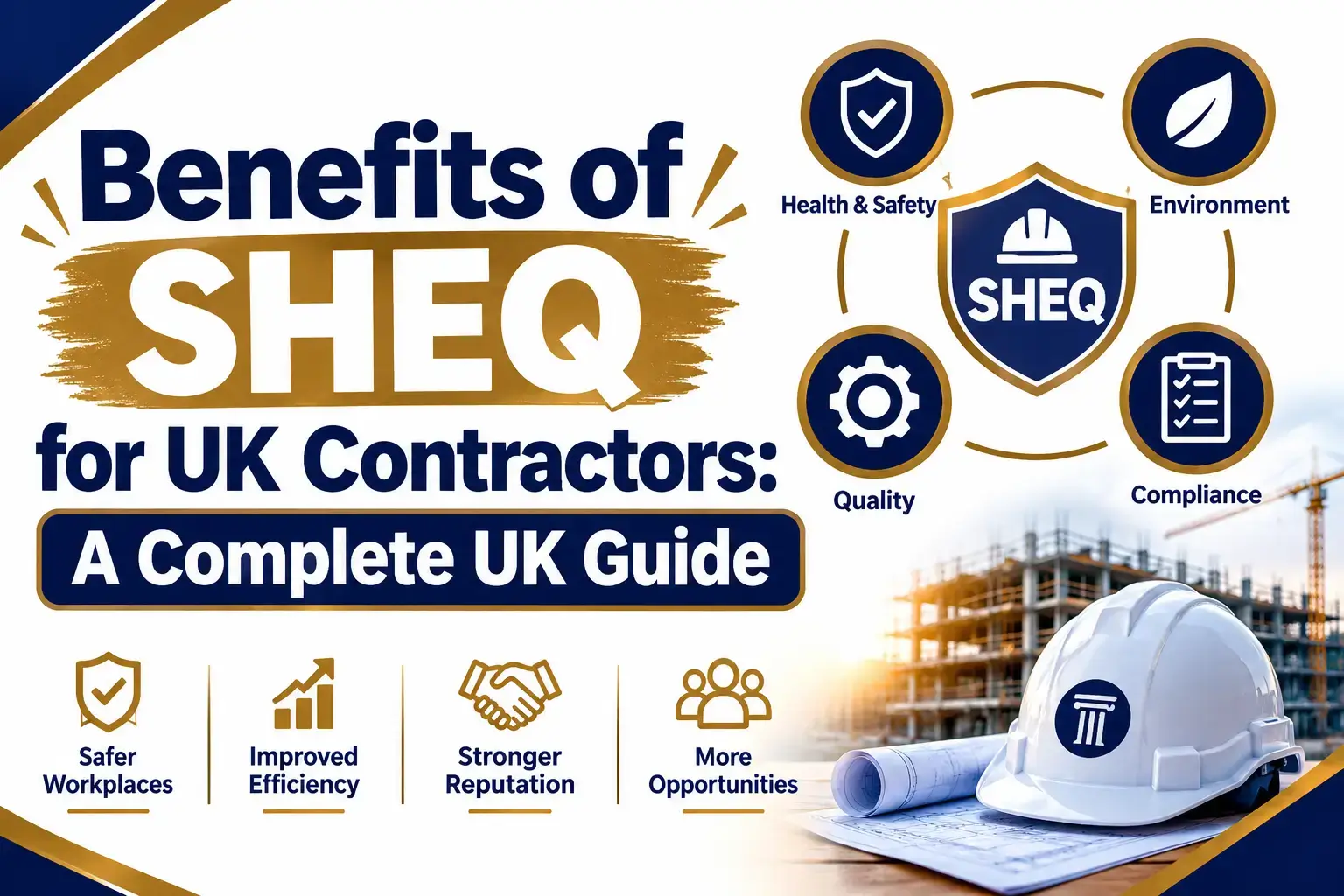
Many UK contractors lose a tender and never learn why. Often, the reason is not the price. Instead, it is the paperwork. Buyers check safety and quality records first, so a weak file ends many bids early. This is where the benefits of SHEQ come in. A good SHEQ system shows clients that a firm works safely and does the job well. Also, it helps the team spot problems early. SHEQ stands for Safety, Health, Environment and Quality. The main benefits of SHEQ for UK contractors include more tenders, fewer accidents, and a stronger reputation. Whether the work is construction, cleaning or security, the same ideas apply. Best of all, a simple plan makes it easy to get started.
What Is SHEQ?
SHEQ stands for Safety, Health, Environment,t and Quality. In short, it is the set of rules, checks, and records that show how a company works each day.
- Safety: stop accidents on site.
- Health: protect people from long-term harm, such as dust, noise, and chemicals.
- Environment: manage waste and reduce the impact on the surroundings.
- Quality: do the job right every time.
Some firms write HSEQ or QHSE, but the idea stays the same. SHEQ is not one law. Instead, it is a system that helps a business meet the law, satisfy clients, and stay tidy. Also, a SHEQ management system puts all four parts in one place. As a result, it saves time. Then the whole team stays on the same page.
Key Benefits of SHEQ
There are many benefits of SHEQ for a UK contractor. Some help a firm win work. Meanwhile, others protect people and profit. Here are the six that matter most.
Win More Tenders
Many buyers check safety and quality records before they read the price. For example, councils, housing providers and main contractors often ask for proof at the pre-qualification stage. If a firm cannot show it, the bid may stop there. A strong SHEQ system provides that proof. Also, it helps a firm earn accreditations such as CHAS, SafeContractor and Constructionline. These open doors to approved supplier lists. With the right records, a firm can answer tender questionnaires faster. As a result, it can bid for more jobs in the same week. Besides, fast replies make a company look organised. Overall, this is one of the biggest benefits of SHEQ for growing firms.
Fewer Accidents and Lower Costs
Accidents hurt people. They also hurt the business because injuries cause delays, sick pay, repairs, and stress.
SHEQ gives simple tools to prevent them:
- Risk assessments before work starts
- Safe working methods for each task
- Regular site checks
- Toolbox talks and training
When a team finds a hazard early, it fixes the hazard early. That means fewer injuries and less lost time. Over time, a firm also wastes less on rework and mistakes. In addition, some insurers may look more kindly on firms that manage risk well. For these reasons, lower costs are a real benefit of SHEQ, even for small teams.
Stay Legally Compliant
SHEQ is not a law on its own. However, it helps a business follow the laws that do apply. In the UK, the Health and Safety at Work etc. Act 1974 sets duties for employers. Employers must protect the health and safety of staff and of others affected by their work. Besides that, construction work falls under the Construction (Design and Management) Regulations 2015. Many people call these rules CDM 2015.
A SHEQ system turns these duties into daily habits. First, the firm writes them down. Then it checks them and keeps records. So when an inspector or client asks questions, clear answers are ready. However, exact duties depend on the type of work. Therefore, a qualified adviser can confirm what applies.
Build a Stronger Reputation
Clients remember contractors who stay organised. Likewise, they remember the ones who do not. When a firm shows clear records, training, and insurance, it looks professional. As a result, clients feel safe giving bigger jobs. They also come back, and they tell others.
A good reputation helps in other ways too:
- Main contractors invite the firm to price more often
- Staff feel proud to work there
- Good people apply for jobs
- Clients trust the firm with their sites and their people
Trust takes years to build, but a few bad days can destroy it. Fortunately, SHEQ helps protect it. Among all the benefits of SHEQ, this one lasts the longest.
Better Quality and Happier Staff
Quality is the “Q” in SHEQ. It means a firm checks its own work before the client does. First, the team finds mistakes early. Then it fixes them fast and learns from them. Happy clients make fewer complaints. Also, they stay longer.
The team gains too. Clear training and safe sites show people that the firm cares. For this reason, trained and safe staff tend to stay. In turn, the firm saves the effort of hiring and training new people all the time.
Simple habits make the difference:
- Do monthly quality checks
- Record each complaint and fix it
- Train new starters on day one
- Thank people for reporting problems
Be Audit-Ready Any Day
An audit should not feel like an emergency. With SHEQ, records live in one place. Also, the firm knows where each certificate, policy, and training record sits. So when a client or assessor asks for documents, the firm can send them fast. Besides, nobody has to spend nights searching old emails.
Here is a simple test. If a client asked for the compliance pack tomorrow, could the firm send it within the hour? If not, that is the first job to fix. Being audit-ready also keeps owners calm. Then they can focus on running the business. Indeed, this is one of the quiet benefits of SHEQ that owners love most.
SHEQ Accreditations in the UK
Accreditations prove a SHEQ system to others. However, the right ones depend on the sector and the clients. Here are the main ones in the UK.
CHAS and SafeContractor
CHAS and SafeContractor are health and safety schemes. Both are members of SSIP, so different schemes can recognise each other. Also, construction, facilities management, and cleaning firms often use them. First, assessors check policies, risk assessments, method statements, training, and insurance. Then, if a firm passes, it gets a certificate that many buyers accept. Which one is right? It depends on the clients, because some prefer one scheme over the other. Therefore, a smart first step is to ask main clients which scheme they accept. After that, apply for that one.
Constructionline
Constructionline is a pre-qualification service for the construction sector. First, a firm fills in its details once. Then buyers can check safety, quality, and company information in one place. As a result, the firm avoids repeating the same forms for every tender. Many principal contractors and public bodies use it. Also, many firms use it alongside CHAS or SafeContractor. Moreover, SHEQ records help a firm complete it with confidence. However, buyers rely on what the firm shares, so the documents must stay up to date.
ISO 9001, 14001 and 45001
ISO standards work in any sector. Together, they cover the full SHEQ picture.
- ISO 9001 covers quality management
- ISO 14001 covers environmental management
- ISO 45001 covers health and safety management
An independent body audits the firm and issues a certificate. Many larger clients and public buyers like to see these certificates, because they show that the system is real and that the firm improves it each year. A business can start with one standard and add the others later. Besides, the documents often carry across all three.

SIA ACS
The SIA Approved Contractor Scheme, or ACS, is for private security companies. It is voluntary. Still, many buyers prefer it or ask for it. The scheme looks at how a business runs. That includes staff vetting, training, licences, insurance, and service quality. Then an assessor compares the systems with set standards. For firms that supply security staff, strong SHEQ records make the assessment smoother. Indeed, they show how the firm vets people, trains them, and handles problems on site.
Benefits of SHEQ by Sector
Every sector uses SHEQ in its own way. Here is how the benefits of SHEQ look in three areas.
Benefits of SHEQ for Construction
Construction sites carry high risk. Because of this, buyers check standards early.
SHEQ helps with:
- Risk assessments and method statements (RAMS)
- CDM 2015 duties
- Training and CSCS card records
- CHAS, SafeContractor and Constructionline
Main contractors want proof before a firm steps on site. With strong records, a subcontractor passes checks faster and wins more work. Besides, ready paperwork avoids delays at the gate. Also, clear records protect the firm if something goes wrong.
Benefits of SHEQ for Cleaning
Cleaning firms work in schools, offices, hospitals and homes. In these places, clients trust them with buildings and people.
SHEQ helps show that this trust is safe:
- COSHH checks for chemicals
- Risk assessments for each site
- Staff vetting and training records
- Insurance that stays in date
Larger clients now ask for this proof in tenders. Therefore, a tidy SHEQ system helps a cleaning firm meet their standards and keep long contracts. Also, regular quality checks cut complaints. In turn, fewer complaints mean fewer lost contracts.
Benefits of SHEQ for Security
Security firms deal with people, access and risk every day. For this reason, clients need proof that the firm checks and trains its officers.
SHEQ helps manage:
- Staff vetting and SIA licence checks
- Training and refresher records
- Incident and complaint logs
- Site risk assessments
Standards such as BS 7858 cover staff screening for security work. Also, these records support accreditations such as SIA ACS and ISO. As a result, buyers see a well-run company and trust it with bigger contracts.
How to Get Started with SHEQ
A business does not need to fix everything at once. Instead, a simple plan that works beats a perfect plan that never starts. These five steps give a clear path.
- Find out what clients ask for. First, list the certificates that top clients and tenders require. Then note which ones are missing.
- Organise people records. Next, keep ID checks, references, licences and training in one place, and add expiry dates.
- Make site checks routine. Use one risk assessment template for every new site. Also log accidents, incidents and complaints.
- Write down policies. Most firms already follow good habits. So write them down, add dates and share them with staff.
- Build one compliance folder. Put certificates, policies, and insurance in one place. Finally, test it by sending a pack to a colleague.
Each step builds on the last. Soon, everything becomes easier to find.
Common SHEQ Mistakes
Many firms make the same errors. Here are the most common ones:
- Letting certificates expire
- Writing policies that nobody follows
- Missing training or licence expiry dates
- Doing risk assessments after work starts
- Skipping records for accidents and near misses
- Keeping documents in five different places
- Copying a template without making it fit the business
Most of these are easy to fix. Also, they only need a little time and a clear routine. Besides, finding two or three of them in a firm is normal. Therefore, most businesses can fix them step by step.
Expert SHEQ Support for UK Businesses
BizGrow Holdings is a UK compliance consultancy with 13+ years of certification experience. The team helps security, construction and cleaning companies become audit-ready and win more work.
Services include:
- SIA ACS support
- ISO 9001, ISO 14001 and ISO 45001
- CHAS, SafeContractor, SMAS, Worksafe and Constructionline
- BS 7858 vetting and BS 10119 support
- COP 119, Cyber Essentials, internal audits and training
First, the team finds the gaps. Then it sets up the documents and supports the client through the audit. Also, every business is different, so the team explains the cost on a free call. Book a free consultation today.
FAQs
Is SHEQ the same as HSEQ?
Yes, in most cases. Both cover safety, health, environment, and quality. Only the name or word order changes.
Who should look after SHEQ in a small business?
The owner or a director should lead it and sign off on policies. Then one named person keeps the records up to date. Also, a consultant can support that person when time is short.
How often should a business review its SHEQ system?
A review at least once a year works well. Also, firms should review after an incident or a big change in work. That way, records stay fresh, and the team stays alert.
Can one set of documents support several accreditations?
Often, yes. Policies, risk assessments, training records, and insurance papers can serve many schemes. However, each scheme has its own rules, so check them before reusing anything.
Do subcontractors need their own SHEQ records?
Main contractors often ask for them. They usually want risk assessments, insurance, training records, and method statements. As a result, ready records help a subcontractor get onto more sites.