Every year, more UK businesses search for clear ways to prove they meet the right standards. Clients want proof. Tenders often demand it. Moreover, growing competition pushes companies to stand out with genuine credentials. That’s exactly where UK accreditation and certification bodies step in, offering trusted verification that clients and regulators can rely on. This guide breaks down the UK accreditation and certification system in simple words. As a result, businesses can quickly understand where to start, which standards matter most, and how to move forward with confidence.
What Are Accreditation & Certification Bodies?
Certification bodies check if a business meets a specific standard. If it passes, they issue a certificate. Accreditation bodies work one level higher. They check the certification bodies themselves, and this way, they make sure these bodies operate fairly and correctly. In short, UK accreditation and certification bodies work together, but each one plays a different role. The table below makes this easier to understand:
| Aspect | Certification Bodies | Accreditation Bodies |
|---|---|---|
| What they check | Businesses | Certification bodies |
| What they issue | Certificates (e.g., ISO 9001 and many more) | Accreditation (approval to certify) |
| Example | BAB, NSI, SSAIB and Forefront | UKAS |
| Main role | Verify a business meets a standard | Verify a certification body operates fairly |
| Result for you | You get a certificate | Your certificate becomes trustworthy |
So, certification bodies certify businesses, while accreditation bodies certify the certifiers. Together, these UK accreditation and certification bodies build the trust that clients and tenders expect.
Understanding UKAS (United Kingdom Accreditation Service)
UKAS sits at the top of the UK’s accreditation system. In fact, it is the only government-recognised national accreditation body in the country. Therefore, businesses across every industry look to UKAS as the ultimate mark of trust within UK accreditation and certification bodies.
UKAS does not certify businesses directly. Instead, it checks certification bodies and confirms they meet strict, impartial standards. This way, UKAS makes the entire accreditation system easy to understand: one trusted body oversees every certifier, so businesses always know where genuine credibility comes from.
Role of UKAS in the UK Compliance System
UKAS accreditation acts like a seal of trust, and it plays a clear role across the entire compliance system:
- Checks certification bodies: confirms they operate fairly, impartially, and consistently
- Grants the “crown and tick” mark: certificates from UKAS-accredited bodies carry this recognised symbol
- Builds instant client trust: clients instantly recognise the certificate as genuine
- Ensures supply chain acceptance: the certificate becomes accepted across contracts, tenders, and government bodies
- Gives businesses a competitive edge: companies working with UKAS-accredited certification bodies stand out when bidding for contracts.
As a result, this mark tells clients and government bodies one clear thing: the certificate is real, verified, and accepted across the supply chain. Consequently, businesses working with UKAS-accredited certification bodies gain a real edge in building long-term client trust.
UKAS-Accredited Certification Bodies for ISO Standards
Several UK accreditation and certification bodies hold UKAS accreditation and issue ISO certificates to businesses. Below are the well-known names in this space, along with a few additional ones worth knowing.
BAB (British Assessment Bureau)
BAB stands out as one of the UK’s fastest-growing UKAS-accredited certification bodies. It covers standards like ISO 9001, ISO 14001, ISO 27001, and ISO 45001, and therefore suits businesses across almost every sector.
NSI (National Security Inspectorate)
NSI is a highly respected, UKAS-accredited body. It mainly certifies security and fire safety companies, making it a go-to choice for that industry.
SSAIB (Security Systems and Alarms Inspection Board)
SSAIB works as another leading UKAS-accredited body. Similar to NSI, it mainly serves the security and fire industry, offering certification against relevant British Standards.
ForeFront Certification
ForeFront Certification operates as a UKAS-accredited ISO certification body. It offers standards such as ISO 9001, ISO 14001, ISO 27001, and ISO 45001, giving businesses another trusted option.
Other UKAS-Accredited Certification Bodies
Besides these four, several other certification bodies also hold UKAS accreditation and issue ISO certificates across the UK:
- Bureau Veritas: a global certification body offering a wide range of ISO standards
- SGS: one of the largest inspection and certification companies worldwide
- LRQA (Lloyd’s Register Quality Assurance): well-known for ISO certification across manufacturing and industrial sectors
- NQA: A UKAS-accredited body offering ISO certification across multiple industries
- Citation ISO Certification: commonly used by small and medium UK businesses
Each of these UK accreditation and certification bodies follows strict UKAS assessment rules. Consequently, every certificate they issue holds real market value, and businesses can choose the body that best fits their industry and goals.
UKAS-Accredited Certification Bodies for British Standards (BS)
Several UK accreditation and certification bodies also assess businesses against British Standards (BS), especially within the security and safety sectors. Here are the main names, along with a few others worth knowing.
NSI (National Security Inspectorate)
NSI stands as one of the leading UKAS-accredited bodies for British Standards in the security sector. It certifies companies against standards like BS 7858, BS 7499, BS 7984, and BS 10800, and it also runs its own Guarding Gold and Guarding Silver approval schemes.
SSAIB (Security Systems and Alarms Inspection Board)
SSAIB works alongside NSI as another major UKAS-accredited body for BS security standards. It certifies businesses against BS 10800, BS 7858, BS 7499, BS 7958, BS 7960, and related codes of practice, making it a common choice for guarding, keyholding, and door supervision companies.
BSI (British Standards Institution)
BSI holds a unique position, since it is the organisation that actually writes and publishes British Standards. Alongside this, BSI also certifies businesses directly through its well-known Kitemark scheme, and it remains UKAS-accredited for this purpose.
BAB (British Assessment Bureau)
BAB mainly focuses on ISO certification. However, it also supports businesses working towards combined management systems, such as ISO 9001 alongside BS 10800, for companies operating in the security industry.
ForeFront Certification
ForeFront Certification primarily certifies ISO standards like ISO 9001, ISO 14001, and ISO 27001. While it is not a leading name for sector-specific BS security standards, it remains a UKAS-accredited option for businesses combining quality management with wider compliance goals.
Other Relevant Bodies
A few other UKAS-accredited bodies also appear across BS certification, depending on the industry:
- Citation ISO Certification: offers combined ISO 9001 / BS 10800 certification for security businesses
- Exova BM TRADA: certifies BS standards mainly within construction and timber industries
- Alcumus ISOQAR: offers certification across ISO and select British Standards
For security companies specifically, NSI and SSAIB remain the two dominant, UKAS-accredited certification bodies, since almost every major BS security standard runs through one of these two.
SSIP and Health & Safety Accreditation Schemes
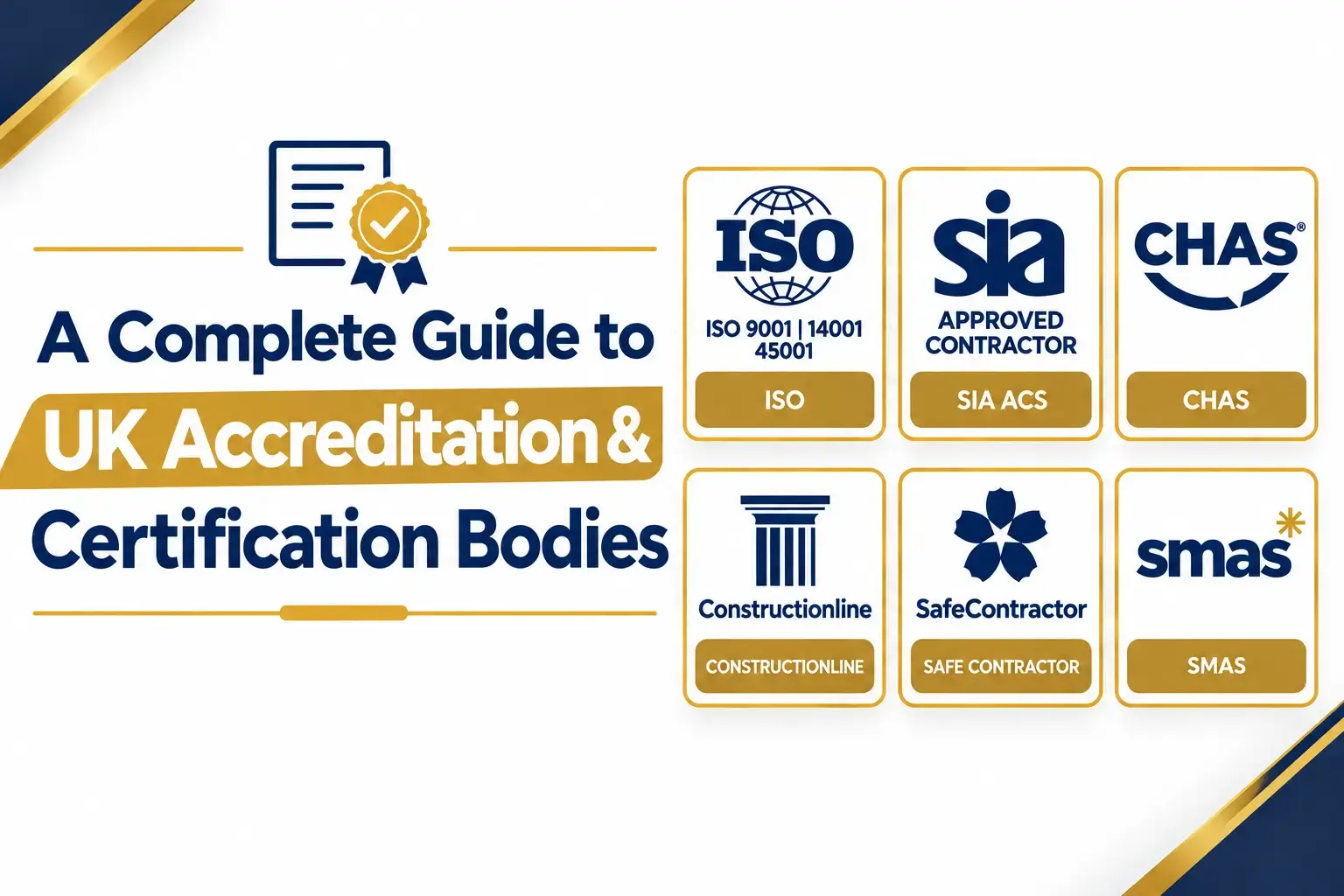
SSIP stands for Safety Schemes in Construction. It is not a single certificate. Instead, it works as an umbrella system that recognises multiple health and safety schemes, and this makes the whole process much easier to understand for busy contractors. Several popular SSIP-recognised schemes exist: CHAS, SMAS Worksafe, SafeContractor, and Constructionline. Most UK contractors choose from these:
- CHAS: one of the oldest and most widely recognised health and safety accreditation schemes
- SMAS Worksafe: a common choice, especially among small and medium contractors
- SafeContractor: a well-known scheme that checks health and safety compliance across various trades
- Constructionline: combines health and safety checks with financial and business assessments
Once a contractor gains accreditation under any SSIP member scheme, most clients automatically accept it. As a result, businesses avoid repeating the same assessment again and again for every new client or contract. This is exactly why SSIP saves time, cuts unnecessary paperwork, and helps contractors move faster from tender to contract award.